Electronics Fundamentals
Electricity Basics
The Big Three
To understand electricity, we need to start with three core concepts: voltage, current, and resistance. The easiest way to think about them is to imagine water flowing through a pipe.
Voltage is like the water pressure. It’s the push or force that makes the water move. The higher the pressure, the more forcefully the water flows.
Current is like the flow rate of the water. It’s the amount of water passing a certain point over a period of time.
Resistance is like the width of the pipe. A narrow pipe restricts the flow, creating high resistance. A wide pipe lets more water through, offering low resistance.
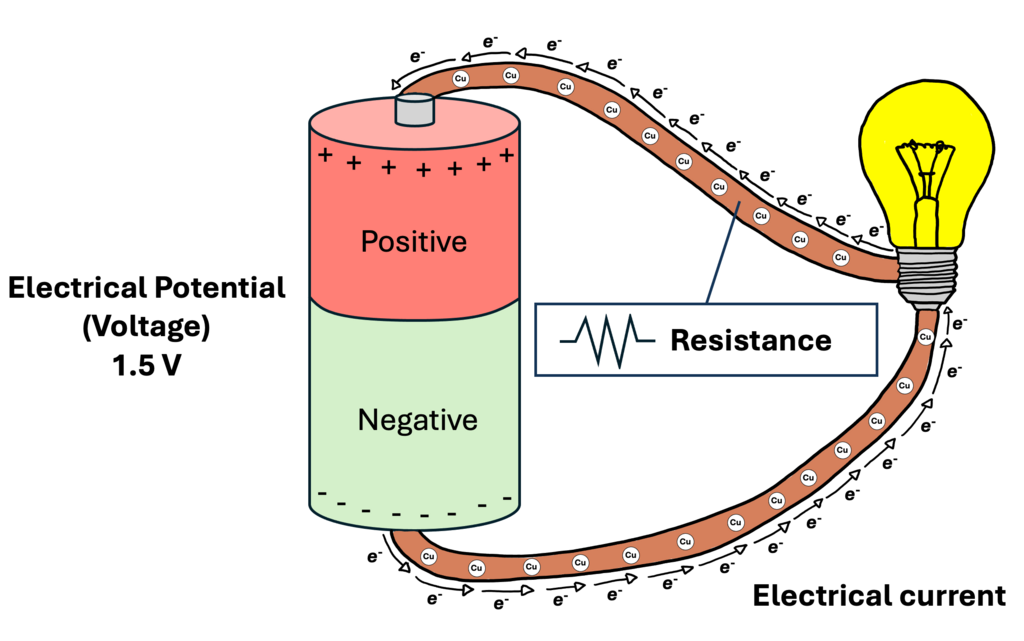
In an electrical circuit, these concepts work the same way. Voltage provides the push, current is the actual flow of electrical charge, and resistance works against that flow.
Voltage
noun
The difference in electric potential between two points. It's the 'push' that causes electric charge to flow.
Voltage is measured in units called volts (V). You can think of it as electrical pressure.
Current
noun
The rate at which electric charge flows past a point in a circuit.
Current is measured in amperes (A), often shortened to "amps." A higher current means more charge is flowing.
Resistance
noun
A measure of the opposition to current flow in an electrical circuit.
Resistance is measured in ohms (). Everything that electricity flows through has some resistance, even the wires themselves.
Ohm's Law
Voltage, current, and resistance don't exist in isolation. They are linked by a fundamental principle of electricity called Ohm's Law. It describes the mathematical relationship between the three.
Ohm's Law describes the relationship between voltage, current, and resistance in an electrical circuit
The law is simple and incredibly powerful. It states that the voltage across a component is equal to the current flowing through it multiplied by its resistance.
Where:
- is Voltage (in Volts)
- is Current (in Amps)
- is Resistance (in Ohms)
This means if you know any two of these values, you can always calculate the third. For example, if a 12-volt battery is connected to a resistor with 100 ohms of resistance, you can find the current.
So, a current of 0.12 amps will flow through the circuit. This simple formula is the foundation for analyzing most basic circuits.
Power and Energy
While Ohm's law describes the flow of electricity, it doesn't tell us how much work that electricity is doing. That's where power and energy come in.
Power is the rate at which electrical energy is transferred or used. Think of it as the electrical 'effort' being used at any given moment. It's calculated by multiplying voltage and current.
Power is measured in watts (W). A brighter light bulb uses more watts than a dimmer one because it's converting electrical energy into light and heat at a faster rate.
For example, a device that draws 2 amps of current from a 120-volt outlet is using of power.
Energy is the total amount of power used over a period of time. If power is how fast you're using electricity, energy is the total amount you've used. Your electricity bill is based on energy consumption, not power.
Energy is measured in watt-hours (Wh) or, more commonly, kilowatt-hours (kWh). A kilowatt is simply 1,000 watts.
If you leave a 100-watt light bulb on for 10 hours, it consumes , or 1 kWh, of energy. Understanding these concepts allows us to see not just how circuits work, but also how much work they can do.
Ready to test your knowledge? Let's see how well you've grasped these fundamental ideas.
In the analogy of water flowing through a pipe, what does the pressure of the water represent?
What is the standard unit of measurement for electrical resistance?
These building blocks—voltage, current, resistance, and power—are the language of electronics. Mastering them is the first step toward understanding how all electrical devices work.