Electronics Fundamentals for Project Building
Electricity Basics
The Building Blocks of Electricity
Everything in electronics starts with electric charge. It’s a fundamental property of matter, just like mass. Charge comes in two flavors: positive and negative. You've seen the effects of charge if you've ever felt a shock from a doorknob after walking across a carpet. That spark is a tiny journey of electric charges.
At the atomic level, tiny particles called protons carry a positive charge, while electrons carry a negative charge. Objects are typically neutral, meaning they have an equal number of protons and electrons. When an object gains or loses electrons, it becomes electrically charged.
Like charges repel each other, while opposite charges attract. A positive charge will push other positive charges away but pull negative charges closer. This simple rule of attraction and repulsion is what makes electricity work.
Charge
noun
A fundamental property of matter that causes it to experience a force when placed in an electromagnetic field. Measured in coulombs (C).
Making Charges Move
For charge to be useful, it needs to move. Two key concepts describe this movement: voltage and current.
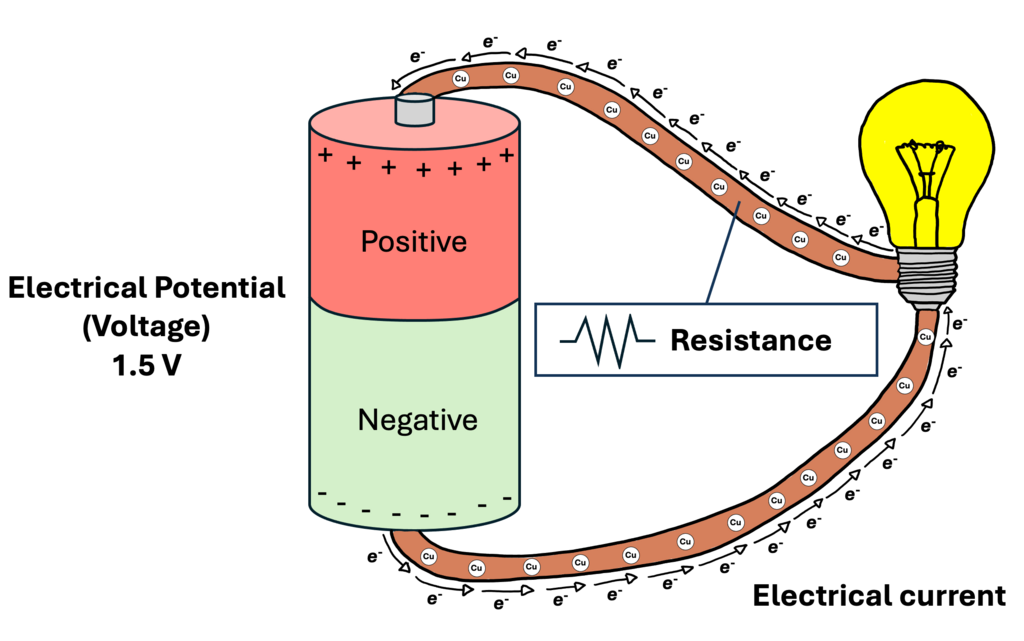
Think of voltage as electrical pressure. Imagine a water tank on a hill. The height of the tank creates pressure at the bottom—the higher the tank, the greater the pressure. Voltage is similar. It's the difference in electrical potential energy between two points. A battery, for instance, creates a voltage that pushes charges to move, much like the water tank's height creates pressure to make water flow.
Voltage
noun
The difference in electric potential between two points, which causes electric charges to flow. Measured in volts (V).
When voltage provides the push, the actual flow of charge is called current. If voltage is the water pressure, current is the rate at which water flows through the pipe. It’s the amount of charge that passes a certain point in a circuit per unit of time. A higher current means more charge is flowing.
Current
noun
The rate of flow of electric charge. Measured in amperes (A), or amps.
Controlling the Flow
Circuits aren't just about pushing charges around; they're about controlling that flow. This is where resistance comes in.
Resistance is a measure of how much a material opposes the flow of electric current. Going back to our water analogy, a narrow, rocky pipe offers more resistance to water flow than a wide, smooth one. Similarly, materials like rubber have very high resistance, which is why they're used as insulators. Metals like copper have very low resistance, making them excellent conductors.
Resistance
noun
A measure of the opposition to current flow in an electrical circuit. Measured in ohms (Ω).
The relationship between voltage, current, and resistance is described by a fundamental principle called Ohm's Law. It states that the current through a conductor between two points is directly proportional to the voltage across the two points, and inversely proportional to the resistance between them.
In this formula, is voltage, is current, and is resistance. If you know any two of these values, you can always find the third.
Finally, when current flows through a component with resistance, it consumes energy. The rate at which this electrical energy is used is called power. Power is what makes a light bulb glow or a motor spin. It's calculated by multiplying voltage and current.
Power
noun
The rate at which electrical energy is transferred by an electric circuit. Measured in watts (W).
Rules of the Road
To analyze more complex circuits, we use two simple but powerful rules known as Kirchhoff's Laws. They help us track how current and voltage behave in any circuit.
First is Kirchhoff's Current Law (KCL). It says that the total current entering a junction (or node) must equal the total current leaving that junction. It's based on the conservation of charge—charge can't just disappear. Think of it like water pipes: the amount of water flowing into an intersection of pipes must equal the amount flowing out.
Next is Kirchhoff's Voltage Law (KVL). This law states that for any closed loop in a circuit, the sum of all the voltage rises (like from a battery) must equal the sum of all the voltage drops (like across resistors). This is based on the conservation of energy.
Imagine walking around a hilly park. You might go up some hills and down others, but if you end up back where you started, your total change in elevation is zero. KVL is the electrical equivalent. The total voltage change around any closed loop must be zero.
With these foundational concepts—charge, voltage, current, resistance, and Kirchhoff's Laws—you have the essential tools to start understanding and analyzing any electrical circuit.
Ready to check your understanding?
If two electrically charged particles repel each other, what can you conclude about their charges?
In the common water analogy for an electric circuit, what does the rate of water flow through a pipe represent?
These principles form the bedrock of electronics. By mastering them, you're ready to explore how these simple ideas combine to create the complex technologies we use every day.