Electronics Fundamentals
Electricity Basics
The Language of Circuits
Electricity can feel mysterious, but at its heart, it follows a few simple rules. To understand it, we just need to learn three basic concepts: voltage, current, and resistance. Think of electricity flowing through a wire like water flowing through a pipe. This simple analogy will help make everything clear.
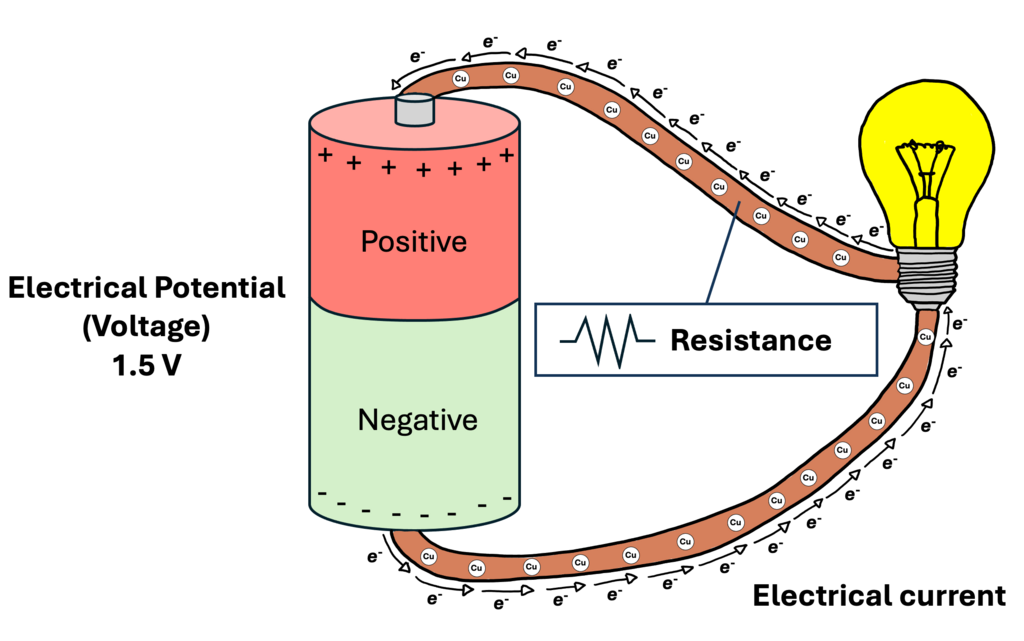
Let's break down the key players in this system.
Pressure, Flow, and Friction
First up is voltage. In our water analogy, voltage is like water pressure. The higher the pressure, the more potential the water has to flow with force. Voltage is the electrical "push" or potential difference that gets charges moving.
Voltage
noun
The pressure from an electrical circuit's power source that pushes charged electrons (current) through a conducting loop.
Next is current. This is the actual flow of water through the pipe. In a circuit, current is the flow of tiny charged particles called electrons. We measure it in Amperes, or "amps" for short.
Current
noun
The rate at which electric charge flows past a point in a circuit.
Finally, we have resistance. Imagine the pipe getting narrower. This constriction slows down the water flow. Resistance in a wire does the same thing, it opposes the flow of current. Every component in a circuit, even the wire itself, has some resistance.
Resistance
noun
A measure of the opposition to current flow in an electrical circuit.
The Unifying Rule
These three concepts don't just exist on their own; they are linked by a fundamental principle of electricity called Ohm's Law. Discovered by Georg Ohm in 1827, this law provides a simple mathematical relationship between voltage, current, and resistance.
Ohm's Law states that the voltage across a conductor is directly proportional to the current flowing through it, provided all physical conditions and temperatures remain constant.
In simpler terms, if you increase the voltage (pressure), the current (flow) will also increase. If you increase the resistance (friction), the current will decrease. The relationship is captured in this elegant formula:
Where:
- is Voltage (in Volts)
- is Current (in Amps)
- is Resistance (in Ohms, symbol: Ω)
Putting Ohm's Law to Work
This simple formula is incredibly powerful because if you know any two of the values, you can always find the third. Let's look at a basic circuit.
Imagine we have a circuit with a 12-volt battery () and a light bulb with a resistance of 4 ohms (). How much current is flowing through the light bulb?
To find the current (), we can rearrange Ohm's Law:
Now, we just plug in our numbers:
So, 3 amps of current are flowing through the circuit.
What if you know the voltage and current, but need to find the resistance? Let's say a 9-volt battery is causing 0.5 amps of current to flow. The resistance would be:
The resistor in the circuit has a value of 18 ohms. By mastering this one law, you've taken the first major step toward understanding how all electronic circuits work.
Using the analogy of water flowing through a pipe, what does voltage represent?
What is the primary function of resistance in an electrical circuit?
Voltage, current, and resistance are the building blocks for all of electronics. Understanding how they relate to each other through Ohm's Law is the key to analyzing and building circuits.