Electronics Fundamentals
Electricity Basics
The Heart of Electricity
Everything around you is made of atoms. At the center of each atom are protons and neutrons, with electrons orbiting them. Protons have a positive electric charge, and electrons have a negative one. These charges are the fundamental ingredients of electricity.
Opposite charges attract each other, while like charges repel.
Think of it like tiny magnets. A positive charge will pull a negative charge closer, but it will push another positive charge away. This simple rule governs how electricity behaves. When an object has an equal number of protons and electrons, its overall charge is neutral. But if it gains or loses electrons, it becomes charged.
electric charge
noun
A fundamental property of matter that causes it to experience a force when placed in an electromagnetic field.
Flowing and Stopping
So, if electricity is about moving electrons, why doesn't everything conduct electricity? It comes down to how tightly atoms hold onto their electrons. Materials are generally split into two categories: conductors and insulators.
| Type | Electron Mobility | Examples |
|---|---|---|
| Conductor | Electrons move freely | Copper, Gold, Water |
| Insulator | Electrons are held tightly | Rubber, Glass, Plastic |
In a conductor, electrons can jump easily from atom to atom. This is why metals are great for making wires. An insulator is the opposite. Its electrons are stuck in place, making it difficult for a charge to pass through. That's why electrical cords are wrapped in rubber or plastic – to keep the electricity safely inside the wire.
Current and Voltage
When electric charges move, they create an electric current. Think of a river. The amount of water flowing past a point each second is the river's current. Similarly, electric current is the rate at which charge flows past a point in a circuit.
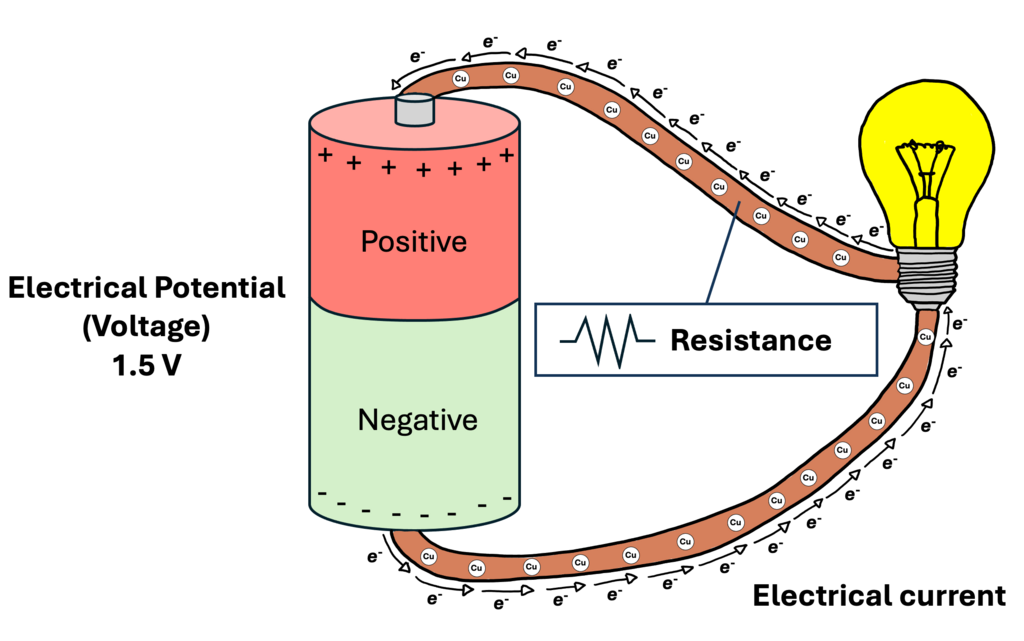
But what makes the charge move in the first place? That's where voltage comes in. Voltage is the push or pressure that causes the electric current to flow. It's like the pressure difference between the start and end of a water pipe. A higher pressure difference makes the water flow faster.
Voltage is the potential for charge to move, and current is the actual movement of that charge.
In a battery, a chemical reaction creates a voltage between its two terminals. This electrical pressure is ready to push electrons through a circuit as soon as you connect one. Without voltage, there's no push, and therefore, no current.
Let's check your understanding of these core concepts.
What is the primary role of voltage in an electric circuit?
Why are materials like rubber and plastic used to coat electrical wires?
These four ideas – charge, conductors, current, and voltage – are the building blocks for understanding everything else in electricity and electronics.