Electronics Fundamentals
Electricity Basics
The Building Blocks of Electricity
Electricity might seem complex, but it boils down to three fundamental concepts: voltage, current, and resistance. Think of electricity flowing through a wire like water flowing through a pipe.
In this analogy, voltage is like the water pressure. It's the force pushing the water along. The higher the pressure, the more forceful the flow.
Current is the rate of flow, like the amount of water moving past a certain point per second. More water moving means a stronger current.
Resistance is like the width of the pipe. A narrow pipe restricts the flow, creating high resistance. A wide pipe allows water to move easily, offering low resistance.
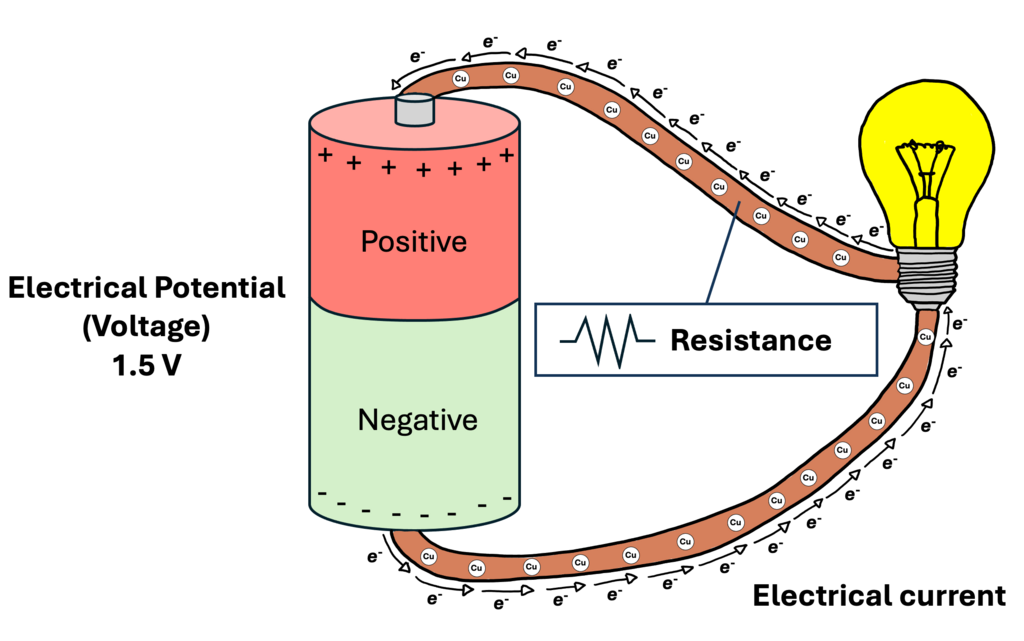
Let's look at these terms more formally.
Voltage
noun
The electrical potential difference or pressure that causes electrons to move through a conductor. It is measured in volts (V).
Voltage doesn't flow through a circuit; it's the push applied across a circuit. This push comes from a power source, like a battery or a wall outlet.
Current
noun
The rate of flow of electric charge (electrons) through a conductor. It is measured in amperes (A), often called amps.
For current to flow, there must be a complete, unbroken path, which we call a circuit. If you break the path, like by opening a switch, the current stops.
Resistance
noun
The measure of opposition to the flow of electric current. It is measured in ohms (Ω).
Everything has some resistance, even conductive materials like copper wire. Materials with very high resistance are called insulators, while those with very low resistance are called conductors.
Ohm's Law
Voltage, current, and resistance aren't independent. They share a simple, reliable relationship described by Ohm's Law. It states that the voltage across a conductor is directly proportional to the current flowing through it, provided all physical conditions and temperature remain constant.
The formula is straightforward:
Where:
- is Voltage (in Volts)
- is Current (in Amps)
- is Resistance (in Ohms)
This simple equation is the foundation of circuit analysis. If you know any two of the values, you can find the third.
For example, if you have a 12-volt battery connected to a component with 6 ohms of resistance, you can calculate the current:
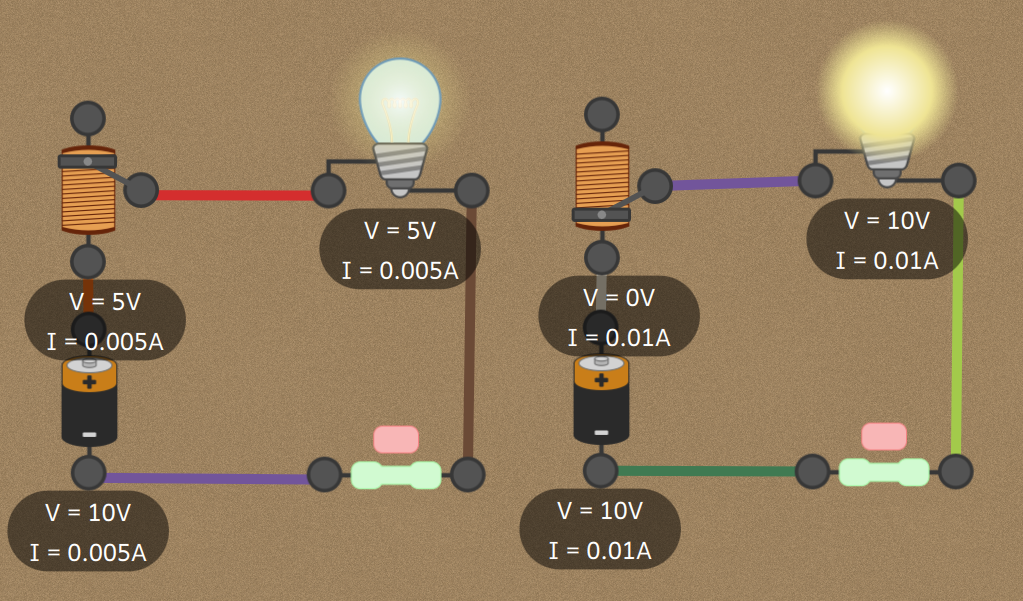
So, 2 amps of current will flow through the circuit. This relationship shows that for a given voltage, if you increase the resistance, the current will decrease.
Electric Power
Power is the rate at which electrical energy is transferred or used in a circuit. We measure it in watts (W). A higher wattage means more energy is being used per second. Think of a bright 100-watt light bulb versus a dim 40-watt one.
The basic formula for calculating power is:
Where:
- is Power (in Watts)
- is Voltage (in Volts)
- is Current (in Amps)
If a device is connected to a 120-volt outlet and draws 2 amps of current, its power consumption is .
By combining the power formula with Ohm's Law, we can also express power in two other useful ways:
These variations are handy when you know the resistance but might be missing voltage or current.
Fields and Flow
So what's happening at a microscopic level? It all starts with the electric field. An electric field is a force field that surrounds any electric charge. When you apply a voltage across a conductor, like a copper wire, you create an electric field within that wire.
This field exerts a force on the free-moving electrons inside the copper, pushing them in a single general direction. This directed movement of electrons is what we call electric current.
Even though individual electrons move quite slowly, the electric field travels at nearly the speed of light. That's why when you flip a switch, the light comes on almost instantly. The signal to start moving propagates through the wire much faster than any single electron travels.
Resistance occurs at this atomic level, too. As electrons move, they bump into the atoms of the conductor. These collisions convert some of the electrical energy into heat. This is why electronic devices get warm during use.
Using the analogy of water flowing through a pipe, what does the width of the pipe represent in an electrical circuit?
A circuit has a 9-volt battery connected to a resistor. If 3 amps of current are flowing, what is the resistance of the resistor according to Ohm's Law ()?
With these basics of voltage, current, resistance, and power, you have the foundational tools to understand how electronic circuits work.