Electronics for Beginners
Introduction to Electricity
The Language of Circuits
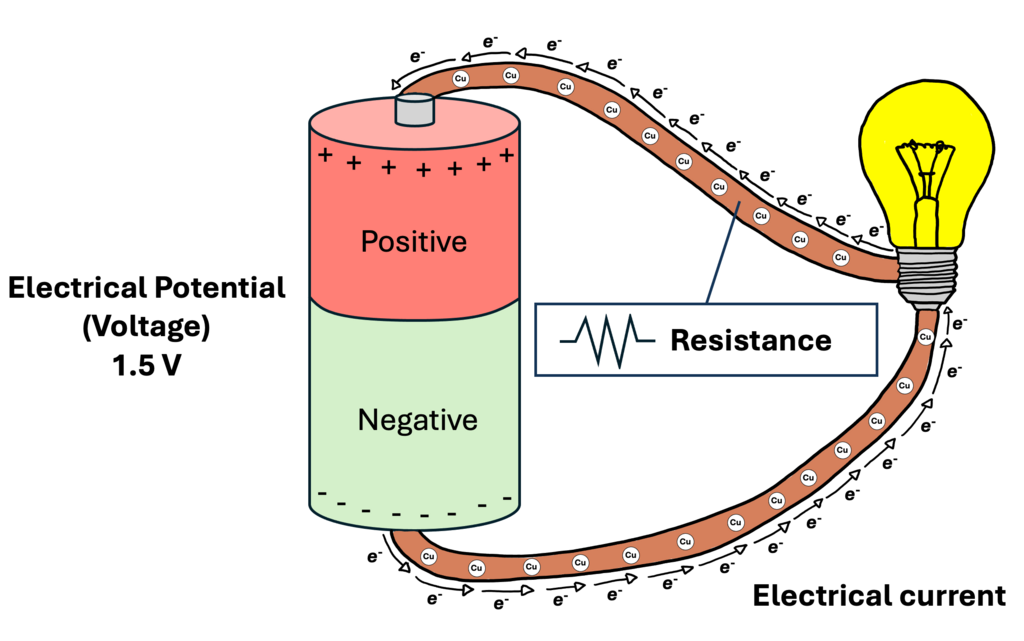
To understand electricity, it helps to think about water flowing through pipes. This simple analogy makes the three most important concepts in electronics easy to grasp.
- Voltage is like water pressure. A water tower with a high water level has more pressure than a shorter one. In electricity, a 9-volt battery has more “pressure” than a 1.5-volt battery.
- Current is the rate of water flow. It's how much water passes a certain point per second. Electrical current is the flow of charged particles, usually electrons.
- Resistance is like the width of the pipe. A narrow pipe resists the flow of water more than a wide one. In a circuit, some materials resist the flow of electricity more than others.
Voltage is what pushes the electric current along, while resistance is what opposes it. All three are present in any active circuit.
Voltage
noun
The difference in electric potential energy between two points. It's the 'push' that causes electric charges to flow.
Voltage is measured in volts (V), current in amperes (A), often called amps, and resistance in ohms (Ω).
Ohm's Law
These three values are linked by a fundamental rule of electronics called Ohm's Law. It states that the voltage across a component is equal to the current flowing through it multiplied by its resistance. This simple relationship is the key to analyzing circuits.
Here, is voltage, is current, and is resistance.
If you know any two of these values, you can find the third. For example, if you connect a 12-volt car battery to a headlight with a resistance of 3 ohms, you can calculate the current.
So, 4 amps of current flow through the headlight.
Measuring Electricity
In the real world, you don't always have these values written down. You measure them with a tool called a multimeter. It's a handheld device that can measure voltage, current, and resistance, among other things.
How you measure each one is slightly different.
To measure voltage, you connect the multimeter's probes in parallel with the component. This means you touch one probe to each side of the component to measure the potential difference across it.
To measure current, you must connect the multimeter in series. This involves breaking the circuit and inserting the multimeter into the path of the current, so the electricity flows through the meter.
To measure resistance, you must first remove the component from the circuit completely. Then you can touch the probes to each end of the component to measure its resistance directly.
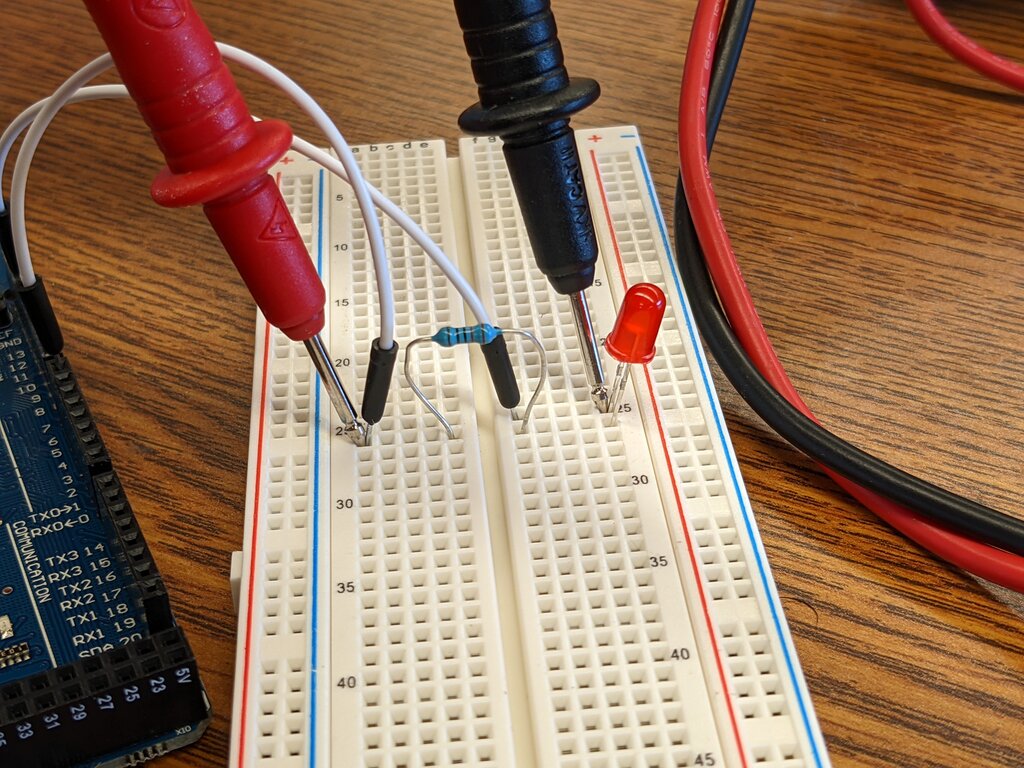
Correctly measuring these fundamental properties is the first step in building, testing, and troubleshooting any electronic device.
In the common analogy of water flowing through a pipe, what does the flow of water itself represent?
Which of the following equations correctly represents Ohm's Law?