Electronics and Circuits Fundamentals
Electricity Basics
The Building Blocks of Electricity
To understand how electronics work, we need to start with three core ideas: voltage, current, and resistance. These concepts describe how electricity behaves inside a circuit, from the simplest flashlight to the most complex computer. Think of them as the fundamental rules that govern the flow of energy.
Understanding the basics of electricity requires familiarity with three fundamental concepts:Voltage: the electric potential difference between two points.Current: defines the flow of electric charge.Resistance: signifies the opposition to that flow.
Let's use an analogy to make this easier to grasp. Imagine electricity is like water flowing through a system of pipes. This will help us visualize what each of these terms really means.
Voltage, Current, and Resistance
Voltage is the “push” or “pressure” in a circuit. In our water analogy, voltage is like the water pressure created by a pump. A pump with higher pressure can push water with more force. Similarly, a power source with a higher voltage can push electric charge through a circuit with more force. Voltage is measured in volts (V).
Think of a 9-volt battery. It provides more electrical “pressure” than a 1.5-volt AA battery.
Current is the actual flow of electric charge. In our water analogy, it's the amount of water flowing past a certain point in the pipe per second. More water moving through the pipe means a stronger current. In an electrical circuit, current is the rate at which electrons flow. It's measured in amperes (A), often shortened to “amps.”
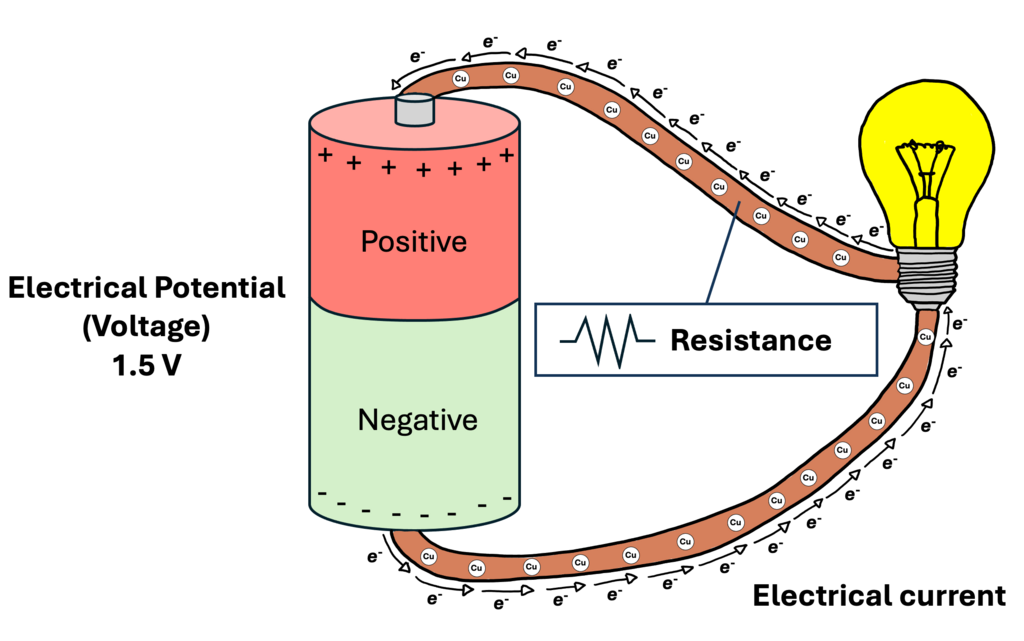
Resistance is any opposition to the flow of current. In our pipe system, resistance would be like a narrow section of the pipe that restricts water flow. In an electrical circuit, components like light bulbs or specific parts called resistors create resistance. They make it harder for the current to flow. Resistance is measured in ohms (Ω).
ohm
noun
The standard unit of electrical resistance.
Tying It All Together
So, how do voltage, current, and resistance relate to one another? A German physicist named Georg Ohm figured this out in the 1820s. His discovery, now known as Ohm's Law, is a cornerstone of electronics.
Ohm's Law states that the current flowing through a circuit is directly proportional to the voltage and inversely proportional to the resistance.
In simpler terms, if you increase the voltage (the push), you get more current (the flow), assuming the resistance stays the same. On the other hand, if you increase the resistance (the obstacle), you get less current, assuming the voltage stays the same.
Where:
- is the voltage in volts
- is the current in amperes
- is the resistance in ohms
This simple formula is incredibly powerful. If you know any two of the values, you can always calculate the third.
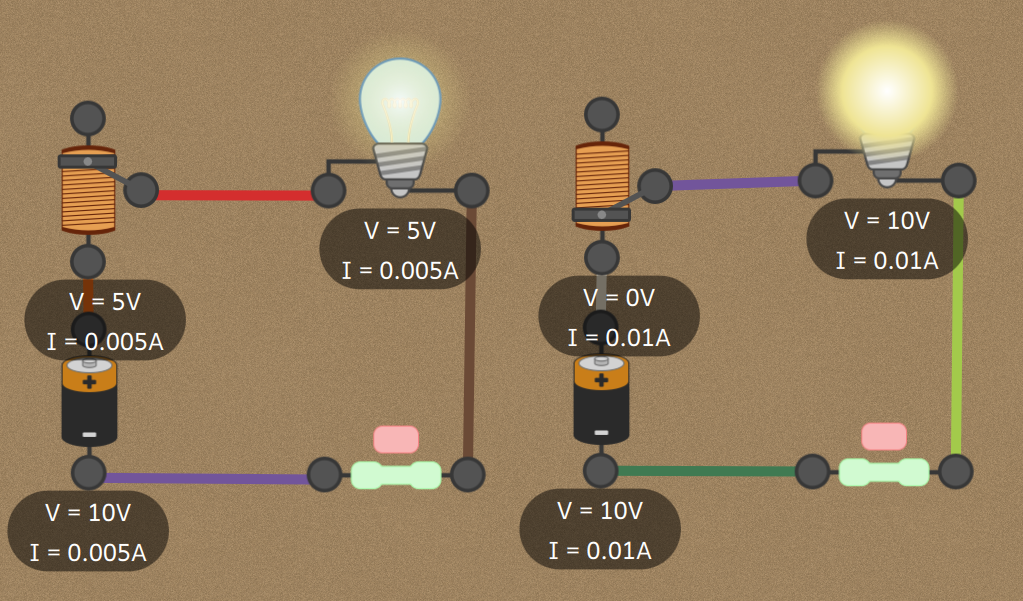
For example, imagine a simple circuit with a 12V battery connected to a component with 6Ω of resistance. To find the current, we can rearrange Ohm's Law:
Plugging in our values:
So, 2 amps of current will flow through the circuit. Understanding this relationship is the first step to analyzing and building circuits.
Let's review these key terms.
Ready to test your knowledge?
Using the analogy of water flowing through pipes, what does voltage represent?
What is the primary function of resistance in an electrical circuit?
With these fundamentals, you're ready to explore more complex electrical concepts.