Electron Orbitals and Nobel Gas Notation
Atomic Structure
The Building Blocks of Matter
Everything around you, from the air you breathe to the screen you're reading this on, is made of atoms. Think of atoms as the fundamental LEGO bricks of the universe. But what are these bricks made of? Atoms themselves are built from even smaller pieces called subatomic particles.
There are three main types:
- Protons: These have a positive (+) electrical charge.
- Neutrons: These have no charge; they are neutral.
- Electrons: These have a negative (-) electrical charge.
Protons and neutrons are bundled together in the center of the atom, forming a dense core. Electrons, which are much smaller and lighter, move around this central core.
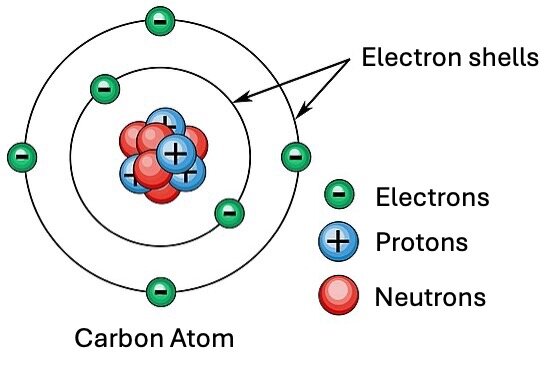
The central core of the atom is called the nucleus. Because it contains all the positively charged protons and neutral neutrons, the nucleus itself has an overall positive charge. It's also where almost all of the atom's mass is concentrated. Protons and neutrons are heavyweights compared to the feather-light electrons.
nucleus
noun
The positively charged central core of an atom, consisting of protons and neutrons and containing nearly all its mass.
The electrons don't orbit the nucleus like planets around the sun. Instead, they exist in a region of space around the nucleus called the electron cloud. This cloud is mostly empty space. To give you a sense of scale, if the nucleus were the size of a marble in the center of a football stadium, the electrons would be whizzing around the outer stands. The atom is vast and mostly empty.
How Atoms Differ
If all atoms are made of the same three particles, how do we get different elements like gold, oxygen, and helium? The key is the number of protons.
The atomic number (Z) of an atom is simply the number of protons in its nucleus. This number is unique to each element. Every single carbon atom in the universe has 6 protons. Every oxygen atom has 8. If an atom has 79 protons, it's gold, no exceptions.
The mass number (A) tells us the total number of protons and neutrons in the nucleus. Because electrons are so light, their mass is considered negligible when calculating the mass of an atom.
You can find the number of neutrons in an atom by subtracting the atomic number from the mass number: Neutrons = A - Z.
| Particle | Symbol | Charge | Location |
|---|---|---|---|
| Proton | p⁺ | +1 | Nucleus |
| Neutron | n⁰ | 0 | Nucleus |
| Electron | e⁻ | -1 | Electron Cloud |
While the number of protons for an element is fixed, the number of neutrons can vary. Atoms of the same element that have different numbers of neutrons are called isotopes.
For example, most carbon atoms have 6 protons and 6 neutrons (Carbon-12). But some have 6 protons and 8 neutrons (Carbon-14). Both are carbon atoms, but Carbon-14 is an isotope of carbon.
Because isotopes have different numbers of neutrons, they have different mass numbers. For this reason, isotopes are often written with their mass number, such as Carbon-12 () and Carbon-14 ().
Now that you've learned about the fundamental pieces of an atom, let's test your understanding.
Which of the following lists the three main subatomic particles found in an atom?
The atomic number (Z) of an element is determined by the number of ________ in the atom's nucleus.
Understanding these basic components of the atom, the nucleus and electron cloud, and the meaning of atomic and mass numbers is the foundation for exploring the chemical world.