Electromagnetism Essentials in Radiography
Electric Charge and Fields
The Spark of Electricity
At the heart of nearly all electrical phenomena is a fundamental property of matter called electric charge. It's carried by particles like protons and electrons. Protons are said to have a positive charge, while electrons have a negative charge. An object with an equal number of protons and electrons is electrically neutral.
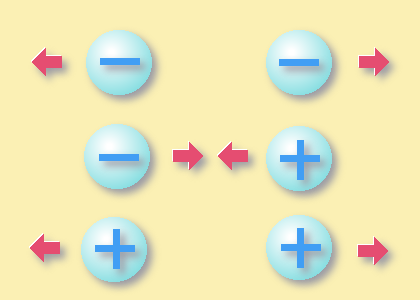
Like many things in nature, charges follow a simple rule of interaction: like charges repel each other, and opposite charges attract. Two protons will push each other away, as will two electrons. A proton and an electron, however, will pull toward each other. This fundamental force is what holds atoms together and drives everything from tiny sparks to massive lightning bolts.
Measuring the Force
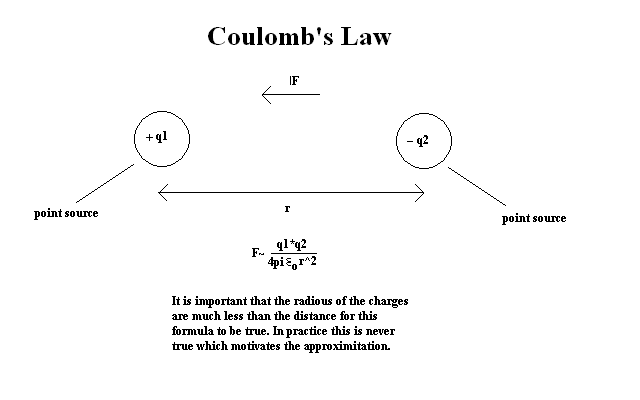
The push and pull between charges isn't just qualitative; it can be precisely measured. The force between two stationary point charges is described by Coulomb's Law, discovered by French physicist Charles-Augustin de Coulomb in the 1780s.
This law states that the force is directly proportional to the product of the two charges and inversely proportional to the square of the distance between them. In other words, the stronger the charges, the stronger the force. The farther apart they are, the weaker the force becomes, and it weakens very quickly with distance.
Fields of Influence
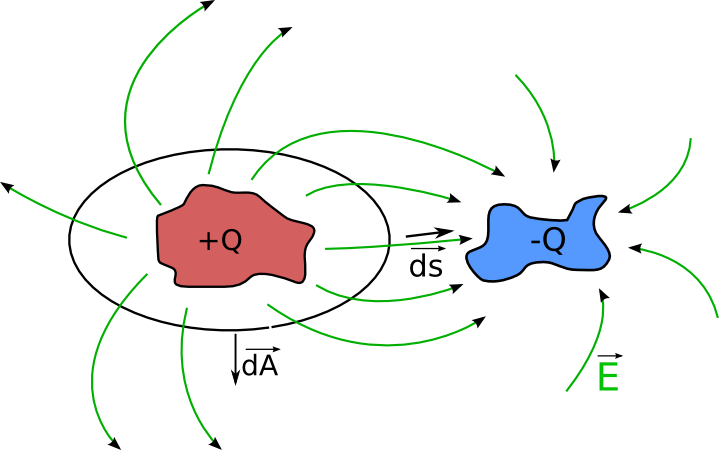
How does one charge "know" another is there to exert a force on it? The concept of a field helps explain this action-at-a-distance. A charge doesn't directly pull on another distant charge. Instead, it creates an electric field in the space around it. Any other charge that enters this field then experiences a force.
An electric field, denoted by , is a vector field. At any point in space, it has both a magnitude (strength) and a direction. The direction of the electric field is defined as the direction of the force that would be exerted on a small, positive test charge placed at that point. The magnitude is the force per unit charge.
We can visualize electric fields using electric field lines. These are imaginary lines drawn to show the field's direction and strength.
- The lines point in the direction of the force on a positive charge (away from positive source charges, toward negative ones).
- The density of the lines (how close they are to each other) indicates the field's strength. Where lines are close together, the field is strong; where they are far apart, it's weak.
Material Matters
Different materials respond to electric fields in different ways, which generally places them into one of two categories: conductors and insulators.
In conductors, such as metals like copper and silver, some electrons are not tightly bound to their atoms. They are free to move throughout the material. When a conductor is placed in an electric field, these free electrons move in response to the force from the field. They rearrange themselves until they create an internal electric field that exactly cancels the external one. This is why the net electric field inside a conductor in electrostatic equilibrium is zero.
This ability of conductors to cancel external fields is the principle behind electrostatic shielding. A conductive box, known as a Faraday cage, can protect its contents from external electric fields.
In insulators, like rubber, glass, or plastic, electrons are tightly bound to their atoms and cannot move freely. When an insulator is placed in an electric field, the charges can't rearrange on a large scale. Instead, the individual atoms or molecules become polarized—the centers of positive and negative charge shift slightly, aligning with the external field. This creates a small, localized electric field that opposes the external field, weakening it within the material, but not canceling it entirely.
If two objects, one with a positive charge and one with a negative charge, are brought near each other, what will happen?
According to Coulomb's Law, if the distance between two stationary point charges is doubled, the electrostatic force between them: