Electromagnetism and Induction Explained
Electric Charge and Fields
The Spark of It All
At the heart of nearly all electrical phenomena is a fundamental property of matter called electric charge. It's not something we can see or touch directly, but its effects are everywhere. Matter is made of atoms, which in turn are made of protons, neutrons, and electrons. Protons carry a positive charge (+), and electrons carry a negative charge (-). Neutrons, as their name suggests, are neutral.
Most objects are electrically neutral because they have an equal number of protons and electrons, so the charges cancel out. An object becomes charged when it gains or loses electrons. Gaining electrons results in a net negative charge, while losing them leaves a net positive charge.
One of the first things you learn about charge is how charged objects interact: opposites attract, and likes repel. Two positive charges will push each other away, as will two negative charges. But a positive and a negative charge will pull toward each other. This simple rule governs everything from static cling to the chemical bonds that hold molecules together.
Quantifying the Force
It’s one thing to say that charges push or pull on each other, but how strong is that force? In the 18th century, French physicist Charles-Augustin de Coulomb precisely measured it. His findings are summarized in what we now call Coulomb's Law.
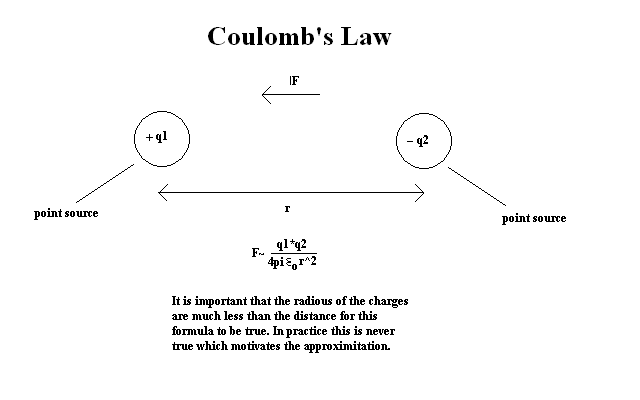
Coulomb's Law states that the force between two stationary point charges is directly proportional to the product of the charges and inversely proportional to the square of the distance between them. In mathematical terms, it looks like this:
Let's break that down:
- is the magnitude of the electrostatic force.
- and are the amounts of the two charges.
- is the distance separating the charges.
- is a constant of proportionality, known as Coulomb's constant.
The most important part of this relationship is the in the denominator. This is an inverse-square law. It means if you double the distance between two charges, the force between them drops to one-quarter of its original strength. If you triple the distance, the force becomes one-ninth as strong. This is similar to how a spray paint can covers a wider, thinner area as you move it away from a surface.
Action at a Distance
A tricky question arises from Coulomb's Law: How does one charge know another is there to push or pull on it? The charges don't have eyes or hands. The answer lies in a concept that is central to electromagnetism: the electric field.
Instead of thinking of charges acting directly on each other, we can imagine that every charge creates an electric field that permeates the space around it. A charge modifies the properties of the space itself. When you bring a second charge into this field, it's the field at that location that exerts a force on the second charge.
The source charge creates the field, and a test charge experiences the field.
Electric Field
noun
A region around a charged particle or object within which a force would be exerted on other charged particles or objects.
The strength of the electric field () at any point is defined as the force () that would be exerted on a small positive test charge () placed at that point, divided by the magnitude of the test charge itself.
The electric field is a vector quantity, meaning it has both magnitude (strength) and direction. The direction of the field is defined as the direction of the force that would be exerted on a positive test charge. So, for a positive source charge, the electric field points radially outward. For a negative source charge, it points radially inward.
Visualizing the Invisible
Since we can't see electric fields, physicists use a tool called electric field lines to visualize them. These lines are imaginary, but they follow a few simple rules that make them incredibly useful for understanding how fields behave.
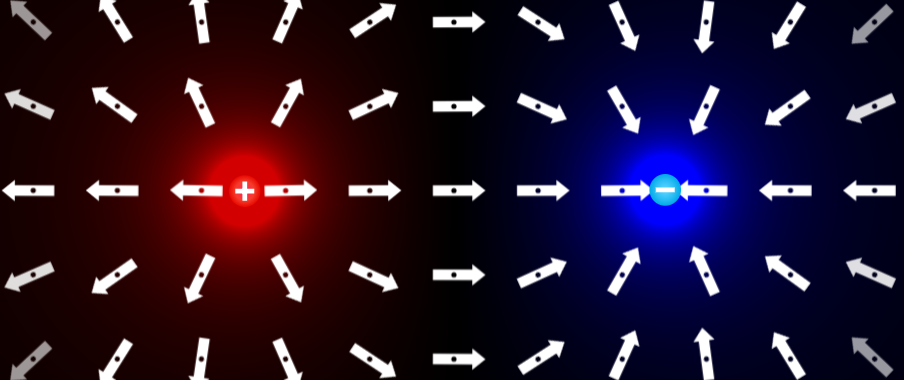
Here are the key properties of electric field lines:
- Direction: Field lines always point away from positive charges and toward negative charges. An arrow on the line indicates the direction.
- Density: The closer the lines are to each other, the stronger the electric field is in that region. Where the lines are spread out, the field is weaker.
- Origin and Termination: Field lines begin on positive charges and end on negative charges. They can also extend to or from infinity if there is a net charge.
- No Crossing: Electric field lines can never cross. If they did, it would mean that the force on a test charge at that point would have two different directions, which is impossible.
By drawing these lines, we can get an intuitive picture of the electric field's structure, whether it's from a single charge, two charges (a dipole), or more complex arrangements.
These foundational concepts of charge, force, and fields are the building blocks for understanding all of electricity and magnetism. They explain everything from how your phone charges to the behavior of light itself.
If two negatively charged particles are placed near each other, what will happen?
An object becomes positively charged when it...