Electromagnetic Induction Explained
Introduction to Electromagnetic Induction
A Hidden Connection
In the early 19th century, scientists were fascinated by the newfound link between electricity and magnetism. They had discovered that an electric current flowing through a wire could create a magnetic field, a principle that powers electromagnets and motors today. This led to a tantalizing question: if electricity could create magnetism, could magnetism create electricity?
For years, many tried and failed to answer this. They would place a strong magnet next to a wire, hoping to see a current appear, but nothing happened. The connection seemed to be a one-way street.
Faraday's Breakthrough
The puzzle was finally solved in 1831 by Michael Faraday, a brilliant and intuitive experimentalist. Faraday suspected that the missing ingredient was change. A stationary magnet might do nothing, but what about a moving one?
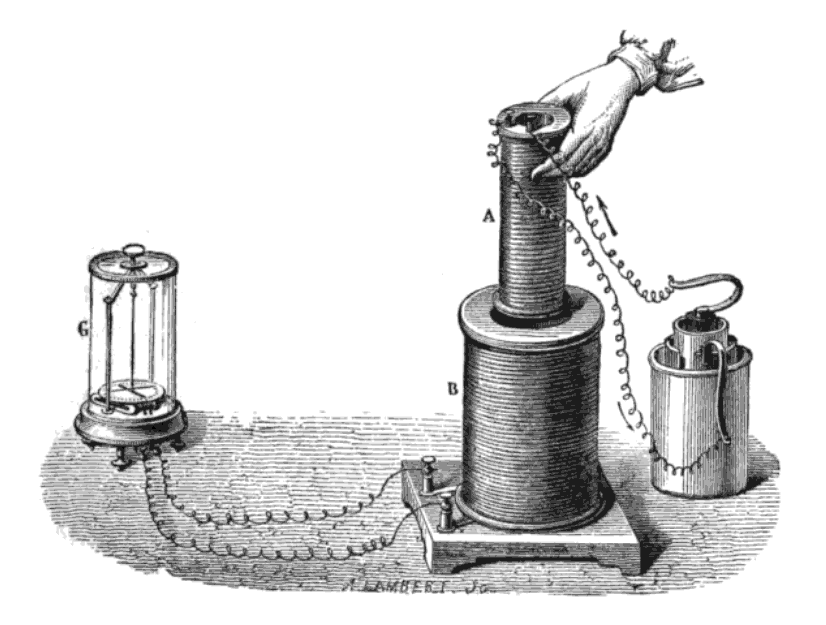
To test his idea, he connected a coil of wire to a galvanometer, a device that detects electric current. When he pushed a bar magnet into the coil, the galvanometer's needle jumped, indicating a current. When he pulled the magnet out, the needle jumped again, but in the opposite direction. Crucially, when the magnet was held perfectly still inside the coil, nothing happened. The current only existed while the magnet was in motion relative to the wire.
This discovery was monumental. It proved that a changing magnetic field could generate, or induce, an electric current in a nearby conductor. This phenomenon is called electromagnetic induction.
Understanding Magnetic Flux
To understand why motion is so important, we need to think about magnetic fields in a new way. Imagine a magnetic field as a collection of invisible lines, called magnetic field lines, flowing from the magnet's north pole to its south pole. The density of these lines represents the strength of the field.
Magnetic Flux
noun
A measurement of the total number of magnetic field lines passing through a given area.
Think of the loop of wire as a window frame and the magnetic field lines as rain. Magnetic flux is like the amount of rain passing through the open window. If the magnet is far away, few lines pass through the coil, so the flux is low. As the magnet moves closer, more lines pass through, and the flux increases. Moving it away decreases the flux.
It's the change in flux, not the flux itself, that matters. A strong magnet held stationary near the coil creates a high but constant flux. Since the flux isn't changing, no current is induced. Pushing the magnet into the coil creates a changing flux, which induces a current.
EMF and Everyday Induction
This changing magnetic flux creates something called an electromotive force, or emf. You can think of emf as an electrical pressure that pushes charges (like electrons) to move around a wire. If the wire forms a complete circuit, this push results in an induced current.
The faster the magnetic flux changes, the greater the induced emf and the stronger the resulting current. This can be achieved by moving the magnet faster, using a stronger magnet, or using a coil with more loops of wire.
Electromagnetic induction isn't just a laboratory curiosity; it's a fundamental principle that powers much of our world. Every time you use an appliance plugged into a wall outlet, you're benefiting from this effect. The electricity itself was likely generated at a power plant by spinning massive coils of wire through powerful magnetic fields, a direct application of Faraday's discovery.
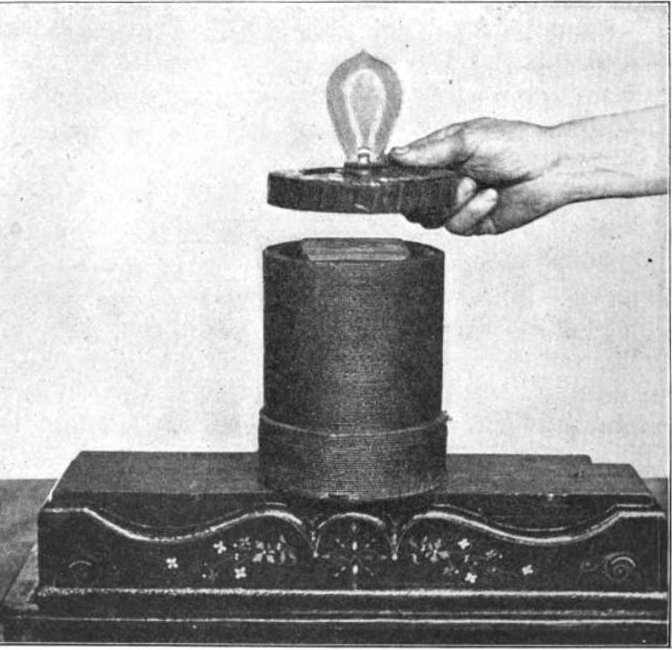
Other everyday examples include the magnetic stripe on a credit card, which induces a current in a reader head as it's swiped, and wireless phone chargers, which use a changing magnetic field in the charging pad to induce a current in a coil inside the phone.
Faraday's insight revealed a deep symmetry in nature. Just as moving charges create magnetic fields, changing magnetic fields create a force that moves charges. This elegant connection between electricity and magnetism is the foundation of modern electrical technology.