Electromagnetic Induction Explained
Magnetic Fields
What is a Magnetic Field?
A magnetic field is an invisible area of influence surrounding a magnet or a moving electric charge. Within this field, a magnetic force can be felt, pushing or pulling on other magnetic materials. Think of it like the heat radiating from a fire. You can't see the heat, but you can feel it when you get close. Similarly, you can't see a magnetic field, but its effects are very real.
Magnetic Field
noun
A region around a magnetic material or a moving electric charge within which the force of magnetism acts.
Magnetic fields are produced in two main ways: by permanent magnets (like the ones on your fridge) and by electric currents (the flow of electric charges). The strength and direction of the field are represented by a vector quantity, symbolized as .
Visualizing the Invisible
Since we can't see magnetic fields, how do we know what they look like? A classic experiment involves sprinkling iron filings on a piece of paper placed over a bar magnet. The filings arrange themselves into a distinct pattern, revealing the shape of the magnetic field.
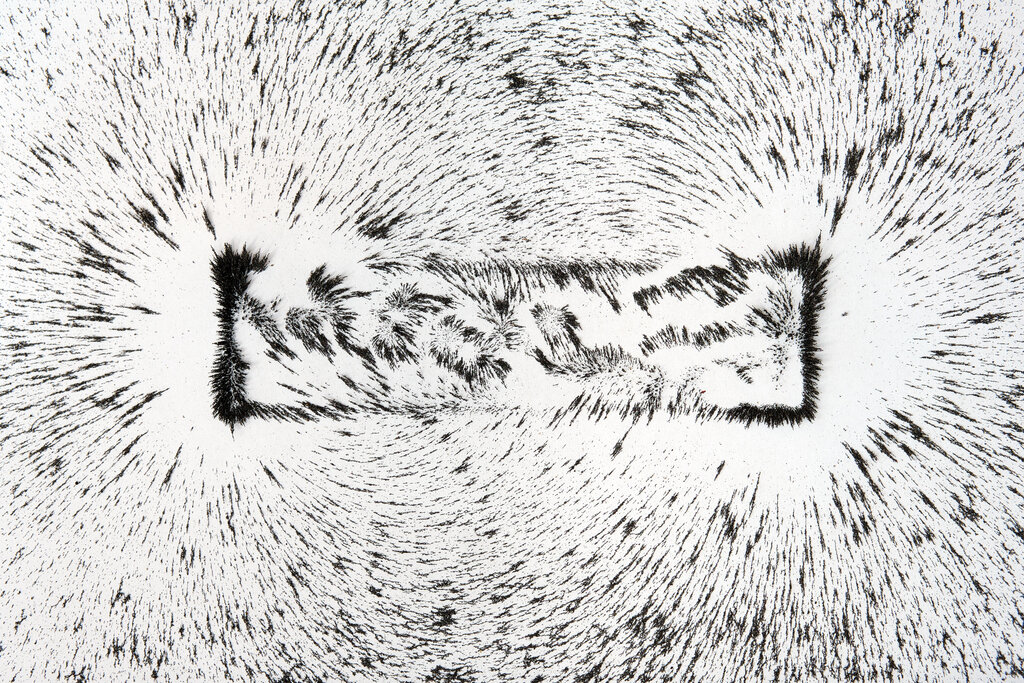
These patterns are made of what we call magnetic field lines. These lines are a useful way to map out the invisible field. They tell us two important things:
-
Direction: The lines show the direction of the force. By convention, magnetic field lines are drawn exiting the north pole of a magnet and entering the south pole.
-
Strength: The density of the lines indicates the field's strength. Where the lines are close together, the magnetic field is strong. Where they are spread apart, the field is weaker. Notice in the image how the filings are densest at the magnet's poles.
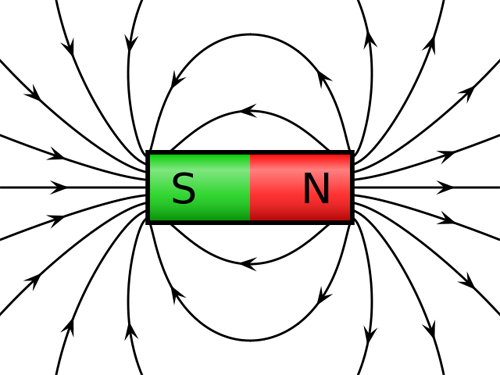
An important rule is that magnetic field lines never cross each other. They always form closed loops, continuing through the inside of the magnet from the south pole back to the north pole.
Electricity's Hidden Companion
Magnets aren't the only source of magnetic fields. In the 1820s, Hans Christian Ørsted discovered that an electric current flowing through a wire also generates a magnetic field. This was a revolutionary discovery that connected the seemingly separate forces of electricity and magnetism.
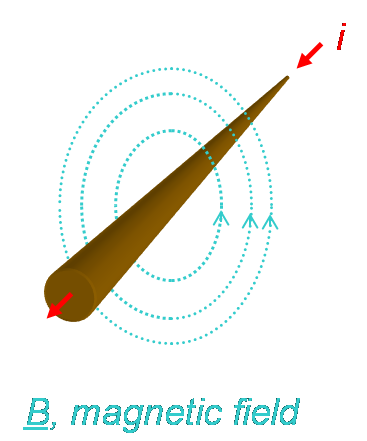
Unlike the field of a bar magnet, the magnetic field around a straight, current-carrying wire forms concentric circles. But which way do these circles point? To figure this out, we use a simple tool called the right-hand rule.
Imagine grabbing the wire with your right hand. Your thumb points in the direction of the current flow. The way your fingers curl around the wire shows the direction of the magnetic field lines.
This simple rule is fundamental to understanding electromagnetism. It firmly establishes that wherever there's an electric current, there's a magnetic field wrapped around it. This connection is the key to how many electrical devices, from motors to generators, work.
Let's check your understanding of magnetic fields.
What are the two primary sources of magnetic fields?
When visualizing a magnetic field with field lines, what does the density of the lines indicate?
Understanding these basics of magnetic fields is the first step. Next, we'll explore what happens when these fields don't just sit still, but change over time.