Electromagnetic Energy and Atomic Spectra
Electromagnetic Waves
Waves Without a Medium
Imagine you have a long rope tied to a doorknob. If you flick your wrist, you create a wave that travels down the rope. The wave moves, but the rope itself just moves up and down. Sound works similarly, as a vibration traveling through the air. But what about light from the sun? It travels through the vacuum of space to reach us. There's no rope, no air, no medium for it to travel through.
Light, radio waves, and microwaves are all examples of electromagnetic (EM) waves. These waves are disturbances not in a physical substance, but in invisible electric and magnetic fields that exist everywhere. A changing electric field creates a magnetic field, and a changing magnetic field creates an electric field. This dance between the two fields creates a self-propagating wave that can travel through empty space.
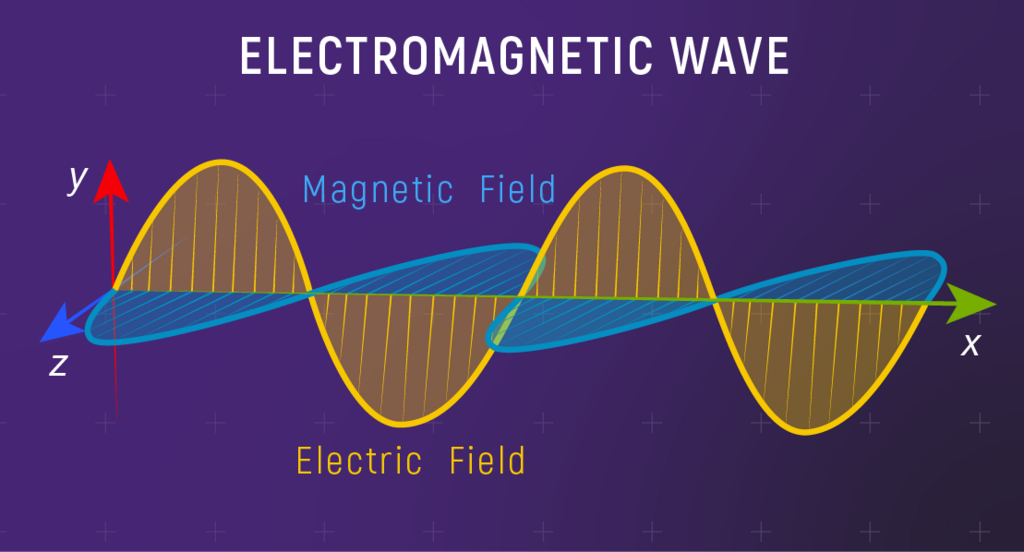
The electric and magnetic fields in an EM wave oscillate at right angles to each other. They are also perpendicular to the direction the wave is traveling. It’s a three-dimensional wave, moving forward while wiggling in two different directions at once.
The Anatomy of a Wave
To describe an EM wave, we need to understand its basic properties. Think back to the rope analogy. How far apart are the crests of the wave? How quickly are you flicking your wrist? These characteristics have precise names in physics.
Wavelength
noun
The distance between two consecutive corresponding points of a wave, such as from one peak to the next.
Wavelength is often represented by the Greek letter lambda (). A related concept is frequency, which is how many full wave cycles pass a point every second. Frequency is measured in Hertz (Hz) and is represented by the letter .
Wavelength and frequency are inversely related. If a wave has a long wavelength, fewer crests will pass by each second, so it has a low frequency. If it has a short wavelength, more crests will pass by, giving it a high frequency.
In a vacuum, all electromagnetic waves travel at the same incredible speed: the speed of light, denoted as . This universal constant links wavelength and frequency in a simple equation.
This means that if you know a wave's frequency, you can calculate its wavelength, and vice versa.
Another key property is amplitude, which is the maximum strength of the electric or magnetic field in the wave. For visible light, amplitude corresponds to brightness or intensity. A high-amplitude light wave is very bright, while a low-amplitude one is dim.
Finally, there's polarization. This describes the direction in which the electric field is oscillating. If the electric field wiggles only up and down, the wave is vertically polarized. If it wiggles side-to-side, it's horizontally polarized. Light from the sun or a lightbulb is typically unpolarized, meaning its electric field oscillates in all random directions perpendicular to its travel.
Polarized sunglasses work by blocking horizontally polarized light, which is the primary component of glare reflected off surfaces like water or roads.
Energy on the Move
Electromagnetic waves don't just travel; they carry energy from one place to another. This is obvious when you feel the warmth of the sun on your skin—that's energy transported by EM waves over 93 million miles.
The rate at which an EM wave transfers energy is described by something called the Poynting vector. It points in the direction the wave is traveling and its magnitude tells you the amount of energy flowing through a unit area per unit time. Essentially, it tells you both the direction and intensity of the energy flow.
The energy of an EM wave is related to both its amplitude and its frequency. A higher amplitude (brighter light) carries more energy. A higher frequency (shorter wavelength) also means more energy. This is why ultraviolet (UV) waves, which have a higher frequency than visible light, can cause sunburn, while lower-frequency radio waves pass through our bodies without any effect.
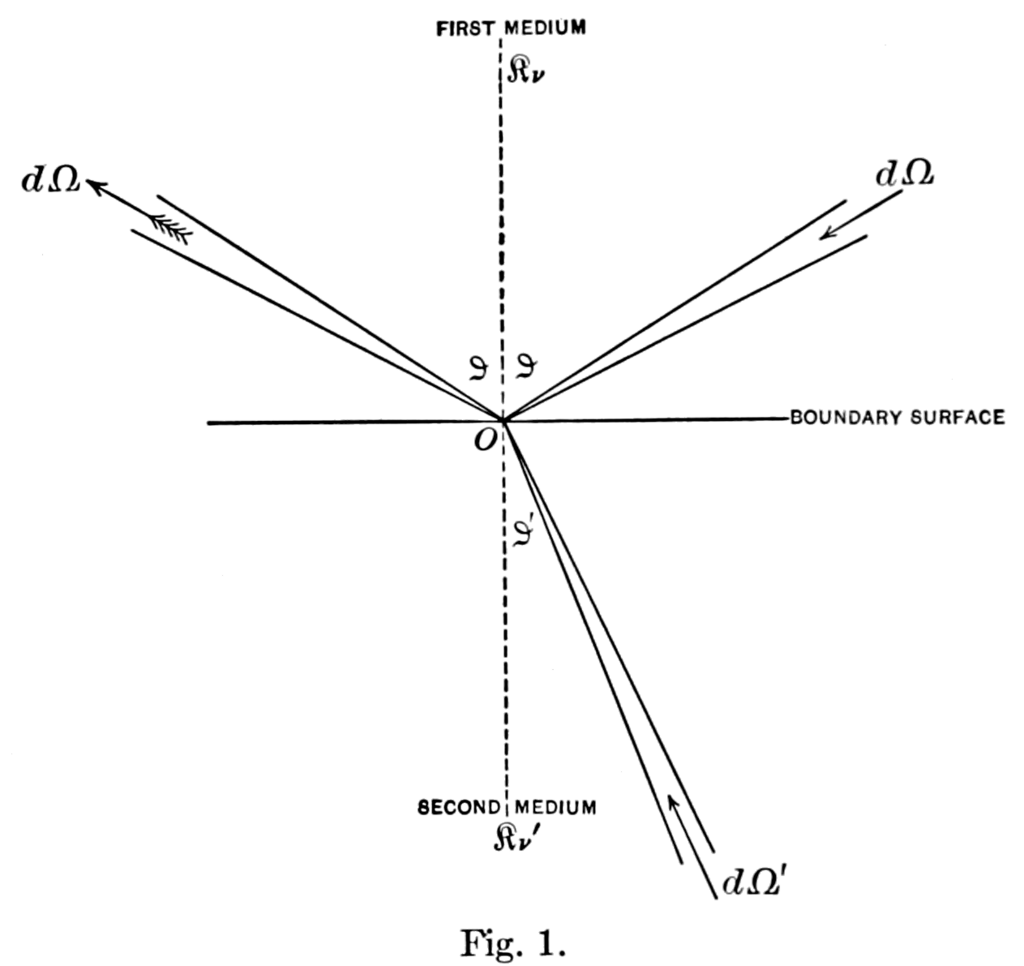
When an EM wave traveling through one medium, like air, encounters another, like glass or water, a few things can happen. Part of the wave might bounce off, which is called reflection. Part of it might pass through, which is called transmission. The transmitted wave usually slows down and bends, a phenomenon known as refraction.
Some materials, called opaque materials, don't let the wave pass through at all. Instead, they absorb the wave's energy, often converting it into heat. A black T-shirt gets hot in the sun because it absorbs most of the light that hits it. A white T-shirt stays cooler because it reflects most of the light.
The way an EM wave interacts with matter depends on the wave's frequency and the properties of the material. This is why a microwave oven heats your food (water molecules absorb microwave energy) but the glass plate it sits on remains cool.
What is the fundamental mechanism that allows electromagnetic waves to travel through a vacuum?
If an electromagnetic wave has a very high frequency, what must be true about its wavelength?
Understanding these fundamental properties is the first step to exploring the vast and fascinating world of electromagnetism.