Electromagnetic Arc Control
Electromagnetic Coil Fundamentals
Currents and Magnetic Fields
Whenever an electric current flows through a wire, it creates a magnetic field. This isn't just a neat trick; it's a fundamental property of electricity. The field wraps around the wire in circles. You can figure out the direction of this field using a simple technique called the right-hand rule. If you point your right thumb in the direction of the current, your fingers will curl in the direction of the magnetic field.
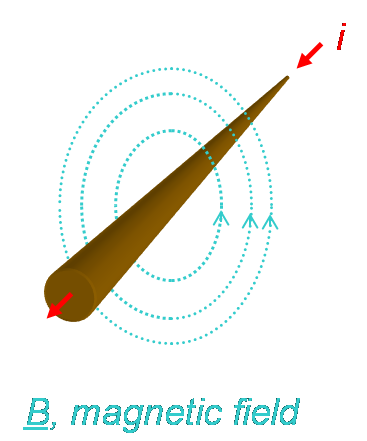
A single straight wire creates a relatively weak magnetic field. But what if we coil the wire into a loop, or many loops? Each loop contributes to the overall field, creating a much stronger and more concentrated magnetic field, especially inside the coil. A tightly wound cylinder of wire is called a solenoid.
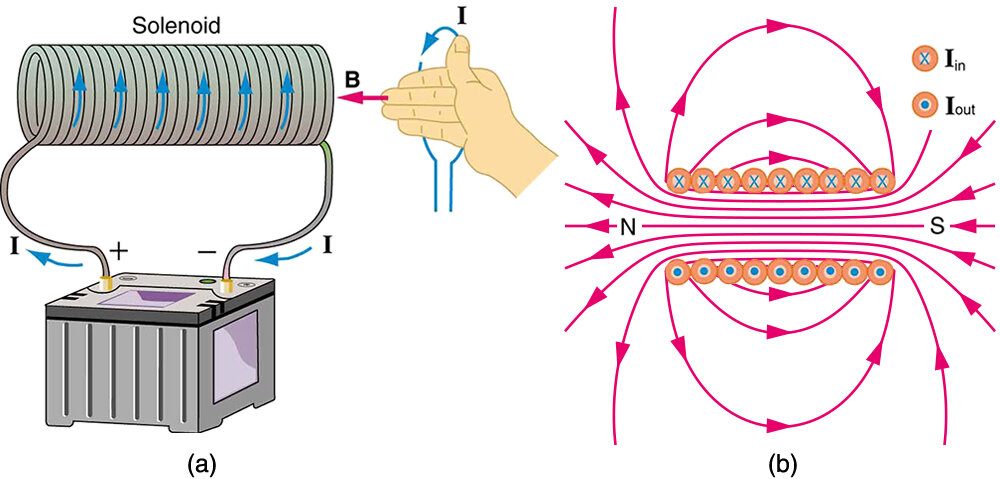
To talk about the strength and extent of these fields, we use the concept of magnetic flux. Think of it as the total number of magnetic field lines passing through a specific area. If the magnetic field is stronger or the area is larger, the flux is greater.
Magnetic flux, denoted by , is a measure of the total magnetic field passing through a surface.
Inductance
Things get interesting when the current changes. According to Faraday's law of induction, a changing magnetic flux through a coil induces a voltage, or electromotive force (EMF), in that same coil. This is a crucial concept. If the current flowing through a coil increases, the magnetic flux it creates also increases. This change in flux induces a voltage that opposes the original increase in current.
Conversely, if the current decreases, the flux decreases, and the induced voltage tries to prop the current back up. This property of a coil to resist changes in current is called inductance.
Inductance
noun
The property of an electrical conductor by which a change in current through it induces an electromotive force in the conductor itself (self-inductance) or in a nearby conductor (mutual inductance).
Every coil has this property, known as self-inductance, usually just called inductance and represented by the letter . The relationship between the induced voltage (EMF), inductance, and the rate of change of current () is straightforward.
The negative sign is important. It comes from Lenz's Law and tells us that the induced voltage always opposes the change in current that created it. This is why inductors are so useful for resisting sudden spikes or drops in current within a circuit.
Coils and Energy
The inductance of a coil depends on its physical characteristics. A coil with more turns, a larger cross-sectional area, or a core made of a magnetic material (like iron) will have a higher inductance than a smaller, air-cored coil. Common coil configurations include solenoids (cylindrical coils) and toroids (donut-shaped coils).
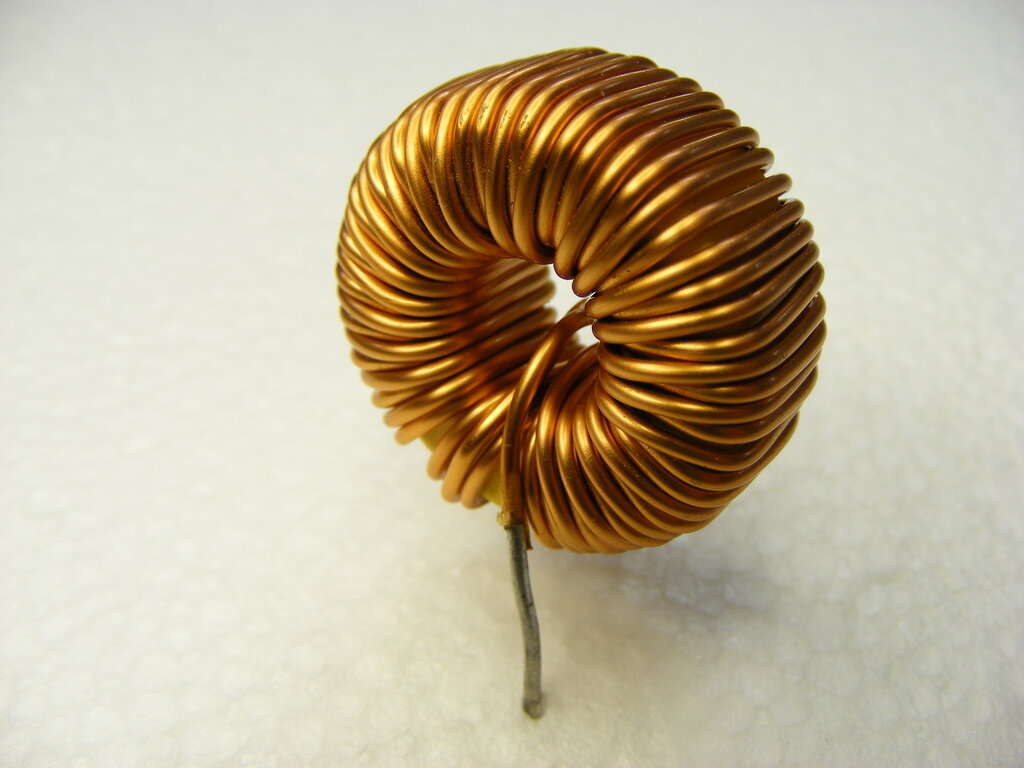
Because an inductor resists changes in current, it takes work to establish a current through it. This work isn't lost; it's stored as energy in the magnetic field surrounding the coil. The amount of energy stored depends on the coil's inductance and the amount of current flowing through it.
Here, is the energy stored (in joules), is the inductance (in henrys), and is the current (in amperes). When the current is switched off, the magnetic field collapses, and this stored energy is released back into the circuit, often as a voltage spike.
What is created around a wire whenever an electric current flows through it?
According to the right-hand rule, if a current flows upwards through a vertical wire, in which direction does the magnetic field circle the wire?
Understanding these basic principles—how currents create fields, how changing fields induce voltages, and how coils store energy—is the first step toward working with electromagnetic systems.