Electricity Fundamentals Explained
Electric Charge
The Spark of Matter
Everything you see is made of atoms. Inside those atoms are even smaller particles, and some of them have a fundamental property called electric charge. It's a basic quality of matter, like mass or volume, but it's responsible for all things electric.
Most of the time, we don't notice electric charge because it comes in two types that balance each other out perfectly. These types are called positive (+) and negative (-).
Protons, found in the center of an atom, have a positive charge. Electrons, which orbit the center, have a negative charge.
An object is electrically neutral when it has an equal number of protons and electrons. Their charges cancel out. But when there's an imbalance, an object has a net charge, and we start to see electrical effects.
Opposites Attract
Charged objects interact with each other based on a simple rule. It governs how they push and pull on one another without ever touching.
Like charges repel, and opposite charges attract.
This means two positively charged objects will push each other away. The same goes for two negatively charged objects. However, a positively charged object and a negatively charged object will pull toward each other.
Conductors and Insulators
Electric charges can move, but how easily they do so depends on the material. We can sort materials into two basic categories: conductors and insulators.
In a conductor, electrons can move freely from atom to atom. Metals like copper, aluminum, and gold are excellent conductors. This freedom of movement is why we use metal wires to carry electricity.
In an insulator, electrons are held tightly to their atoms and can't move around easily. Materials like rubber, glass, plastic, and wood are good insulators. They are used to prevent the flow of charge, like the rubber coating on an electrical cord.
| Conductors | Insulators |
|---|---|
| Copper | Rubber |
| Silver | Glass |
| Gold | Plastic |
| Aluminum | Wood |
| Water (impure) | Air |
Static Electricity
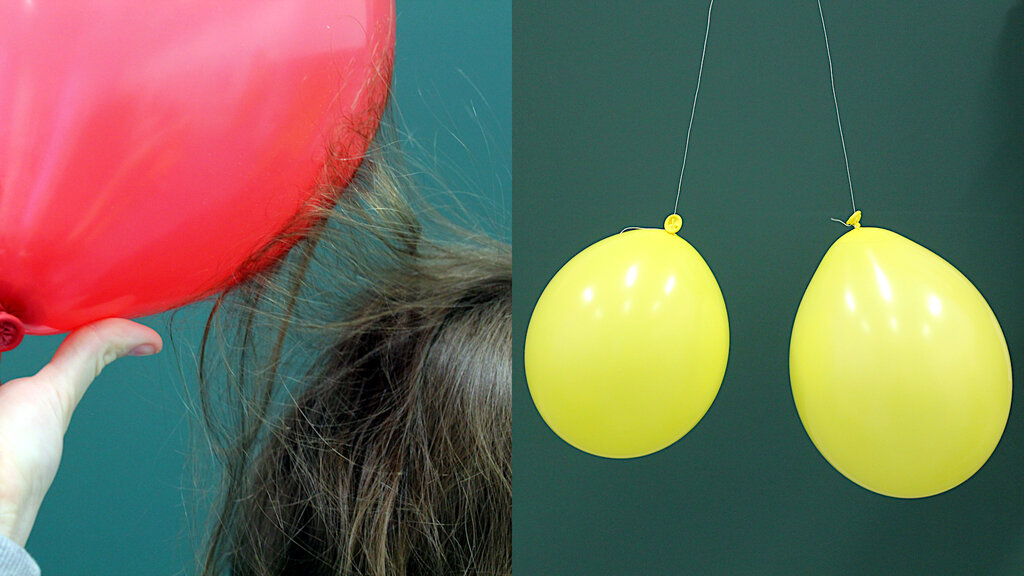
When you rub two different insulating materials together, electrons can be scraped off one and deposited onto the other. This creates an imbalance of charge. The buildup of this charge on an object's surface is called static electricity.

Since the balloon and your hair now have opposite net charges, they attract each other. Your hair literally stands up to reach for the balloon!
The same thing happens when you walk across a carpet in socks, especially in dry weather. Your body picks up extra electrons from the carpet. You now have a net negative charge.
When you touch a metal doorknob (a conductor), all that built-up charge jumps from your hand to the knob at once. That sudden discharge is the tiny spark and shock you feel.
Now, let's check your understanding of these fundamental concepts.
What is the fundamental property of some subatomic particles that is responsible for all electrical phenomena?
If two objects are both positively charged and brought near each other, they will...
This simple property of charge is the starting point for understanding all of electricity.