Electricity Circuits and IoT Logic
Electricity Basics
The Spark of Everything
At the heart of all things electrical is something called charge. It's a fundamental property of matter, just like mass. Most of the time, we don't notice it because objects are usually neutral, meaning they have a perfect balance of positive and negative charges.
The main characters in this story are tiny particles: protons (which have a positive charge) and electrons (which have a negative charge). When we talk about electricity, we're almost always talking about the movement of electrons.
Just like magnets, charges follow a simple rule: opposites attract and likes repel. Two electrons will push each other away, while an electron and a proton will pull toward each other.
Making Charges Move
A pile of electrons isn't very useful on its own. To get electricity, we need those charges to start moving. This flow of electric charge is called current.
Think of it like water in a pipe. The water itself is like the charge, and the rate at which it flows past a certain point is the current. A tiny trickle is a low current, while a rushing river is a high current. We measure electric current in a unit called amperes, or amps for short.
Current
noun
The rate of flow of electric charge.
But what makes the current flow in the first place? For that, we need a push. In electricity, that push is called voltage. It's the difference in electrical potential between two points.
Going back to our water analogy, voltage is like water pressure. A water tower creates pressure that pushes water through pipes. Similarly, a battery creates voltage that pushes electrons through a wire. A 9-volt battery provides a bigger push than a 1.5-volt battery. Voltage is measured in volts.
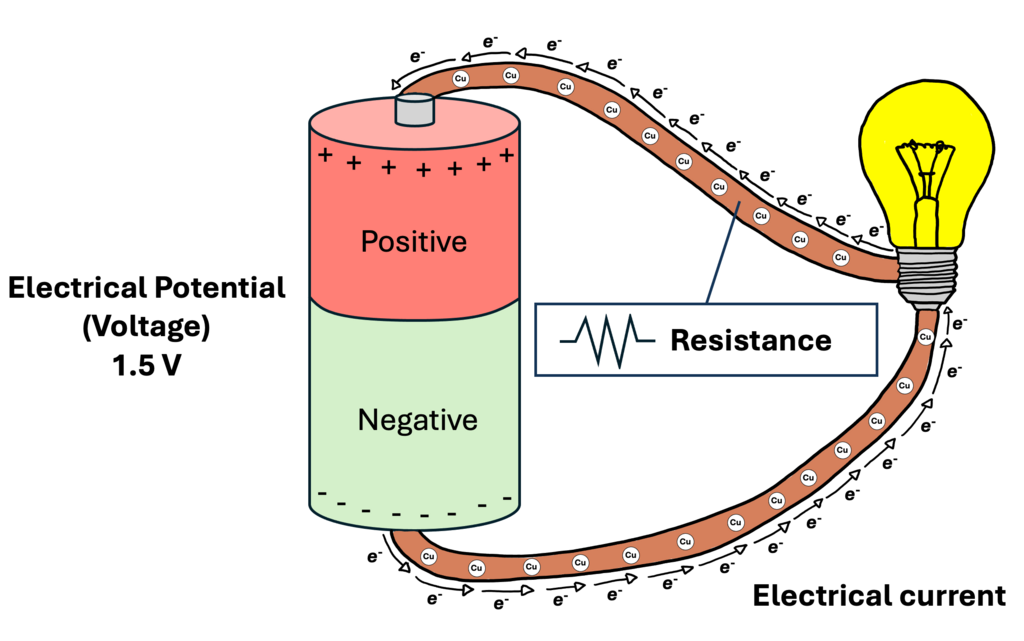
As electrons flow through a circuit, they don't get a completely free ride. They bump into atoms and other obstacles along the way. This opposition to the flow of current is called resistance.
In our water pipe, resistance would be like a narrow, clogged section that makes it harder for water to get through. Materials like copper have very low resistance, which is why we use them for wires. Materials like rubber have very high resistance, making them good insulators. We measure resistance in ohms (Ω).
To recap the analogy:
- Electric Charge is the water.
- Current is the flow rate of the water.
- Voltage is the water pressure.
- Resistance is the pipe's narrowness.
The Fundamental Rule
These three concepts—voltage, current, and resistance—are not independent. They are linked by a simple and powerful relationship known as Ohm's Law. It's the foundational equation for understanding circuits.
Ohm's Law states that the voltage across a conductor is directly proportional to the current flowing through it, provided all physical conditions and temperatures remain constant. In simple terms, it connects the three key elements we've just discussed.
Or, using the standard symbols for each unit:
Where:
- is voltage (in Volts)
- is current (in Amperes)
- is resistance (in Ohms)
This simple formula tells us everything about how these quantities relate. If you increase the voltage (the push), the current will increase. If you increase the resistance (the obstacle), the current will decrease. This relationship is the key to analyzing and designing electrical circuits.
Imagine a circuit with a 9-volt battery and a resistor. If the resistor has a resistance of 3 ohms, the current flowing through the circuit would be 3 amps ($9V / 3Ω = 3A$).
Let's check your understanding of these core concepts.
What is the fundamental rule governing the interaction between electric charges?
In the common analogy of electricity as water flowing through a pipe, what does the water pressure represent?
With these building blocks, you now have the fundamental tools to understand how electricity works.