Electricity and Oil Gas Integration
Electricity Fundamentals
The Language of Circuits
To understand electricity, it helps to think of it like water flowing through pipes. This simple analogy unlocks the three most important concepts: voltage, current, and resistance.
Voltage (V) is like the water pressure in the pipes. It’s the push or force that makes the electric charge move. It's measured in volts (V). A 9-volt battery provides more “pressure” than a 1.5-volt battery.
Current (I) is the actual flow of electric charge, like the amount of water flowing through the pipe. It’s measured in amperes (A), or amps for short. More charge flowing per second means a higher current.
Resistance (R) is anything that slows down the flow. Think of a narrow section in a pipe. It resists the water flow. In electronics, materials like rubber have high resistance, while copper has very low resistance. It’s measured in ohms (Ω).
In short: voltage pushes, current flows, and resistance opposes.
Ohm's Law
These three concepts are tied together by a fundamental rule called Ohm's Law. It provides a simple mathematical relationship between voltage, current, and resistance.
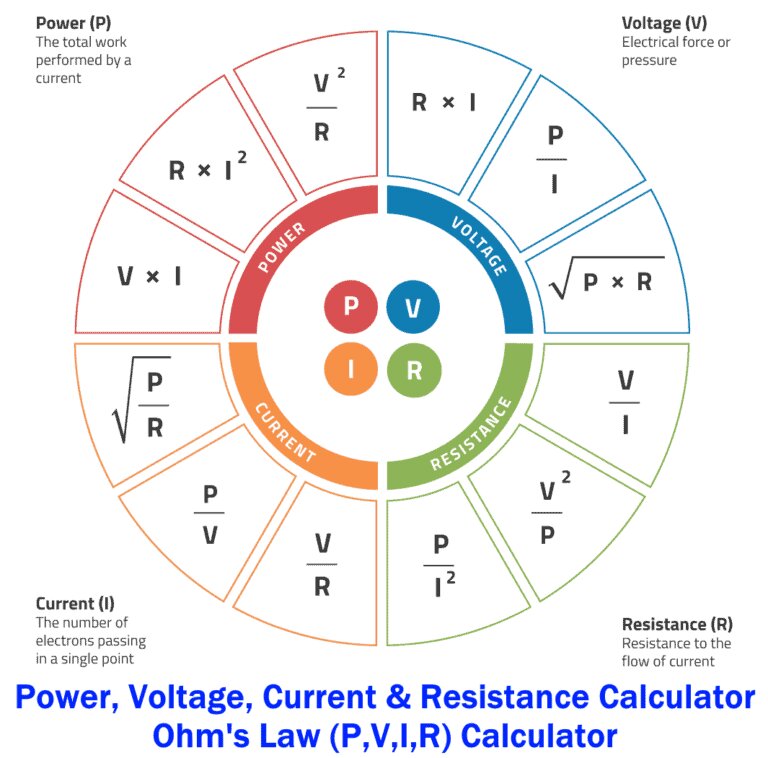
The law states that the voltage across a component is equal to the current flowing through it multiplied by its resistance.
This simple formula is incredibly powerful. If you know any two of the values, you can always find the third. For example, if a small light bulb with a resistance of 3 Ω is connected to a 1.5 V battery, we can calculate the current that flows through it.
Using Ohm's Law, we rearrange the formula to solve for current: . Plugging in the numbers gives us . So, half an amp of current flows through the bulb.
Rules of the Road
For more complex circuits, we need a couple more rules, known as Kirchhoff's Laws. They help us figure out how current and voltage behave in circuits with multiple paths and components.
Kirchhoff's Laws are the cornerstone of electrical circuit analysis, providing the mathematical foundation for understanding how current flows and voltage distributes in any electrical network.
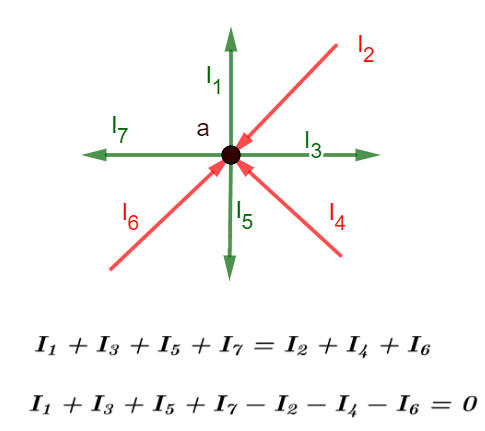
The first law is the Junction Rule, or Kirchhoff's Current Law (KCL). It says that the total current entering a junction (a point where wires meet) must equal the total current leaving it. This is just like with plumbing: the amount of water flowing into an intersection of pipes must be the same as the amount flowing out.
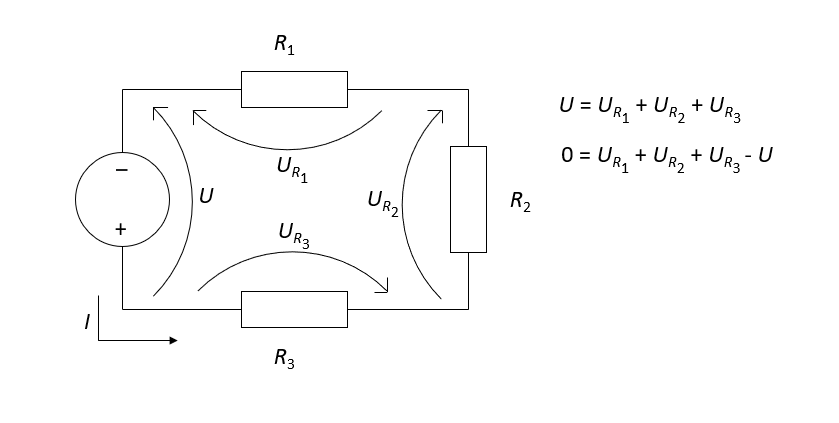
The second law is the Loop Rule, or Kirchhoff's Voltage Law (KVL). It states that for any closed loop in a circuit, the sum of all the voltage gains (from sources like batteries) must equal the sum of all the voltage drops (across components like resistors). Think of it as a hike that starts and ends at the same point. The total elevation you climb must equal the total elevation you descend, bringing you back to your starting height. In a circuit, the voltage returns to its starting level after a full loop.
Power and Energy
So, what are we using all this electricity for? To do work, which brings us to power and energy.
Electrical Power (P) is the rate at which electrical energy is used. It’s a measure of how quickly a device converts electrical energy into another form, like light, heat, or motion. Power is measured in watts (W).
You can calculate power by multiplying voltage and current.
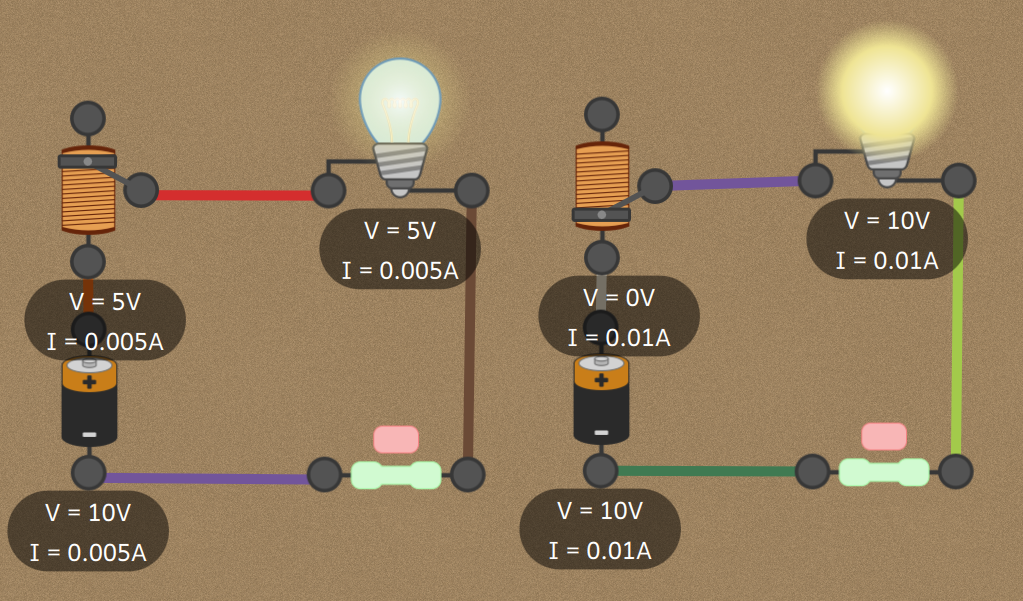
A 60-watt light bulb uses energy faster than a 10-watt bulb, which is why it shines brighter.
Electrical Energy (E) is power used over a period of time. Your electricity bill doesn't charge you for power, but for energy. The unit you see on your bill is the kilowatt-hour (kWh), which is the energy used by a 1,000-watt device running for one hour.
Energy is calculated by multiplying power by time.
These building blocks—voltage, current, resistance, power, and the laws that connect them—form the foundation of all electrical systems, from the smartphone in your pocket to the power grid that spans the globe.