Electrician Training Program
Electrical Fundamentals
The Building Blocks of Electricity
Think of electricity like water flowing through a pipe. This simple analogy helps make sense of the three core concepts you need to know: voltage, current, and resistance.
Voltage () is like the water pressure. It's the force that pushes the electric charge forward. Without this pressure, nothing flows. Voltage is measured in volts.
Current () is the actual flow of electric charge, similar to the amount of water moving through the pipe. It's the movement that does the work, like lighting a bulb. Current is measured in amperes, or amps (A) for short.
Resistance () is any friction or obstruction that slows down the flow. Think of it as a narrow section in the pipe. Resistance is measured in ohms ().
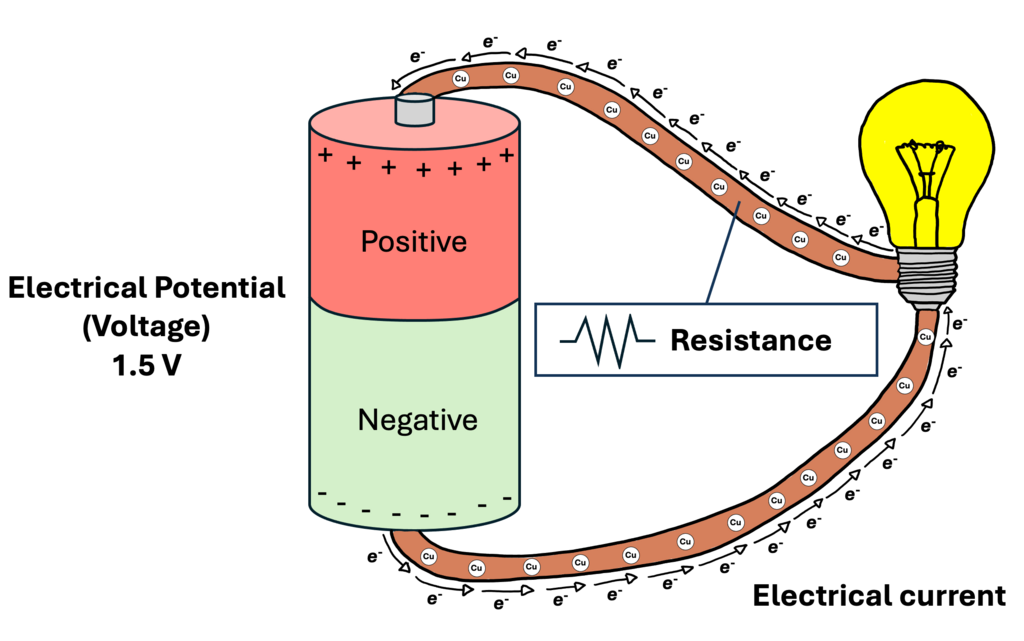
Every electrical circuit has these three elements. A power source provides the voltage (pressure), which drives the current (flow) through a load, like a light bulb, which has resistance (obstruction).
voltage
noun
The difference in electric potential between two points, which causes electric charge to flow.
Electrical Power
So, if voltage pushes and current flows, how do we measure the work that's actually being done? That's where power comes in.
Power () is the rate at which electrical energy is used to do work, like generating light or heat. The unit for power is the watt (W). A 100-watt light bulb uses more energy per second than a 60-watt bulb, which is why it shines brighter.
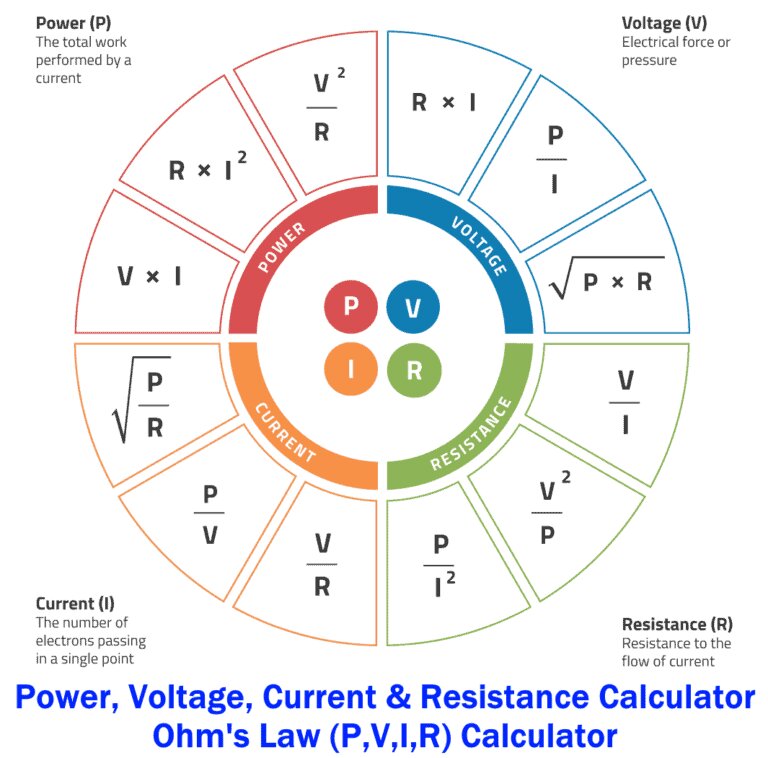
Power is the product of voltage and current. To find the power in watts, you simply multiply the volts by the amps.
For example, if a device draws 2 amps of current when connected to a 120-volt outlet, the power it consumes is:
Ohm's Law
Voltage, current, and resistance aren't independent. They share a simple, predictable relationship defined by Ohm's Law. This is one of the most important rules in electronics.
This formula states that voltage is equal to the current multiplied by the resistance. It lets you calculate any one of the three values if you know the other two.
- Need to find current? Rearrange it to:
- Need to find resistance? Rearrange it to:
Knowing this relationship is crucial for troubleshooting circuits and making sure your wiring is safe and effective.
Circuits Two Ways
Electrical components can be connected in a couple of basic ways: in series or in parallel. How they're wired changes how the circuit behaves.
A series circuit provides only one path for the current to flow. The components are connected end-to-end, like links in a chain.
In a series circuit, if one component breaks (like an old holiday light burning out), the entire circuit opens and the current stops flowing. The total resistance is simply the sum of all individual resistances:
The current is the same through every component, but the voltage is divided among them.
A parallel circuit provides multiple paths for the current. Each component is connected on its own branch.
In a parallel circuit, if one component breaks, the others can still operate because the current has other paths to take. This is how most buildings are wired. Each component receives the same voltage, but the total current from the source is divided among the branches. Adding more branches to a parallel circuit actually decreases the total resistance.
Ready to test what you've learned? Let's check your understanding.
In the analogy of electricity as water flowing through a pipe, what does electrical current () represent?
According to Ohm's Law, what is the current () flowing through a circuit with a voltage of 12V and a resistance of 3 Ohms ()?
Mastering these core principles is the first step toward working safely and confidently with electricity. Everything else you learn will build upon this foundation.