Electrical Data Analysis Fundamentals
Electricity Basics
The Spark of an Idea
At the heart of electricity is a fundamental property of matter called electric charge. It's carried by tiny particles like electrons and protons. You can think of charge as coming in two 'flavors': positive (+) and negative (-). Electrons carry a negative charge, while protons carry a positive one.
Like charges repel each other, while opposite charges attract. A proton and an electron will pull toward each other, but two electrons will push each other away. This push and pull isn't magic; it's a force that acts across space through what's called an electric field.
Every charged particle creates an electric field around it. When another charge enters this field, it feels a force.
The lines in the diagram show the direction of the force that a positive test charge would feel if placed in the field. For the positive charge, the arrows point outward, showing repulsion. For the negative charge, they point inward, showing attraction.
Making Charges Move
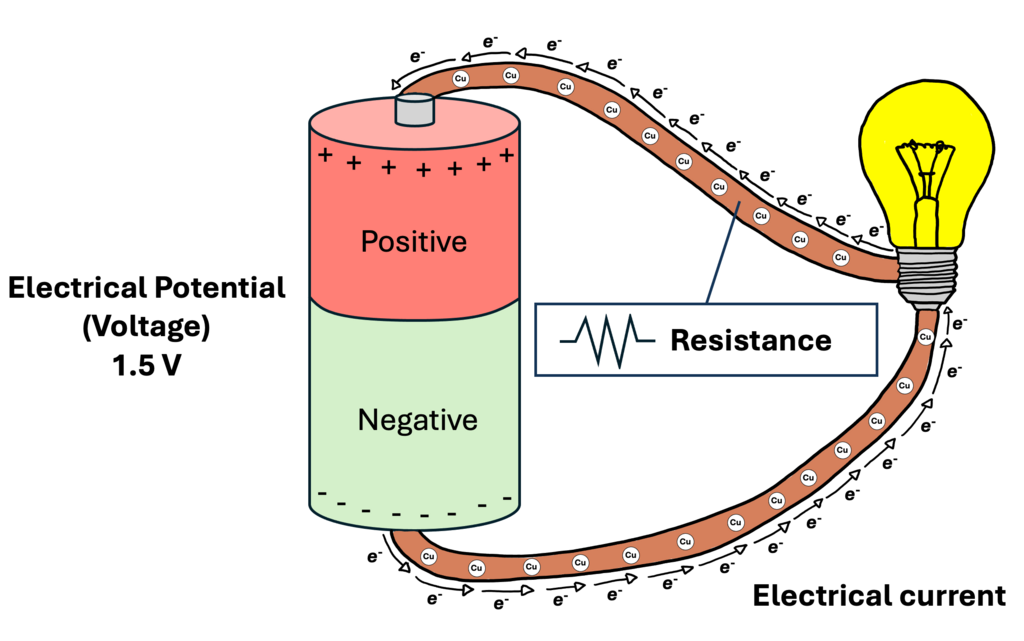
An electric field can make charges move. But to get a steady flow, we need to talk about three key concepts: voltage, current, and resistance. A common analogy is to think of electricity as water flowing through a pipe.
Voltage
noun
The electric potential difference between two points. It's the 'push' or 'pressure' that causes electric charge to flow.
In our water analogy, voltage is like the water pressure. Higher pressure pushes the water through the pipe more forcefully.
Current
noun
The rate of flow of electric charge. It's how much charge passes a certain point in a given amount of time.
Current is like the flow rate of the water, such as gallons per minute. It's the amount of 'stuff' that's actually moving.
Resistance
noun
A measure of the opposition to current flow in an electrical circuit. It determines how much voltage is required to produce a certain current.
Resistance is like the width of the pipe. A narrow pipe restricts water flow more than a wide one. Similarly, a component with high resistance makes it harder for current to flow.
The Fundamental Rule
The relationship between voltage, current, and resistance in many materials is described by a simple but powerful formula known as Ohm's Law. It states that the voltage across a component is directly proportional to the current flowing through it, provided the temperature and other physical conditions remain unchanged.
Here, stands for voltage (measured in volts), for current (measured in amperes or amps), and for resistance (measured in ohms). This simple equation is a cornerstone of circuit analysis.
If a heater with a resistance of 10 ohms is connected to a 120-volt outlet, the current flowing through it would be amps.
Keeping the Signs Straight
When analyzing a circuit, it's crucial to know whether a component is absorbing energy (like a resistor or a light bulb) or supplying it (like a battery). To keep this organized, engineers use the passive sign convention.
It's a simple rule: if the current enters a component through its positive voltage terminal, the power is positive. This means the component is absorbing or dissipating power. Think of a resistor heating up—it's absorbing electrical energy and turning it into heat.
Conversely, if the current enters through the negative terminal and leaves through the positive one, the component is supplying power. This is what happens in a battery. The battery does work on the charges, giving them the energy to move through the circuit.
This convention ensures our calculations for power and energy are consistent and make physical sense.
What happens when two electrons are brought close to each other?
In the water pipe analogy for electricity, what does 'resistance' correspond to?
These building blocks—charge, fields, voltage, current, and resistance—form the foundation of how all electrical circuits work.