Electrical Circuit Analysis Techniques
Circuit Fundamentals
The Building Blocks of Circuits
At the heart of all electronics is electric charge. We can think of charge as a fundamental property of matter, much like mass. In circuits, we're interested in the movement of this charge, which is almost always carried by tiny particles called electrons. The total charge is measured in coulombs (C), named after the French physicist Charles-Augustin de Coulomb.
Charge
noun
A fundamental property of matter that causes it to experience a force when placed in an electromagnetic field. Symbolized by 'q' or 'Q'.
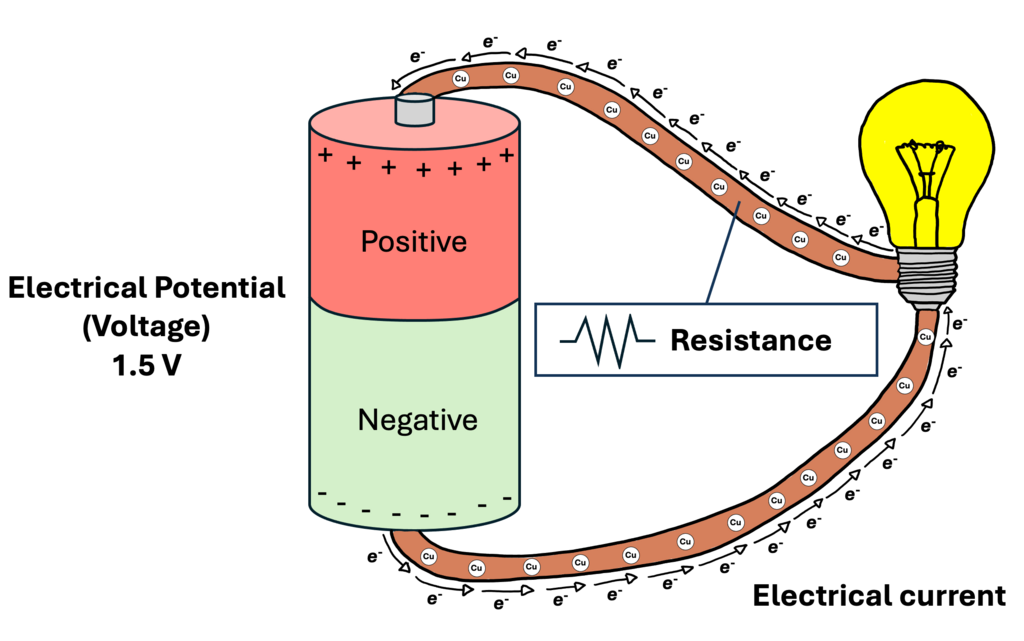
While static charge is interesting, circuits are all about charge in motion. The flow of electric charge is called current. Imagine a river: the amount of water flowing past a point each second is the current. In a wire, electric current is the amount of charge flowing past a point each second.
We measure current in amperes (A), or amps for short. One ampere is equal to one coulomb of charge passing by in one second.
Current is the rate of flow of charge.
Voltage, Energy, and Power
So what makes charge move? A force is needed to push the current through a circuit. This electrical “pressure” is called voltage, or more formally, potential difference. It represents the energy required to move a unit of charge between two points. Voltage is measured in volts (V).
Mathematically, voltage is the change in energy () per unit charge ().
This brings us to power and energy. Energy is the capacity to do work, measured in joules (J). Power is the rate at which energy is used or transferred. If you lift a box, you use energy. If you lift it quickly, you're using more power than if you lift it slowly. Power is measured in watts (W).
Power is the rate of energy transfer. One watt is equal to one joule per second.
In an electrical context, power is simply the product of voltage and current. A component consuming 1 watt of power is using 1 joule of energy every second.
Resistance and Ohm's Law
As current flows through a material, it encounters opposition. This opposition is called resistance, measured in ohms (). A material with low resistance, like copper, is called a conductor. A material with very high resistance, like rubber, is an insulator.
A component designed specifically to have a certain amount of resistance is called a resistor. Resistors are fundamental for controlling the flow of current in circuits.
The relationship between voltage, current, and resistance in a simple circuit is described by a fundamental principle called Ohm's Law. It states that the voltage across a resistor is directly proportional to the current flowing through it.
This means if you increase the voltage (the push), more current will flow. If you increase the resistance (the opposition), less current will flow for the same voltage.
Storing Energy
Besides resistors, which dissipate energy as heat, there are two other fundamental passive elements in circuits: capacitors and inductors. These components store energy.
Capacitors store energy in an electric field. You can think of a capacitor as a tiny, fast-charging battery. It consists of two conductive plates separated by an insulating material. It resists changes in voltage. The relationship between the current flowing through a capacitor () and the voltage across it () is based on the rate of change of the voltage.
Inductors store energy in a magnetic field. An inductor is typically a coil of wire. It resists changes in current. Think of it like a water wheel; it takes effort to get it spinning, and once it is, it takes effort to stop it. The relationship between the voltage across an inductor () and the current through it () depends on the rate of change of the current.
These three components—resistors, capacitors, and inductors—are the building blocks for countless electronic circuits.
| Component | Symbol | Stores Energy As | V-I Relationship |
|---|---|---|---|
| Resistor | R | Dissipates as heat | |
| Capacitor | C | Electric Field | |
| Inductor | L | Magnetic Field |
Now, let's review these core concepts.
Ready to test your knowledge?
Electric current is defined as the:
According to Ohm's Law, if you keep the voltage in a circuit constant but double the resistance, what will happen to the current?
With these fundamentals, you have the foundation to start analyzing more complex circuits.