Electrical and Electronics Engineering Fundamentals
Electrical Quantities
The Building Blocks of Electricity
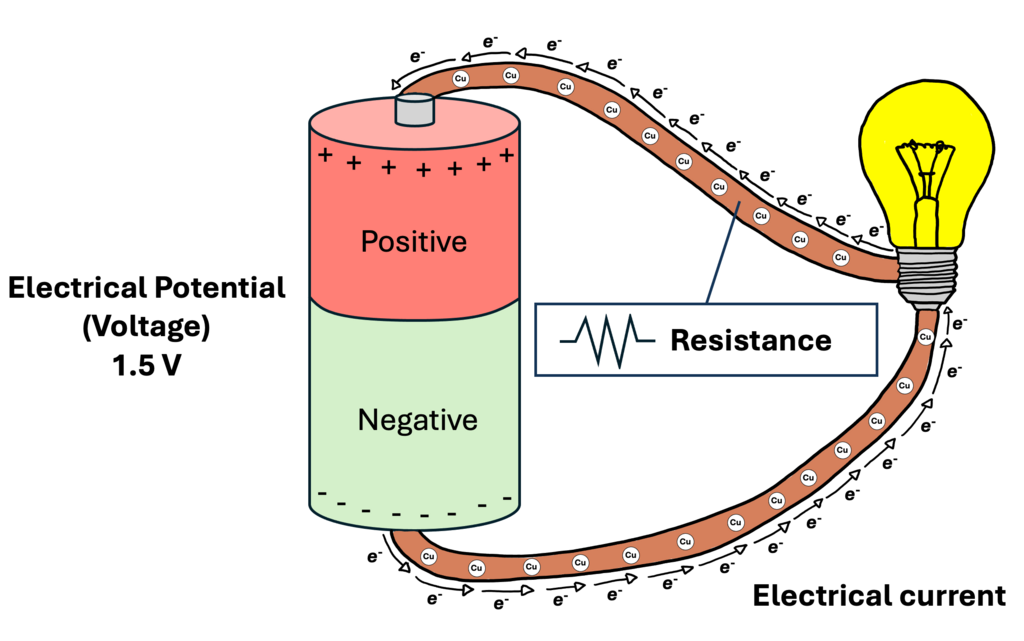
To understand how electricity works, we need to get familiar with four fundamental concepts: voltage, current, resistance, and power. Think of them as the key players in the world of circuits. Let's look at each one.
Voltage
noun
The pressure from an electrical circuit's power source that pushes charged electrons (current) through a conducting loop.
Voltage is like the electrical 'pressure' in a circuit. Imagine a water tank with a hose at the bottom. The higher the water level in the tank, the more pressure there is at the end of the hose. Voltage is similar; it's the potential difference that pushes electric charge around. It's measured in volts (V). To measure voltage, you use a voltmeter in parallel with the component you're measuring, meaning you connect it across two points in the circuit.
Current
noun
The rate at which electric charge flows past a point in a circuit.
If voltage is the pressure, then current is the actual flow of charge, like the flow rate of water through the hose. It's the movement of electrons through the wires. We measure current in amperes (A), often called 'amps' for short. To measure current, you place an ammeter in series, meaning you have to break the circuit and insert the meter so the current flows through it.
Resistance
noun
A measure of the opposition to current flow in an electrical circuit.
Resistance is exactly what it sounds like: it's the circuit's opposition to the flow of current. In our water analogy, resistance would be like a narrow section of the hose that restricts water flow. Every component in a circuit has some resistance. This property is measured in ohms (). Factors like the material of a wire, its length, and its thickness all affect its resistance.
Putting It All Together
Voltage, current, and resistance don't exist in isolation. They are linked by a fundamental principle called Ohm's Law. It states that the voltage across a conductor is directly proportional to the current flowing through it, provided the temperature and other physical conditions remain unchanged.
Ohm's Law gives us a simple way to calculate any one of the three quantities if we know the other two.
Where:
- is the voltage in volts
- is the current in amperes
- is the resistance in ohms
So, if you have a 12V battery connected to a component with 6 of resistance, you can calculate the current: .
The Power Equation
The last key quantity is power. Electrical power is the rate at which electrical energy is transferred by a circuit. It tells you how much work the electricity is doing per unit of time. The unit for power is the watt (W).
Power
noun
The rate at which work is done or energy is transferred in an electrical circuit.
Power is calculated by multiplying voltage by current. This relationship is crucial for understanding energy consumption and designing circuits that can handle the required load.
We can also combine this power formula with Ohm's Law to find power if we only know current and resistance, or voltage and resistance.
These four quantities—voltage, current, resistance, and power—are the foundation for everything else in electronics. Understanding how they relate to each other is the first step toward analyzing and building any electrical circuit.
In the analogy of water flowing through a hose, what does voltage represent?
How must an ammeter be connected to a circuit to correctly measure current?