Electric Motor Repair Fundamentals
Electric Motor Basics
From Electricity to Motion
At its heart, an electric motor does one simple thing: it turns electrical energy into mechanical energy. It takes the power from a battery or an outlet and converts it into physical movement, like spinning a fan, turning the wheels of a car, or making your phone vibrate.
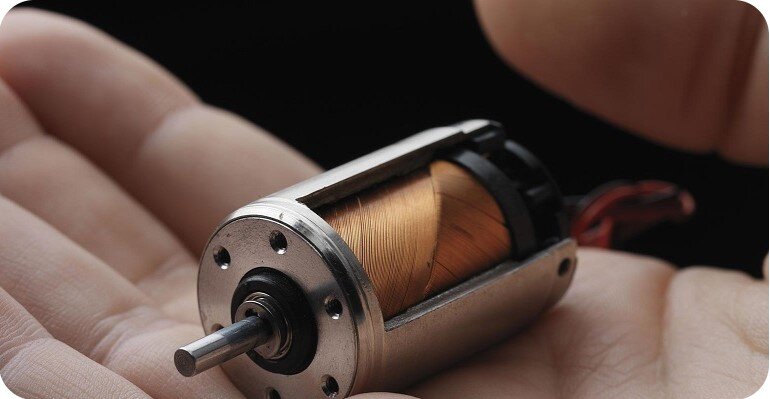
This magic trick relies on the relationship between electricity and magnetism. When an electric current flows through a wire, it creates a magnetic field around it. This is the core principle. An electric motor is essentially a device designed to harness this effect in a very clever way, using interacting magnetic fields to create continuous rotation.
The Main Players
Every electric motor has two essential parts: a stationary part and a rotating part. Think of it like a spinning top on a table. The table stays still while the top spins.
Stator
noun
The stationary part of an electric motor. Its job is to create a steady magnetic field.
The stator is the motor's outer casing and contains either permanent magnets or electromagnets (coils of wire that become magnetic when electricity passes through them). This creates a constant magnetic environment.
Rotor
noun
The rotating part of an electric motor. It sits inside the stator and is what actually spins to do work.
The rotor is the spinning core. It's also an electromagnet. By changing the magnetic field of the rotor, we can make it push against and pull toward the stator's magnetic field, causing it to turn.
Generating Torque
So, how do we get the rotor to spin continuously? The secret lies in cleverly manipulating its magnetic field.
The rotor often includes a component called the armature, which is essentially the electromagnet part of the rotor. It's a coil of wire wrapped around an iron core. When we send an electric current through this coil, the armature becomes a magnet.
The magnetic field of the stator pushes and pulls on the newly created magnetic field of the armature. This push-and-pull creates a rotational force called torque.
But there's a problem. Once the rotor's poles align with the stator's opposite poles (north to south), it would just stop. The attraction would hold it in place. To keep it spinning, we need to continuously switch the direction of the current in the armature. This flips the polarity of the armature's magnetic field, causing the stator to repel the part it was just attracting, keeping the rotation going.
This is the job of the commutator and brushes. The commutator is a metal ring split into segments, attached to the end of the armature coil. The brushes are stationary contacts that deliver electricity from the power source to the spinning commutator. As the rotor spins, the brushes make contact with different segments of the commutator, reversing the flow of current through the armature coil every half-rotation. This constant flipping of the magnetic field is what creates a smooth, continuous spin.
This whole process—powering an electromagnet to create a force that causes rotation, then using a commutator to keep it rotating—is the foundation of how most simple electric motors work. By converting electrical energy into the force of torque, they turn inanimate objects into powerful tools.
Ready to check your understanding of these core concepts?
What fundamental principle allows an electric motor to function?
The stator is the stationary part of the motor, while the rotor is the part that spins.
Understanding these fundamental parts and principles is the first step in being able to diagnose any issues a motor might have.