Elastic Moduli in Physics
Stress and Strain
What is Stress?
When you apply a force to an object—whether you push it, pull it, or twist it—the material doesn't just passively accept it. Internally, it pushes back. Imagine a rope in a game of tug-of-war. The rope is being pulled from both ends. Inside the rope, countless tiny fibers are resisting that pull. This internal resistance, spread out over the rope's cross-sectional area, is called stress. It's a measure of how much internal force a material's particles exert on each other per unit of area.
stress
noun
The internal force per unit area that particles of a body exert on each other in response to external forces.
We calculate stress (\\[sigma\\], the Greek letter sigma) by dividing the applied force () by the cross-sectional area () over which the force is applied.
The units for stress are typically pascals (Pa), which are newtons per square meter (N/m²), or pounds per square inch (psi) in the imperial system.
Types of Stress
Stress isn't just one thing; it comes in different flavors depending on how the force is applied. The three main types are tensile, compressive, and shear stress.
Tensile stress occurs when forces pull on an object, causing it to stretch or elongate. Think of stretching a rubber band.
Compressive stress happens when forces push on or squeeze an object, trying to shorten it. Imagine a column supporting the weight of a roof.
The third type, shear stress, acts parallel to a surface. It's a sliding or cutting force. If you push the top of a deck of cards, the cards slide past one another. That's a shear force at work. Shear stress is what allows scissors to cut paper—the two blades apply forces in opposite directions on the same plane.
Measuring Deformation: Strain
When an object is subjected to stress, it deforms. It changes shape or size. Strain is the measure of this deformation. It’s not just about how much it changes, but how much it changes relative to its original size. A 1-inch stretch is a big deal for a short rubber band but barely noticeable for a long bungee cord. Strain accounts for this by expressing the change in length as a fraction of the original length.
strain
noun
A measure of the deformation of a material, expressed as the ratio of the change in a dimension to the original dimension.
We calculate tensile or compressive strain (\\[epsilon\\], the Greek letter epsilon) by dividing the change in length () by the original length ().
Since strain is a ratio of length to length, it is a dimensionless quantity—it has no units. It's often expressed as a percentage or in terms of 'microstrain'.
Just as with stress, there are different types of strain. Tensile strain is the stretch from tensile stress, and compressive strain is the shortening from compressive stress. Shear strain (\\[gamma\\], gamma) is a bit different. It measures the change in the angle of a material's geometry. Imagine the square block from before deforming into a parallelogram. Shear strain measures the amount of that tilt.
The Stress-Strain Curve
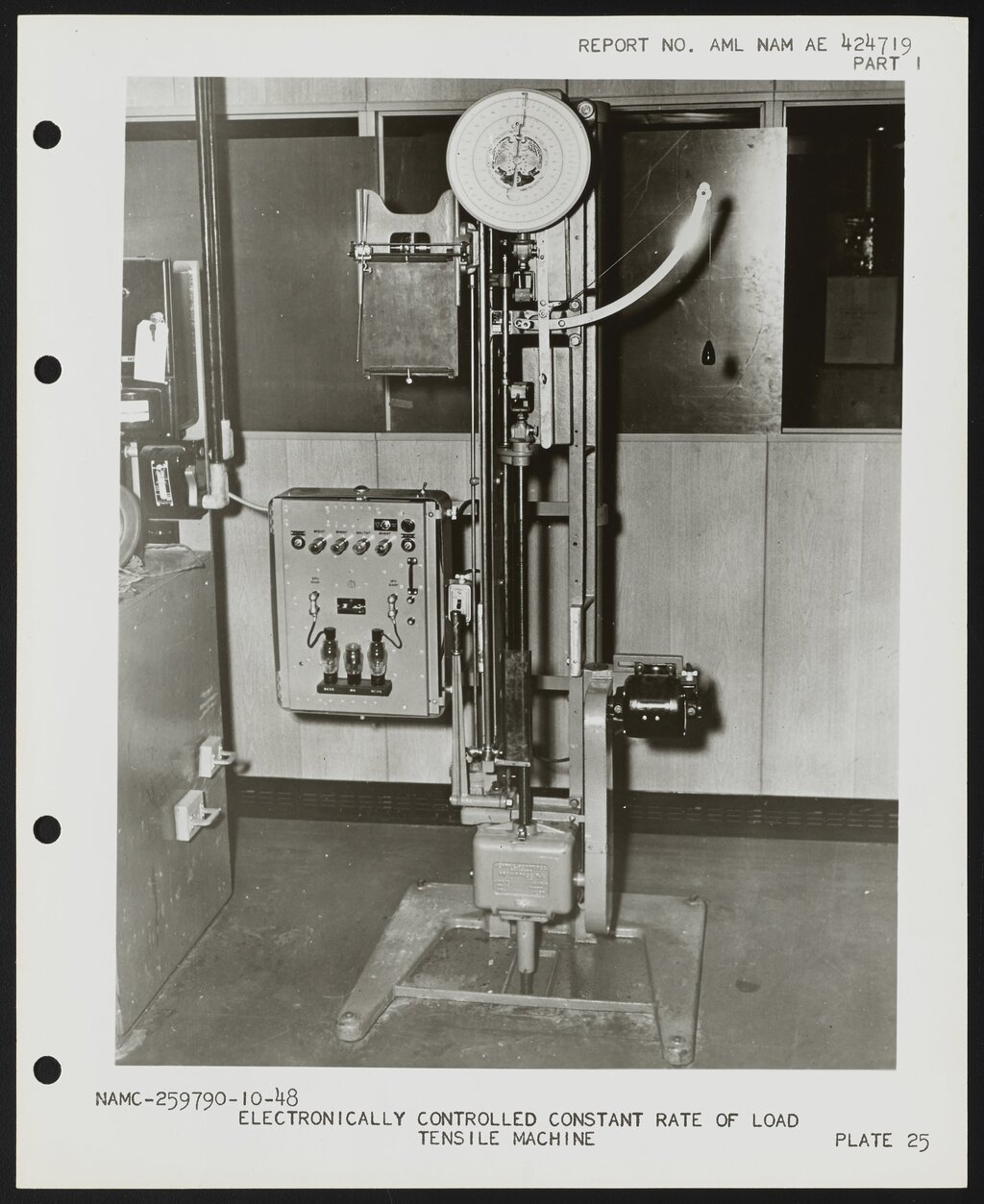
The relationship between stress and strain is fundamental to understanding a material's behavior. If you take a sample of a material, put it in a machine that pulls on it, and measure both the stress and the strain as you pull harder, you can plot the results on a graph. This graph is called a stress-strain curve.
The stress-strain curve is like a material's signature. It tells us how stiff a material is, how much it can stretch before it permanently deforms, and how much energy it can absorb before breaking. For many materials, the curve starts as a straight line, indicating that stress is directly proportional to strain. As the stress increases, the material's response changes, and the curve begins to bend.
By analyzing this curve, engineers can determine whether a material is suitable for a specific application, like building a bridge, designing an airplane wing, or making a rubber sole for a shoe.
In the context of materials science, what is the best definition of stress?
When a pair of scissors cuts through a piece of paper, what is the primary type of stress the paper experiences?
Understanding stress and strain is the first step in mechanics of materials. These two concepts are linked, describing the cause (stress) and effect (strain) of applying forces to an object.