Einstein's Universe
Einstein's Early Life
A Curious Mind
Albert Einstein was born in Ulm, Germany, in 1879 to a secular Jewish family. His father, Hermann, was an engineer and salesman, and his mother, Pauline, was a homemaker. The family moved to Munich a year after his birth, where a quiet, thoughtful boy began to notice the world around him.
Two events from his childhood stood out for the rest of his life. The first was at age five, when his father showed him a simple pocket compass. Young Albert was mesmerized. What invisible force could possibly make the needle point so consistently in one direction? This question sparked a lifelong fascination with unseen forces.
The second moment came when he was twelve. He discovered a book on Euclidean geometry, which he later called his "sacred little geometry book." The clear, certain proofs were a revelation. It showed him that the human mind could penetrate the secrets of the universe through pure thought, an idea that would become a cornerstone of his career.
The Rebel Student
Einstein's formal schooling was less inspiring. He disliked the strict, rote-learning style of his school in Munich, the Luitpold Gymnasium. He felt it stifled creativity and critical thinking. When his family moved to Italy for business reasons, Einstein was left behind to finish his studies, but he soon left to join them.
Determined to pursue science, he applied to the prestigious Swiss Federal Polytechnic School in Zurich. He was only sixteen, two years younger than the other applicants. While he excelled in the math and physics sections of the entrance exam, he failed the other subjects. On the advice of the school's principal, he enrolled in a cantonal school in Aarau, Switzerland, to complete his secondary education.
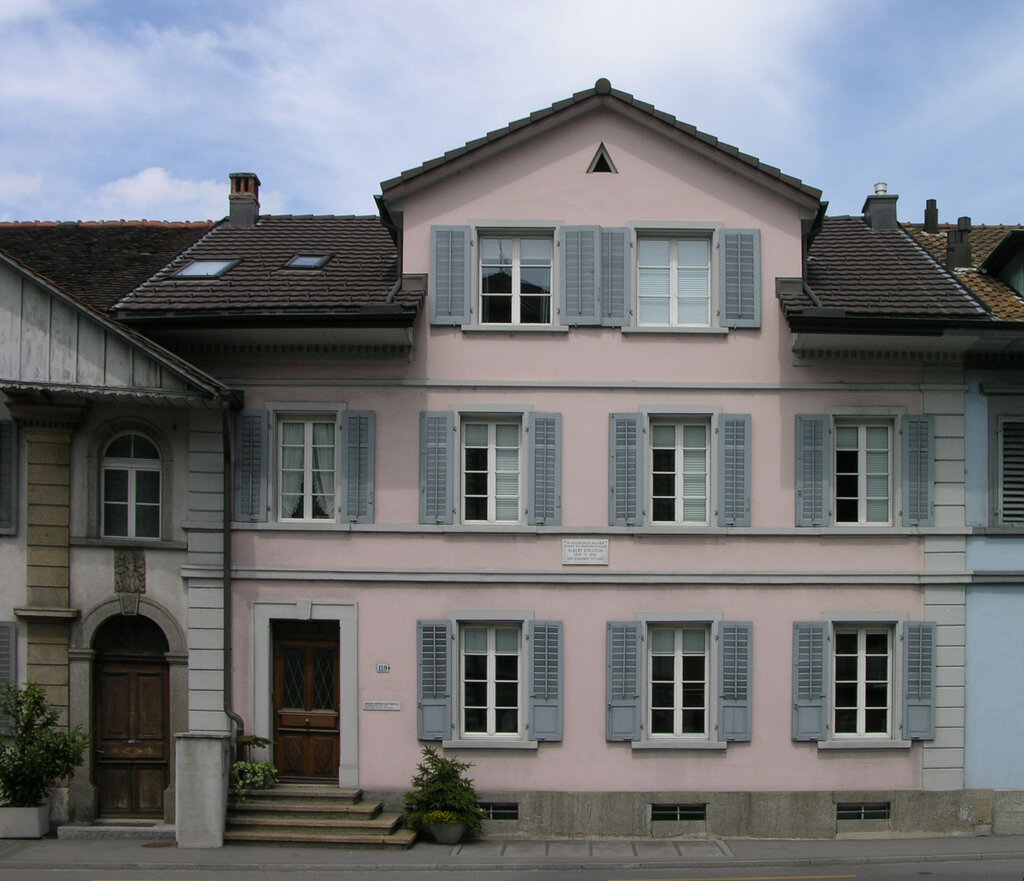
After a year in Aarau, he was accepted into the Polytechnic. In Zurich, he enjoyed the freedom to study the topics that interested him, often skipping lectures to read the works of master physicists on his own. It was here that he met Mileva Marić, a fellow physics student who would become his first wife.
From Graduate to Patent Clerk
Einstein graduated in 1900 with a teaching diploma. But his rebellious nature and tendency to challenge his professors had earned him a mixed reputation. He struggled to find an academic position, sending out applications with no success. For two years, he scraped by with tutoring and substitute teaching jobs.
Finally, in 1902, the father of his close friend Marcel Grossmann helped him secure a position at the Swiss Patent Office in Bern. He was hired as a technical expert, third class. His job was to examine patent applications for new inventions.
This seemingly mundane job was a blessing in disguise. The work required him to analyze the core principles of new devices, cutting through complex language to find the essential idea. This daily practice of dissecting concepts and conducting "thought experiments" sharpened the skills he would soon use to revolutionize physics.
From this modest post, working by day and pondering the universe by night, Einstein laid the groundwork for his most famous discoveries.
In which city was Albert Einstein born?
What subject did Einstein discover in a book that he called his 'sacred little geometry book'?
These formative years reveal a young man driven not by academic ambition, but by a deep, unwavering curiosity about the fundamental workings of the world.