Einstein's Relativity Explained
Introduction to Relativity
A Crack in the Old Physics
For over two centuries, Isaac Newton's laws of motion and gravity were the bedrock of physics. They could predict the orbit of a planet, the path of a cannonball, and the fall of an apple with incredible accuracy. This framework, known as classical mechanics, seemed to describe the entire universe perfectly.
But by the late 19th century, a few stubborn problems began to appear. The most troubling one involved light. According to classical ideas, speeds should add up. If you're on a train moving at 50 mph and you throw a ball forward at 20 mph, someone on the ground sees the ball moving at 70 mph. Simple enough.
Light, however, refused to play by these rules. Experiments showed that the speed of light was always the same, no matter how fast you were moving toward or away from the light source. It was as if the person on the train shined a flashlight, and both they and the person on the ground measured the light's speed as exactly the same. This made no sense in Newton's world.
Classical physics worked beautifully for everyday speeds, but it broke down when dealing with the extreme speed of light.
A young patent clerk named Albert Einstein took this puzzle seriously. He realized that the problem wasn't with the experiments; it was with the fundamental ideas of space and time themselves.
The Universal Speed Limit
Einstein started with a bold assumption. What if the constant speed of light wasn't a problem to be solved, but a fundamental law of the universe? This became the cornerstone of his theory of special relativity.
Special Relativity
noun
A theory describing how space and time are relative for observers moving at constant speeds.
The theory rests on two simple-sounding ideas:
- The laws of physics are the same for everyone in uniform motion.
- The speed of light in a vacuum is the same for all observers, regardless of their motion or the light source's motion.
The second point is the strange one. It means if a spaceship is speeding toward you at 99% the speed of light and turns on its headlights, you'll measure the light from those headlights approaching you at exactly the speed of light, not 199% of it. This has profound consequences. If speed (distance divided by time) is constant for everyone, then distance and time themselves must be relative. They must stretch and shrink depending on your motion.
Einstein's special theory of relativity revolutionized physics by teaching us that space and time are not separate entities, but join as ``spacetime''.
Gravity as Geometry
Special relativity was a breakthrough, but it only dealt with constant-speed motion. It didn't include acceleration or gravity. For the next ten years, Einstein worked on a bigger idea: the theory of general relativity.
He began with a thought experiment. Imagine you're in an elevator in deep space, far from any gravitational pull. If the elevator starts accelerating upward, you'll feel pressed to the floor, just like you do on Earth. If you drop a ball, it will fall to the floor. In fact, there's no experiment you could do inside the windowless elevator to tell the difference between being accelerated in space and sitting still in a gravitational field.
This insight is called the equivalence principle: the effects of gravity are indistinguishable from the effects of acceleration.
This led Einstein to a revolutionary conclusion. Gravity isn't a force pulling objects across space, as Newton thought. Instead, gravity is a feature of spacetime itself. Massive objects like planets and stars warp or curve the fabric of spacetime around them.
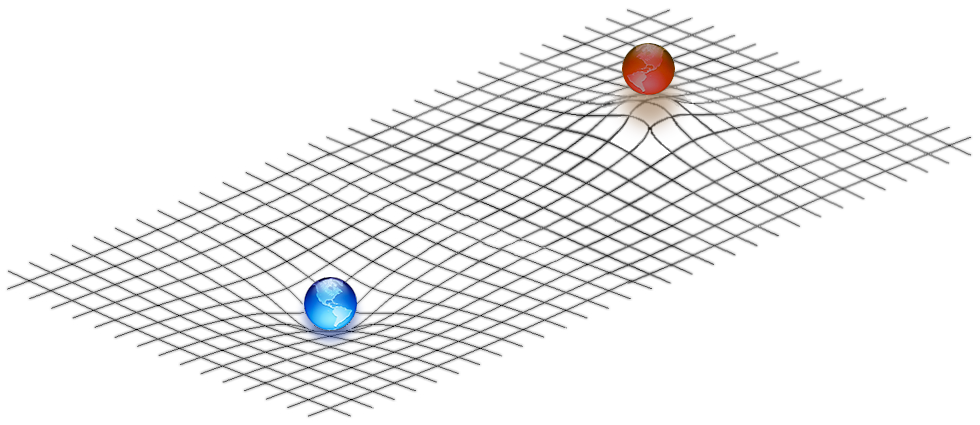
Objects moving through this curved spacetime simply follow the straightest possible path, which appears to us as a curved orbit. Think of a bowling ball placed on a stretched rubber sheet. It creates a dip. If you roll a marble nearby, it will circle the bowling ball, not because of a mysterious force, but because it's following the curve in the sheet.
This new understanding of gravity as the geometry of spacetime replaced Newton's laws and gave us a framework for understanding the entire cosmos, from black holes to the expansion of the universe.
What major observational puzzle in the late 19th century could not be explained by Isaac Newton's classical mechanics?
According to special relativity, what must happen if the speed of light is constant for all observers?