Einstein's Relativity Explained
Introduction to Special Relativity
A New Kind of Physics
For a long time, Isaac Newton's laws of motion seemed to explain everything. From a falling apple to the orbit of the moon, his equations worked perfectly. They described a universe that was orderly and predictable, like a giant clockwork mechanism. Space was a fixed stage, and time ticked by at the same rate for everyone, everywhere.
But by the end of the 19th century, a few cracks started to appear in this perfect picture. Physicists were wrestling with some strange properties of light and electricity. Their experiments were showing results that just didn't fit with Newton's world. Something was missing. In 1905, a young patent clerk named Albert Einstein proposed a revolutionary new framework to make sense of it all. He called it Special Relativity.
One of the cornerstone principles of the Theory of Special Relativity is the constancy of the speed of light.
Two Simple Postulates
Einstein built his entire theory on two simple, yet powerful, ideas called postulates.
First is the Principle of Relativity. This states that the laws of physics are the same for all observers who are moving at a constant velocity. Imagine you're on a perfectly smooth train with no windows. If you toss a coin, it will fly up and fall back into your hand exactly as it would if the train were stopped at the station. Without looking outside, there's no experiment you can do to prove you're moving. Your frame of reference is just as valid as that of someone standing on the ground.
The second postulate is the radical one: The speed of light in a vacuum is constant for all observers. Its value is the same for everyone, regardless of their own motion or the motion of the light source.
This doesn't sound too strange at first, but think about it. If you're driving 50 mph and you throw a baseball forward at 20 mph, someone on the sidewalk sees the ball moving at 70 mph (50 + 20). That makes sense. But if you turn on your headlights, you don't measure the light speeding away at c while the person on the sidewalk measures it at c + 50 mph. Both of you measure the exact same speed: c, approximately 299,792,458 meters per second. This breaks our everyday intuition about adding speeds together.
Weird and Wonderful Effects
If we accept these two postulates as true, the universe becomes a much stranger place than Newton imagined. To make the speed of light constant for everyone, something else has to give. That something is space and time itself.
Time Dilation One major consequence is that time can pass at different rates for different observers. If someone is moving at a high speed relative to you, you will see their clock ticking more slowly than your own. This isn't a trick of perception; time itself is slowing down for them from your perspective. This effect is known as time dilation, or the slowing of moving clocks. For the person on the speeding rocket, time feels perfectly normal. But when they return, they will have aged less than the people who stayed behind.
Length Contraction Space is also relative. An object moving at a high speed will appear shorter in its direction of motion than it does when it's at rest. If a fast-moving spaceship flies past you, it will look squished from your point of view. For the people on board, everything in the ship has its normal length. This effect, called length contraction, only happens along the direction the object is traveling.
These effects are only noticeable at speeds approaching the speed of light, which is why we don't see them in our daily lives. But they have been measured and confirmed countless times in particle accelerators and with atomic clocks.
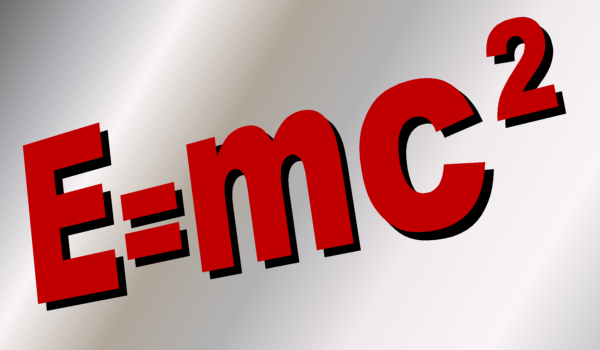
Perhaps the most famous outcome of special relativity is the relationship between mass and energy. Einstein showed that mass is a form of concentrated energy. They are two sides of the same coin and can be converted into one another. This relationship is captured in the most famous equation in physics:
Here, E is energy, m is mass, and c is the speed of light. Because c is such a large number, this equation tells us that a tiny amount of mass can be converted into an enormous amount of energy. This is the principle behind nuclear power and nuclear weapons.
Special relativity forced a complete rethinking of space and time. They are not absolute and separate, but are interwoven into a single continuum called spacetime. And what we experience depends entirely on our motion through it.
Let's check your understanding of these new ideas.
Which of the following is one of the two main postulates of Einstein's Special Theory of Relativity?
Imagine a spaceship that is 100 meters long when at rest. If it flies past you at 90% the speed of light, how would you perceive its length?
These concepts laid the groundwork for Einstein's later theory, General Relativity, which would go on to describe gravity in a whole new way.