Effective Learning Strategies
Topic Deconstruction
Map Your Path to Mastery
Most people try to learn everything at once, but the secret to true expertise is knowing exactly where to start. By performing a task analysis, you will stop guessing what to study and start identifying the high-leverage sub-skills that accelerate your progress. In this chapter, we will build a mental map of your domain, helping you distinguish foundational concepts from contextual details so you can focus your effort where it truly matters. By the end, you will have a clear, prioritized blueprint for efficient learning.
The Art of Deconstruction
To master any complex skill, you must first stop viewing it as a single, overwhelming monolith. Instead, think of it as a mechanical watch. On the surface, you see hands moving in a smooth circle. But beneath that face lies a delicate arrangement of gears, springs, and levers. If you want to fix the watch—or build one—you cannot simply interact with 'the watch' as a whole. You have to take it apart and understand each component. This process of is the first and most critical step of task analysis.
Divide complex skills into smaller, easier-to-manage parts.
When we look at a macro-skill like coding, we often get lost in the abstraction. But coding is just a label for a collection of distinct sub-skills. There is the syntax of the language, the logic of algorithm design, the investigative work of debugging, and the clarity required for documentation. If you try to learn 'coding' without seeing these parts, you will likely hit a wall because you are trying to swallow the watch whole rather than examining the gears.
The Three Categories of Sub-Skills
Not all gears in the watch are created equal. To organize your learning, you should categorize your sub-skills into three distinct buckets: foundational, support, and advanced contextual. This structure helps you understand the hierarchy of what you are learning and prevents you from jumping into the deep end before you can swim.
| Category | Example: Photography | Purpose |
|---|---|---|
| Foundational | Exposure Triangle (ISO, Shutter, Aperture) | The essential physics required to create any image. |
| Support | Composition and Lighting Techniques | Skills that make the foundational output higher quality. |
| Advanced Contextual | High-speed Sports or Macro Insect Photography | Niche applications that require specific, narrow expertise. |
Foundational sub-skills are your 'must-haves.' Support sub-skills make you better and more efficient. Advanced contextual sub-skills are the 'bells and whistles' used in specific, high-level scenarios. By grouping skills this way, you can see that mastering the exposure triangle is far more important for a beginner than learning how to photograph a bee's wing at 5x magnification.
The Power of Dependencies
Crucially, deconstruction reveals the hidden within a skill. A dependency exists when one skill is a prerequisite for another. You cannot effectively learn to debug a complex web application if you don't understand the basic syntax of the language it's written in. This is not just about logic; it's about cognitive load. If you are struggling to remember how to write a 'for loop,' your brain has no room left to solve the high-level logic problem.
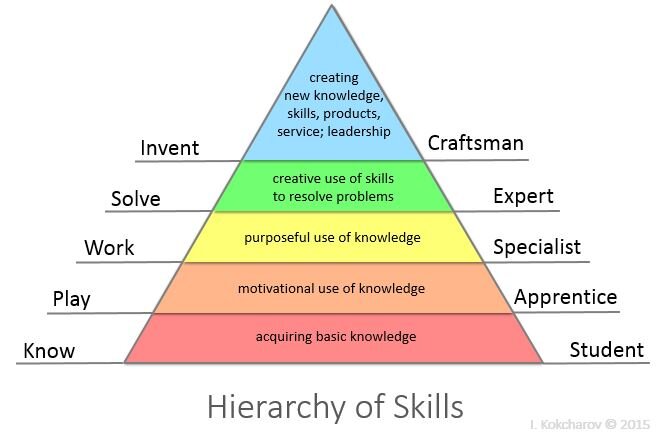
Understanding these dependencies dictates your order of acquisition. You don't learn skills in a random sequence; you build them like a tower. If you pull a block from the bottom before it's ready, the whole structure becomes unstable. This is why many people feel like they've hit a 'plateau'—it's often just a missing foundational piece that's finally caught up with them.
Now, take a moment to think about the domain you want to master. If you had to break it into those three buckets—foundation, support, and advanced context—what would they be? Identifying these moving parts is the only way to ensure you aren't just spinning your gears. Once you see the components, you can start deciding which ones to pick up first.