EEG Waveforms and Mnemonics
Beta Wave Mastery
Beta Waves: The Brain’s High Gear
When you're focused on a task, solving a problem, or even just having an active conversation, your brain is firing on all cylinders. This heightened state of alertness is dominated by Beta waves. These are fast brain waves, with a frequency ranging from 13 to 30 Hz. Think of them as your brain's performance mode.
A simple way to remember their function is the mnemonic 'Busy Beta'. When your mind is busy with active concentration, planning, or critical thinking, Beta waves are at the forefront. This state of high neural activity demands a significant amount of energy. It's metabolically similar to high-energy cellular processes like beta-oxidation, where fatty acids are broken down to produce large amounts of ATP. In essence, Beta activity reflects a brain that is fully fuelled and engaged.
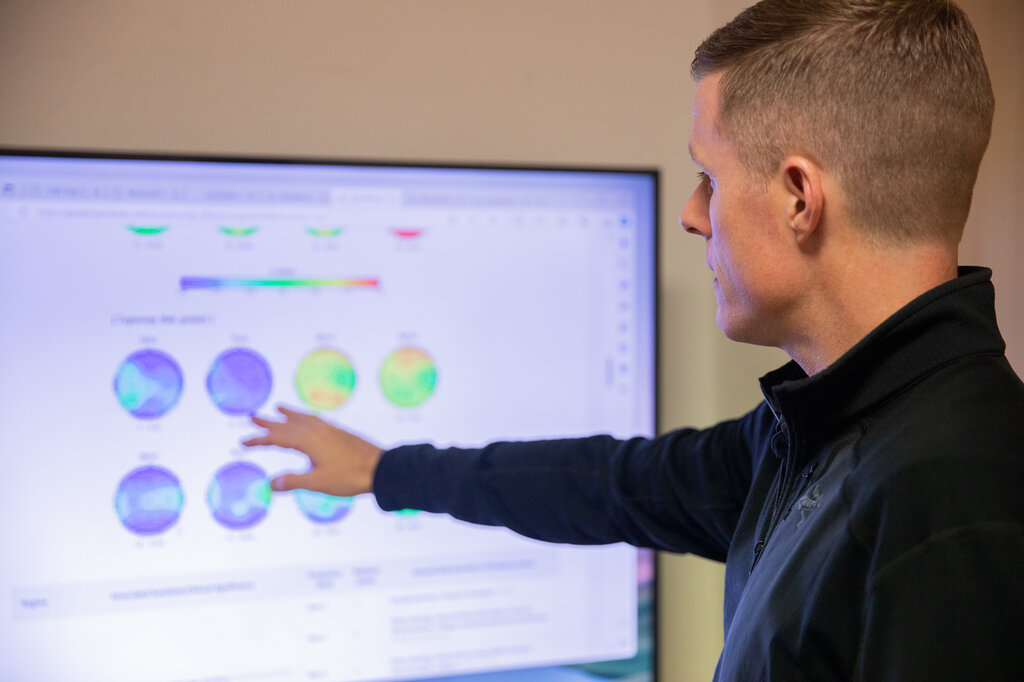
In a clinical setting, seeing dominant Beta waves on an EEG is normal for a person who is awake, alert, and has their eyes open. It's the signature of a conscious and actively processing mind. When a patient closes their eyes to relax, these faster waves typically give way to the slower Alpha rhythm you've already learned about.
Interpreting the Signals
While Beta waves are a sign of normal wakefulness, their characteristics can also be a powerful diagnostic clue. Certain medications, for instance, can dramatically alter the EEG. A classic example is the effect of like diazepam or lorazepam. Patients taking these drugs often show a pronounced increase in Beta wave activity, sometimes referred to as 'beta buzz'. This is a key finding to note, as it confirms the drug's effect on the brain but can also mask other underlying patterns.
One of the practical challenges in reading an EEG is distinguishing true Beta waves from artifacts. Muscle activity, particularly from the scalp and facial muscles, produces high-frequency electrical noise that can look very similar to Beta waves. This is known as electromyographic (EMG) artifact.
True Beta waves are typically widespread or localized to specific brain regions, have a sinusoidal (wavy) shape, and are modulated by cognitive tasks. Muscle artifacts, on the other hand, are often sharper, more erratic, and may appear as dense spikes, usually most prominent over the temporal electrodes near the jaw and facial muscles.
Careful observation of the waveform's morphology, location, and persistence helps clinicians make the correct distinction, ensuring an accurate interpretation of the brain's activity.
What is the typical frequency range of Beta brain waves?
A patient's EEG shows a prominent increase in Beta wave activity, sometimes referred to as 'beta buzz'. This finding is a classic effect of which type of medication?