EEG Research for High Schoolers
Introduction to EEG
Reading Brainwaves
Electroencephalography, or EEG, is a way to listen in on the brain's electrical activity. Think of it like putting a sensitive microphone on the outside of a stadium. You can't hear individual conversations, but you can hear the roar of the crowd. EEG doesn't read thoughts, but it measures the combined electrical pulses of millions of neurons firing together. This collective hum of activity is called a brainwave.
Electroencephalography
noun
A non-invasive method to record the electrical activity of the brain along the scalp.
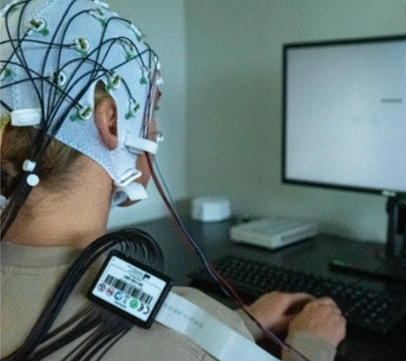
This technique uses small metal discs called electrodes, which are placed on the scalp. These electrodes detect the tiny electrical voltages that result from brain cell activity. The signals are then amplified and recorded, creating a graph of brainwaves. It's a safe and painless way to get a real-time glimpse of what's happening inside the brain.
A Brief History
The story of EEG begins with a German psychiatrist named Hans Berger. In the 1920s, he was convinced that he could measure the brain's electrical currents from outside the head. Many of his colleagues were skeptical. Using a simple radio galvanometer, he placed silver foil electrodes on a patient's scalp and, in 1924, recorded the first human electroencephalogram.
Berger was the first to describe the different brainwave patterns, most notably the rhythmic wave he named the alpha wave, which appeared when a person was relaxed with their eyes closed. His work opened a new window into the brain, proving that it was constantly active, even during rest.
Berger's discovery showed that the brain produces a continuous electrical buzz, a fundamental insight that launched the entire field of neurophysiology.
From Berger's early, sensitive equipment in a shielded room, EEG technology has become remarkably advanced and portable. Today, we have high-density caps with over a hundred electrodes and even wearable headbands that can be used for research outside of a traditional lab.
Listening to Neurons
So how does it actually work? Your brain is made up of billions of nerve cells called neurons. Neurons communicate with each other using tiny electrical impulses. A single neuron's signal is far too small to be detected from outside the skull.
However, when large groups of neurons, especially in the brain's outer layer called the cortex, fire in synchrony, their combined electrical energy creates a small electrical field. This field is strong enough to spread through the brain tissue, skull, and scalp, where it can be picked up by the EEG electrodes.
Different brain states produce different brainwave patterns. For example, the slow, high-amplitude waves seen during deep sleep are very different from the fast, low-amplitude waves of an alert and focused brain. EEG allows researchers to see these changes and link them to specific mental states or tasks.
What's It Used For?
EEG has a wide range of applications in both medicine and research. Clinically, it is a crucial tool for diagnosing and managing epilepsy, as it can detect the abnormal electrical patterns associated with seizures. It's also used to diagnose sleep disorders, evaluate brain injuries, and monitor brain function during surgery.
In research, EEG helps us understand how the brain processes information. Neuroscientists use it to study attention, perception, memory, and language. Because EEG provides millisecond-level precision, it is excellent for tracking the timing of brain processes. It can show exactly when the brain reacts to a stimulus, like a sound or an image.
This makes it a powerful tool for everything from developing better educational strategies to designing brain-computer interfaces that allow people to control devices with their minds.
Now that you have a basic understanding of what EEG is and how it works, let's test your knowledge.
What does an Electroencephalogram (EEG) primarily measure?
Who is credited with recording the first human EEG and discovering alpha waves?
This overview covers the fundamentals of EEG. From its historical roots with Hans Berger to its modern applications, EEG remains a vital window into the brain's electrical symphony.