Ecosystem Dynamics and Interactions
Energy Flow Dynamics
The Ecosystem's Energy Budget
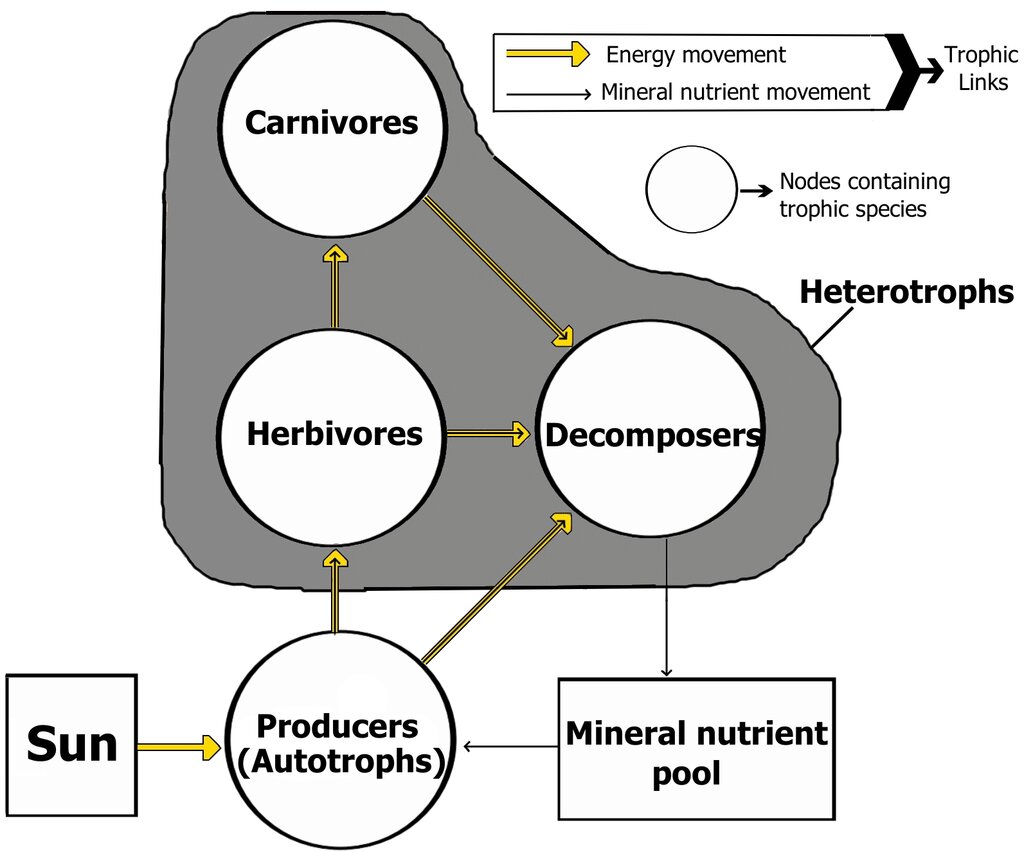
Every ecosystem, from a coral reef to a tundra, runs on an energy budget. The ultimate source of this energy is the sun, captured by producers like plants and algae through photosynthesis. But how much of that solar energy actually becomes usable for the rest of the food web? The total rate at which producers create organic matter is called (GPP). Think of it as the ecosystem's total income.
However, just like a person's gross income isn't what they take home, GPP isn't the total energy available to consumers. Producers must use a significant portion of this energy for their own metabolic processes, such as respiration. They need to breathe, grow, and maintain their cells. The energy used for this is a necessary expense.
What remains after these metabolic costs are paid is the Net Primary Productivity (NPP). This is the energy stored as biomass (new leaves, stems, roots) and is the actual amount of energy available to herbivores, the primary consumers.
The Ten Percent Rule
When a herbivore eats a plant, it doesn't get 100% of the plant's stored energy. The transfer of energy between trophic levels is surprisingly inefficient. This inefficiency is a direct consequence of the , which states that in any energy conversion, some energy is lost as heat.
Trophic Level
noun
The position an organism occupies in a food web. The chain starts at trophic level 1 with primary producers (like plants), moves to level 2 with herbivores, level 3 with carnivores, and so on.
As a rule of thumb, only about 10% of the energy from one trophic level is incorporated into the biomass of the next. This is known as the "Ten Percent Rule." The other 90% is used for the organism's own metabolic processes (like moving, breathing, and keeping warm) or is lost as heat. Not all parts of an organism are eaten or digestible, which also contributes to the loss.
As energy is transferred as food, most part is lost as heat at each stage (10% LAW)
This drastic reduction at each step explains why food chains are rarely longer than four or five levels. There simply isn't enough energy left at the top to support another layer of predators.
Pyramids of Power
The progressive loss of energy at each trophic level can be visualized as an . Whether you measure energy, biomass, or the number of individuals, the structure typically narrows towards the top. It takes a huge base of producers to support a small number of top predators.
Energy budgets vary dramatically between different biomes. Terrestrial ecosystems often have a larger biomass of producers compared to consumers. In contrast, many aquatic ecosystems have a smaller producer biomass (phytoplankton) that is consumed rapidly by a larger biomass of primary consumers (zooplankton). This is possible because of the incredibly high productivity and turnover rate of phytoplankton.
| Ecosystem Type | Average NPP (g C/m²/year) | Key Limiting Factors |
|---|---|---|
| Tropical Rainforest | 1000 - 3500 | Light, Nutrients |
| Temperate Forest | 600 - 2500 | Temperature, Sunlight |
| Desert | 10 - 250 | Water |
| Open Ocean | 2 - 400 | Nutrients (Nitrogen, Phosphorus, Iron) |
| Estuaries/Reefs | 1500 - 3700 | Water clarity, Nutrients |
Understanding these energy dynamics is crucial. It dictates the structure of communities, the length of food webs, and the total amount of life an area can sustain. Every organism's life is shaped by this relentless, inefficient, and one-way flow of energy.
Let's check your understanding of how energy moves through ecosystems.
What is the key difference between Gross Primary Productivity (GPP) and Net Primary Productivity (NPP)?
The significant loss of energy at each step in a food chain is a direct result of the Second Law of Thermodynamics.
This fundamental flow of energy, governed by the laws of physics, is the engine that drives all ecological interactions.