Economics Fundamentals
Introduction to Economics
What Is Economics Anyway?
At its heart, economics is the study of how people make decisions when they can't have everything they want. This core problem is called scarcity. We have unlimited wants but limited resources. You experience scarcity when you have to choose between buying a new video game or saving that money for a concert ticket. You can't do both. A whole country experiences it when it has to decide whether to spend tax money on building new schools or upgrading its military.
Economics is simply the study of choices in a world of scarcity.
To understand these choices, economists use models. One of the most powerful and fundamental models is supply and demand. It's the engine that drives market economies, helping to determine the price of everything from a cup of coffee to a car.
The Two Sides of a Market
Every market has two sides: buyers and sellers. The behavior of buyers is captured by the concept of demand, while the behavior of sellers is captured by supply.
Supply and demand is perhaps one of the most fundamental concepts of economics and it is the backbone of a market economy.
Let's start with demand. The law of demand is intuitive: when the price of a good goes up, people buy less of it. When the price goes down, they buy more. If your favorite pizza place raises its price for a slice to $10, you'll probably go less often. If they drop it to $1, you might go every day. This relationship between price and the quantity people are willing and able to buy is shown by a demand curve.
Now for the other side: supply. The law of supply works in the opposite direction. When the price of a good goes up, sellers are willing to produce and sell more of it. If you're a baker and the price people are willing to pay for a loaf of bread doubles, you'll work overtime to bake more bread because it's more profitable. This creates an upward-sloping supply curve.
Finding the Balance
So, buyers want low prices and sellers want high prices. How does a market decide on a price? This happens where the supply and demand curves cross. This intersection is called the market equilibrium.
equilibrium
noun
A state in which opposing forces or influences are balanced. In economics, it's where the quantity demanded equals the quantity supplied.
At the equilibrium point, we find the equilibrium price () and equilibrium quantity (). At this price, the number of pizzas bakers want to sell is exactly the number of pizzas customers want to buy. Everyone who wants to buy a pizza at that price can, and every baker who wants to sell a pizza at that price can. The market is "cleared."
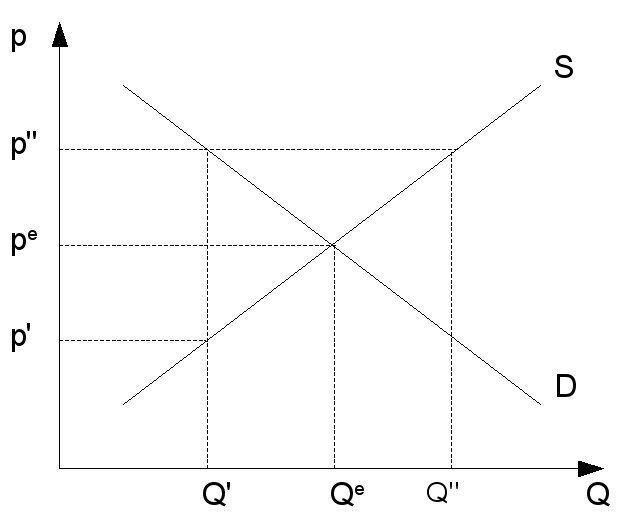
What if the price isn't at equilibrium? If the price is too high, sellers will bring a lot of pizzas to the market, but not many people will buy them. This creates a surplus, or excess supply. To get rid of the unsold pizzas, sellers will have to lower their prices, moving the market back toward equilibrium.
If the price is too low, everyone will want to buy a pizza, but bakers won't find it profitable to make very many. This leads to a shortage, or excess demand. With too many buyers chasing too few pizzas, sellers can raise their prices. This again pushes the market back toward equilibrium.
Prices are the signals that guide economic decisions. They act like a traffic cop, directing resources to where they are most valued.
This mechanism is how market economies answer the fundamental questions of what to produce, how to produce it, and for whom to produce it. No single person is in charge; the interactions of millions of buyers and sellers, all making their own choices, set the prices that allocate our scarce resources.
The fundamental economic problem that arises because people have unlimited wants but limited resources is known as:
According to the law of supply, if the price of coffee beans increases significantly, what are coffee growers most likely to do?
This powerful model of supply and demand is the foundation for understanding almost all economic activity, from your personal finances to global trade.