Echoes of Empire: The History of Russian in Ukraine
Imperial Integration Policies
A Shift in Allegiance, A Shift in Language
The year 1654 marked a pivotal moment. The Treaty of Pereyaslav brought the Cossack Hetmanate, a semi-autonomous Ukrainian state, under the protection of the Tsar of Muscovy. While intended as a military alliance, this agreement began a slow but steady integration of Ukrainian lands into what would become the Russian Empire. This political shift also triggered a linguistic one. For decades, the official language of the Hetmanate's administration and legal system was a written standard known as prosta mova, or "simple speech." It was a blend of Church Slavonic, Old Ukrainian, Polish, and Latin. But as ties with Moscow deepened, Russian began to seep into official correspondence, first as a language of diplomacy, then as something more.
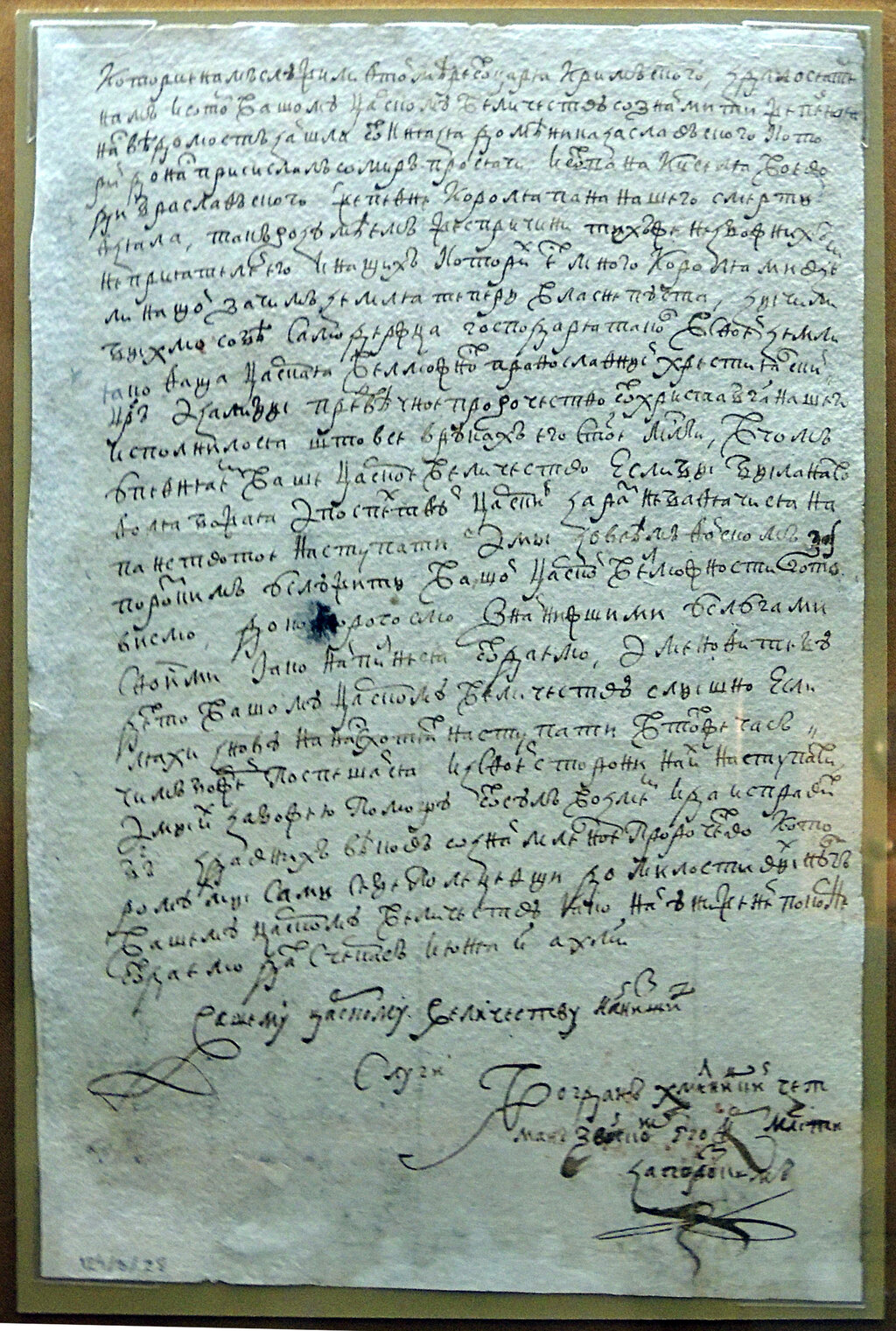
The initial changes were gradual. The Hetmanate's chancery officials began adopting Russian terms and grammatical structures to align with the administrative practices of Moscow. This wasn't a top-down decree at first, but a pragmatic adaptation. Communication with the imperial center was crucial, and using its language smoothed the way for petitions, reports, and negotiations. The distinct prosta mova began to lose its unique standing as the language of power.
The Tsar's Decree
The turn of the 18th century brought a more forceful approach under Peter the Great and his drive to modernize and centralize his empire. He saw linguistic and religious uniformity as essential tools for state-building. His policies took direct aim at the sources of Ukrainian cultural production. In 1720, he issued a decree severely restricting the printing of books in the Ukrainian variant of Church Slavonic. All religious texts now had to conform to the Russian synodal standard. This effectively choked off the development of a distinct Ukrainian literary and religious language, forcing printers in Kyiv and Chernihiv to adopt the Moscow-approved version. The goal was to create a single, unified Orthodox cultural space under Russian authority.
Peter's decree stated that religious books should be printed "so that they may be in complete agreement with the Great Russian ones... so that there should be no separate dialect in them."
The Empress and the Academy
The process of integration accelerated under Catherine the Great. In a series of administrative reforms, she dismantled the remaining autonomy of the Cossack Hetmanate throughout the 1760s and 1780s, fully incorporating its territory into the Russian imperial system. Her policies extended deep into the cultural and educational spheres. A landmark moment came in 1784 when a decree mandated that Russian become the sole language of instruction at the Kyiv-Mohyla Academy, Ukraine's most prestigious center of learning. Previously, the academy had a multilingual environment, with Latin, Polish, and prosta mova all in use. This change was designed to mold a new generation of elites who were not only loyal subjects of the empire but also native speakers of its official language. An education in Russian became the passport to a career in the imperial bureaucracy, military, or clergy.
This created a clear linguistic divide. The nobility, clergy, and burgeoning urban intelligentsia increasingly adopted Russian as their primary language for public life, education, and social advancement. It became the language of high culture and opportunity. Meanwhile, the Ukrainian language, now stripped of its official and educational functions, was increasingly confined to the private sphere and the rural peasantry. It was spoken at home and in the villages but held little prestige in the halls of power. This set the stage for a deep, class-based linguistic split, where the language of the state and the city was Russian, while the language of the countryside remained Ukrainian.
Time to review what we've learned about this period of imperial integration.
What was the initial stated purpose of the 1654 Treaty of Pereyaslav?
What was prosta mova?
These policies laid the foundation for a long and complex relationship between the two languages, establishing a hierarchy that would persist for centuries.