Earth's Rotational Dynamics Unveiled
Earth Angular Momentum Budget
The Angular Momentum Budget
The Earth is not a simple rigid rotator. Its total angular momentum is a composite vector sum, partitioned among the solid Earth (crust and mantle), the fluid outer core, the oceans, and the atmosphere. For an isolated system, the total angular momentum, , is conserved. Since external torques from celestial bodies are negligible on short to medium timescales, any change in the angular momentum of one component must be balanced by an equal and opposite change in the others.
This principle of conservation dictates a continuous, dynamic exchange of momentum between Earth's different layers and fluids, driving observable variations in its rotation.
Inertia of a Deformable Body
To properly describe the rotation of a non-rigid body like Earth, we must use the rotational tensor of inertia, . Unlike the scalar moment of inertia used for simple objects, this tensor accounts for the complex, three-dimensional distribution of mass. Any redistribution of mass within the Earth system, from melting ice sheets to mantle convection, alters the components of this tensor.
The total angular momentum vector is the product of the inertia tensor and the angular velocity vector, : . Crucially, because is a tensor, and are not necessarily collinear. Changes in mass distribution (altering ) or angular momentum transfer (altering ) will thus induce changes in the Earth's rotational velocity and the orientation of its spin axis.
Momentum Exchange Mechanisms
The conservation of total angular momentum, , implies that the sum of the time derivatives of each component's momentum is zero. The exchange between these components occurs via torques exerted at their interfaces.
The most significant and well-observed exchanges on daily to seasonal timescales occur between the solid Earth and the geophysical fluids: the atmosphere and oceans.
The atmosphere transfers angular momentum to the solid Earth primarily through two mechanisms. First is the pressure torque, often called mountain torque, which arises from differential atmospheric pressure on the windward and leeward sides of mountain ranges. Second is the frictional torque, resulting from wind stress acting upon the Earth's surface. Zonal winds are the primary driver; westerly winds transfer angular momentum to the solid Earth, increasing its rotation speed (shortening the day), while easterly winds have the opposite effect.
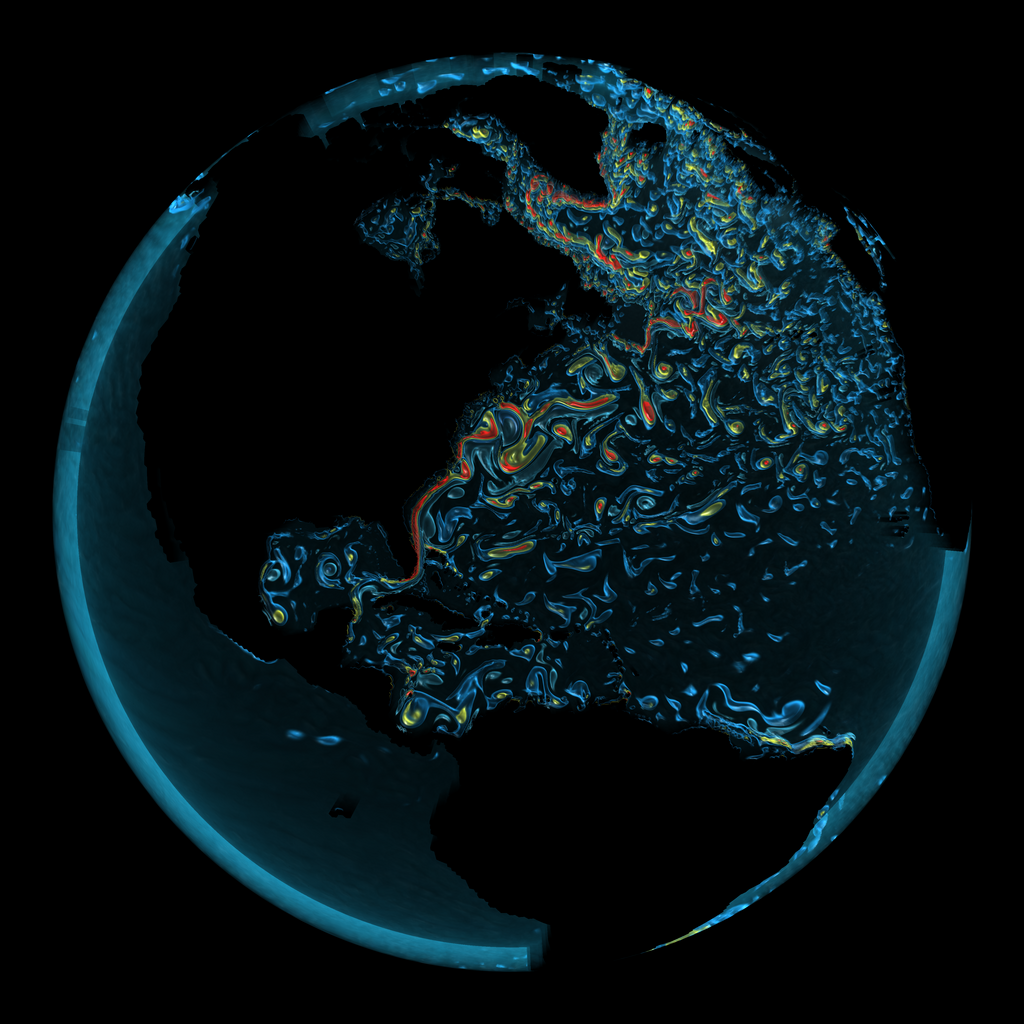
Similarly, the oceans exchange momentum with the solid Earth through bottom friction and pressure torques against seafloor topography. Oceanic Angular Momentum (OAM) is dominated by the motion of large-scale currents like the Antarctic Circumpolar Current. Changes in ocean circulation, driven by wind stress and thermohaline variations, result in fluctuations in OAM that must be compensated by the solid Earth and atmosphere.
By carefully monitoring each component's angular momentum through satellite observations (like GRACE for mass distribution) and atmospheric/oceanic models, scientists can verify the closure of the angular momentum budget. This detailed accounting is essential for isolating the signals of different geophysical processes in the Earth's rotation data.
Which of the following best explains why the Earth's angular momentum vector, , is not necessarily collinear with its angular velocity vector, ?
If a period of unusually strong and sustained global westerly winds occurs, what is the expected immediate effect on the solid Earth's rotation?