Earth's Rotation Unveiled
Day and Night Cycles
The Perpetual Sunrise
Earth is constantly in motion. As it hurtles through space on its year-long journey around the sun, it's also spinning like a top. This spin, or rotation, is what creates the most fundamental rhythm of our lives: the cycle of day and night.
Imagine a single, giant spotlight—the sun—shining on a spinning ball. The side of the ball facing the light is brightly lit, while the side facing away is cast in shadow. Earth is that ball. The half bathed in sunlight experiences day, and the half in shadow experiences night. Because the planet is always turning, any given point on its surface will pass from the light into the shadow and back again, creating a continuous transition from dawn to dusk.
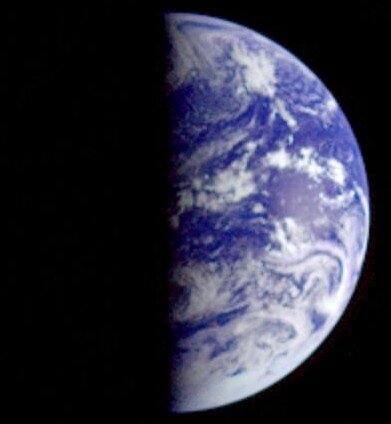
This moving boundary between daylight and darkness has a name: the terminator line. It’s not a sharp, crisp line like a shadow on a wall. Instead, it’s a diffuse zone where light fades gradually. This transition zone is what we experience as twilight, the period of soft, scattered sunlight that occurs after sunset and before sunrise.
terminator
noun
The line that separates the illuminated day side and the dark night side of a planetary body.
A Constant Chase
The terminator is always on the move, sweeping across the planet's surface as Earth spins. At the equator, this line travels at a brisk pace of about 1,670 kilometers per hour (around 1,037 miles per hour). This is the speed of Earth's rotation at its widest point. As you move towards the poles, the speed of rotation decreases, and so does the speed of the terminator.
This constant movement is why sunrise and sunset are predictable, daily events. From our perspective on the ground, it feels like the sun is moving across the sky. But it's actually us—our specific location on the planet—that is rotating into and out of the sun's light. When our spot on Earth spins into the light, we see the sunrise. As our rotation carries us away from the light and into the planet's own shadow, we see the sunset.
The sun doesn't rise or set. The Earth turns. We are the ones moving through the light.
Daylight's Universal Clock
Every planet that rotates experiences a day and night cycle. The length of that cycle, however, varies wildly. A day on Jupiter, for instance, is less than 10 hours long because it spins so rapidly. In contrast, a single sidereal day, or one full rotation, on Venus takes 243 Earth days—longer than its entire year.
Earth’s rotation gives us a roughly 24-hour cycle that has shaped life itself. It dictates when plants perform photosynthesis, when animals hunt or rest, and the fundamental patterns of human civilization. The simple, reliable spin of our planet is the clockwork behind the world we know. While we often think about our yearly orbit around the sun, it's this daily rotation that governs our immediate experience of time and light.
What is the primary cause of the cycle of day and night on Earth?
What is the name for the moving boundary between the sunlit side and the dark side of Earth?