Earth's Rotation Explained
What is Earth's Rotation
The Daily Spin
Every moment of every day, our planet is in constant motion. The most fundamental of these movements is its rotation. Earth's rotation is the spinning of the planet on its own axis, an imaginary line that runs through the North and South Poles. Think of it like a spinning top, constantly turning around a central point.
This spin isn't random; it has a consistent direction. If you were looking down on the North Pole from space, you would see the Earth spinning counter-clockwise. From our perspective on the surface, this means the planet turns from west to east. This is why the sun, moon, and stars appear to rise in the east and set in the west each day—it's actually our planet spinning towards the east that creates this illusion of movement.
Rotation vs. Revolution
It's easy to confuse rotation with another key movement: revolution. While they both describe motion, they are fundamentally different. Rotation is the act of spinning around an internal center, or axis. , on the other hand, is the movement of one object in a path around another object. For Earth, this means orbiting the Sun.
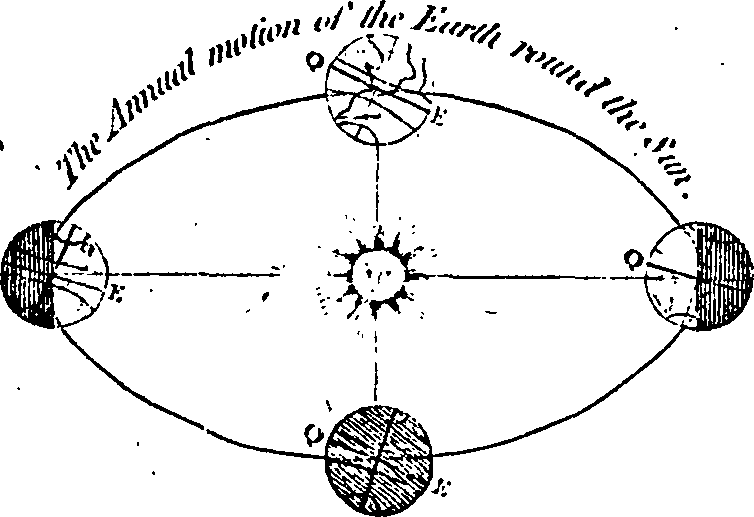
A simple analogy can help. Imagine a basketball player spinning a ball on their finger while walking in a circle around the center of the court. The ball spinning on the finger is like Earth's rotation. The player walking around the court is like Earth's revolution around the Sun.
| Feature | Rotation | Revolution |
|---|---|---|
| What it is | Spinning on an internal axis | Orbiting an external body |
| Reference Point | The planet's own center | The Sun |
| Analogy | A top spinning in place | A car driving around a racetrack |
Understanding this distinction is key. Rotation gives us our day, while revolution gives us our year. Both motions happen simultaneously, defining our planet's place and rhythm in the cosmos.