Earth's Rotation Explained
Earth's Rotation Basics
Our Spinning Planet
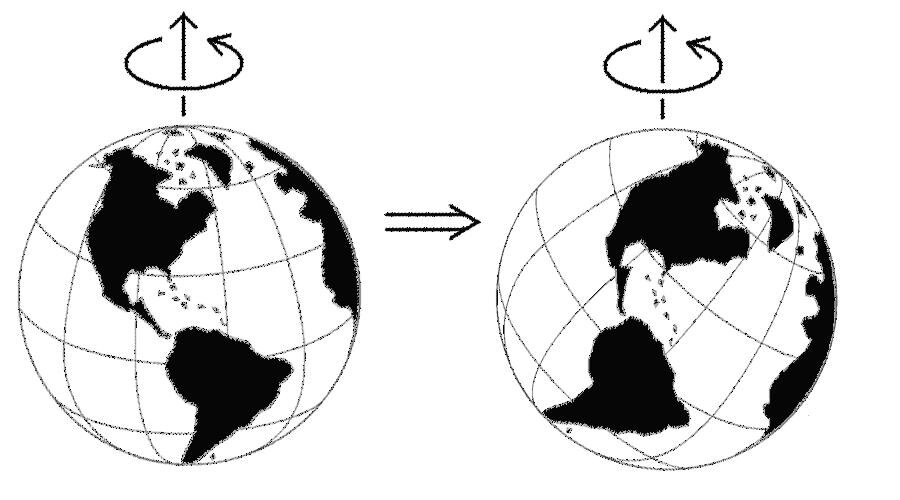
Every day, we ride a carousel of planetary scale. Earth's rotation is its constant spin on an imaginary line called an axis, which runs from the North Pole to the South Pole. This spin is what gives us the cycle of day and night.
Imagine a spinning top. Earth does the same thing, just on a much grander scale and without wobbling quite as much. This rotation is a relic of our planet's formation, a fundamental motion that has shaped its environment, climate, and even its physical form.
A Constant Turn
Every point on Earth completes one full 360-degree turn in roughly 24 hours. This rate of spin is called angular velocity, and it's the same whether you're standing at the equator or near one of the poles. We measure this spin in radians per second.
While the angular velocity is constant, the linear speed—how fast you're actually moving through space—is not. This speed depends entirely on your latitude, or your distance from the axis of rotation. Think of people on a merry-go-round: those on the outer edge travel a much larger circle and move faster than those near the center, even though they all complete a rotation in the same amount of time.
At the equator, the Earth's circumference is about 40,075 kilometers. To cover that distance in 24 hours, you'd be moving at a brisk 1,670 kilometers per hour (about 1,037 mph). But if you were to stand at one of the poles, you'd simply be spinning in place, with a linear speed of zero.
The Origin of Spin
Why does Earth spin at all? The answer lies in its violent birth. About 4.6 billion years ago, the solar system was a vast, swirling cloud of gas and dust. Gravity began pulling this material together to form the Sun and planets. As this cloud collapsed, it started to spin faster due to the —the same principle that makes a figure skater spin faster when they pull their arms in.
This initial rotation was messy. Clumps of matter collided and merged, and each impact nudged the forming Earth, contributing to its overall spin. One of the most significant events was likely a collision with a Mars-sized protoplanet named , the leading theory for the Moon's formation. This cataclysmic impact would have given our young planet a massive push, setting the basic rotational speed and axial tilt we still have today.
Over billions of years, this spin has been remarkably stable, though it's not perfectly constant. The gravitational pull of the Moon and Sun creates tides, which act as a gentle brake, slowly increasing the length of our day by a tiny fraction of a second each century.