Earth's Planetary Formation Process
Nebular Physics
From Cloud to Disk
Our solar system began as a vast, rotating cloud of molecular gas and dust—a solar nebula. As you know, gravity pulls matter together. Over millions of years, this gravitational pull caused the nebula to contract. Due to the conservation of angular momentum, as the cloud shrank, it spun faster and flattened into a spinning disk, much like a figure skater pulling their arms in to speed up a spin. This structure is known as a protoplanetary disk.
In essence, this theory states that the Sun, the planets, and all other objects in the Solar System formed from nebulous material billions of years ago.
The center of this disk, where material was most concentrated, grew incredibly hot and dense, eventually igniting to form our Sun. The young Sun, in its T-Tauri star phase, was highly active. It blasted out powerful stellar winds that helped clear away much of the remaining gas and dust from the inner solar system. But this disk wasn't a calm, orderly place. It was a turbulent, chaotic environment, stirred by powerful forces.
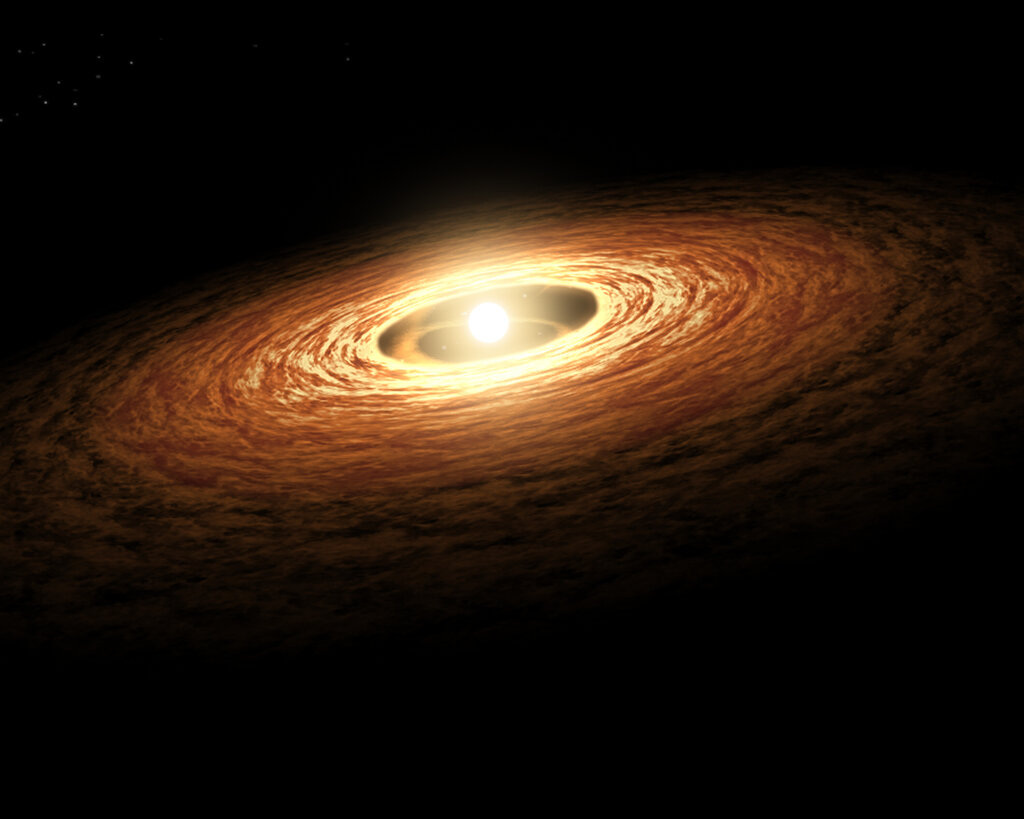
Two key phenomena drove this turbulence. The first is the Kelvin-Helmholtz instability, which occurs at the boundary between two fluids moving at different speeds. Think of wind creating waves on water. In the protoplanetary disk, layers of gas orbited the protostar at different velocities, creating shearing forces that generated swirling eddies and waves. The second, and perhaps more significant, was the magnetorotational instability. This instability arises from the interaction between a weak magnetic field and the differentially rotating, ionized gas in the disk. It effectively acts as a source of viscosity, transferring angular momentum outward and allowing material to fall inward toward the growing star.
The Great Divide
The composition of the planets was determined by a critical factor: temperature. The new Sun baked the inner regions of the protoplanetary disk, creating a steep temperature gradient. Close to the Sun, it was too hot for most materials to condense into solids. Only substances with very high boiling points could solidify.
refractory
adjective
A substance that is resistant to heat and has a high melting or boiling point.
These are known as refractory materials, like iron and silicate rock. Further out in the disk, beyond a certain point, the temperature dropped significantly. This boundary is called the ice line or frost line. Beyond this line, it was cold enough for volatile materials—compounds with low boiling points like water, ammonia, and methane—to freeze into solid ice grains. This division is the primary reason our solar system has rocky, terrestrial planets in the inner part and gas or ice giants in the outer part.
The availability of ice beyond the frost line was a game-changer. Ices were far more abundant than rock and metal, providing a huge reservoir of solid material. This allowed the cores of the outer planets to grow much larger, much faster. Once these cores reached a critical mass, about 10-15 times that of Earth, their gravity was strong enough to pull in and hold onto the vast amounts of hydrogen and helium gas that dominated the nebula, forming the massive atmospheres of Jupiter and Saturn.
Building a Planet
The transition from micron-sized dust grains to kilometer-scale planetesimals is not straightforward. Initially, dust particles collide and stick together through electrostatic forces, growing into pebble-sized objects. However, this process hits a major snag known as the 'meter-size barrier'. Objects around a meter in size experience a strong headwind from the surrounding gas in the disk. This gas drag causes their orbits to decay rapidly, sending them spiraling into the star in a cosmic death march before they can grow any larger. So how did any planets form at all?
Overcoming the meter-size barrier is one of the most significant challenges in planet formation theory.
The leading solution is a process called pebble accretion. Instead of relying on slow, random collisions between meter-sized bodies, this model proposes that larger, pre-existing planetesimals (perhaps formed in localized high-pressure zones or 'dust traps') rapidly sweep up vast quantities of smaller pebbles. These pebbles, being smaller, are more strongly coupled to the gas and drift inward more slowly. A sufficiently massive planetesimal can gravitationally capture these drifting pebbles very efficiently, allowing it to grow extremely quickly—fast enough to bypass the meter-size barrier and form a planetary core.
This mechanism is especially effective beyond the ice line, where the abundance of icy pebbles provided a massive food source for growing planetary cores. It helps explain how the gas giants could form their massive cores within the relatively short lifetime of the protoplanetary disk, which typically disperses in just a few million years. The physics of the nebula didn't just set the stage; it directed the entire play of planet formation.
Let's check your understanding of these formation processes.
What is the primary reason the rotating solar nebula flattened into a disk as it contracted?
The division between the inner rocky planets and the outer gas/ice giants in our solar system is primarily explained by which concept?
From a spinning cloud of gas to the building blocks of worlds, the dynamics of the early solar nebula laid the blueprint for the planets we see today.