Earth's Grids and Halves
Latitude
Finding Your Place North or South
Imagine Earth as a giant sphere. How would you describe where a specific spot is? A good start is to figure out how far north or south it is. This is where latitude comes in.
Latitude is a measurement of distance north or south of the Equator. Think of it like the rungs on a ladder. The Equator is the main rung in the middle, and all other lines of latitude, called parallels, run parallel to it, circling the globe from east to west.
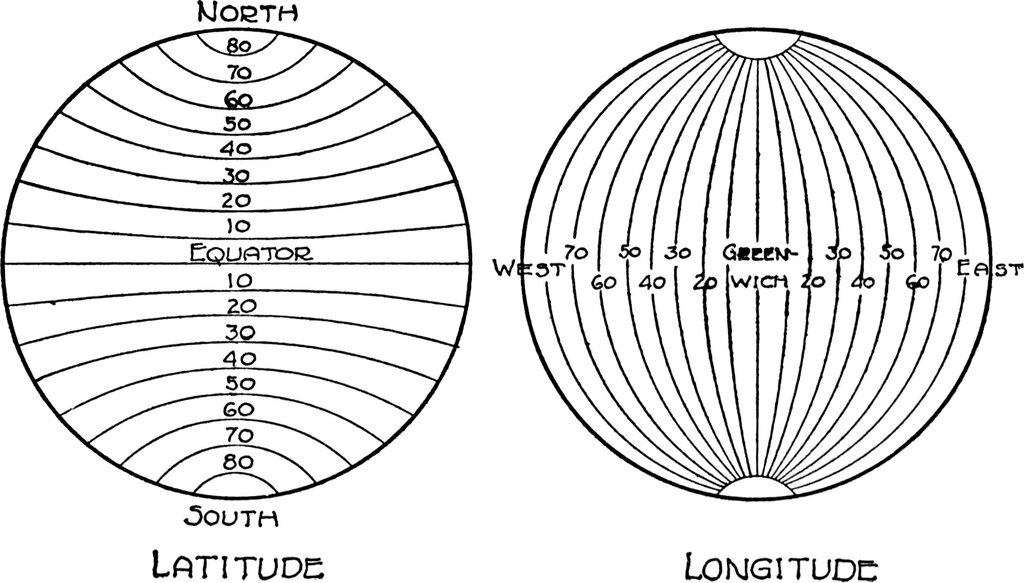
The Equator is the starting point, sitting at 0 degrees (). From there, we measure latitude in degrees going north or south. If you travel north, the latitude increases until you reach the North Pole at North. If you go south, it increases until you hit the South Pole at South.
So, every location on Earth has a latitude between and North (N) or and South (S).
For more precision, degrees are broken down into smaller units. Just like an hour is divided into minutes and seconds, a degree of latitude is divided into 60 minutes, and each minute is divided into 60 seconds. This allows for incredibly precise location mapping.
The Major Parallels
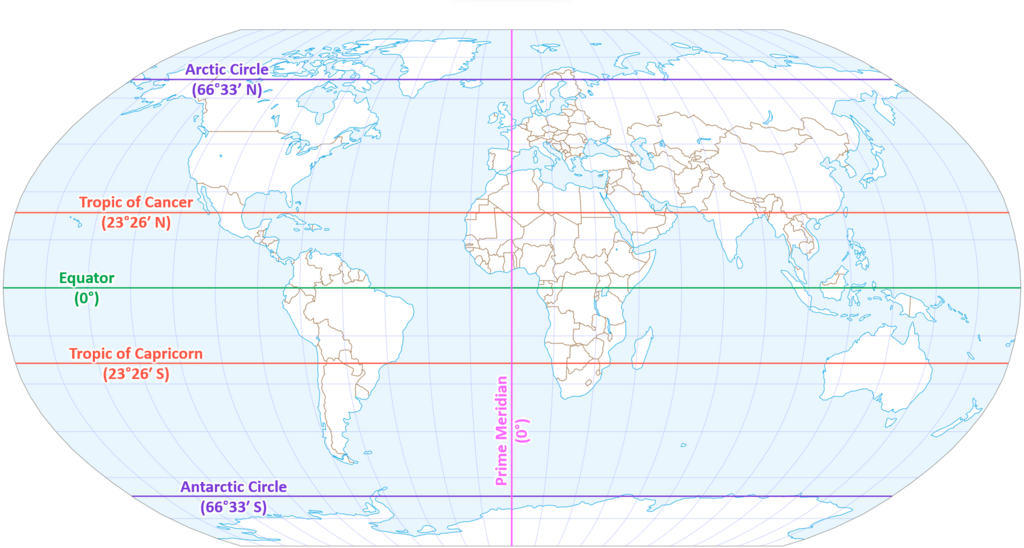
While there are infinite parallels of latitude, a few are especially important because of Earth's relationship with the sun. These key lines mark significant climate zones and solar events.
| Line | Latitude | Significance |
|---|---|---|
| Arctic Circle | N | The southernmost latitude in the Northern Hemisphere that experiences 24-hour daylight or darkness at least once a year. |
| Tropic of Cancer | N | The northernmost latitude where the sun can be directly overhead. This occurs on the June solstice. |
| Equator | Divides the Earth into the Northern and Southern Hemispheres. | |
| Tropic of Capricorn | S | The southernmost latitude where the sun can be directly overhead. This occurs on the December solstice. |
| Antarctic Circle | S | The northernmost latitude in the Southern Hemisphere that experiences 24-hour daylight or darkness at least once a year. |
How Latitude Shapes Our World
Latitude isn't just a number on a map; it has a direct impact on our daily lives, primarily through its effect on climate and the length of daylight.
The most significant effect of latitude is on climate. Areas near the Equator (low latitudes) receive more direct sunlight throughout the year, making them warmer. As you move towards the poles (high latitudes), sunlight strikes the Earth at a lower angle. The same amount of solar energy is spread over a much larger area, resulting in cooler temperatures.
Latitude also determines the variation in daylight hours. At the Equator, days are about 12 hours long all year. As you move to higher latitudes, the seasonal difference becomes more extreme. Locations within the Arctic and Antarctic Circles experience periods of 24-hour daylight in the summer and 24-hour darkness in the winter.
Ready to check your understanding? Let's see what you've learned about latitude.
What does latitude measure?
Lines of latitude are also known as parallels because they run parallel to the Equator and never intersect.
Understanding latitude is the first step in pinpointing any location on the globe and grasping why different parts of the world experience such different climates.