Earthquake Magnitude Scales Explained
Seismic Waves
Energy on the Move
When an earthquake occurs, the sudden release of energy sends vibrations, known as seismic waves, radiating out from the focus. These waves are not all the same. They travel at different speeds and move the ground in different ways. Broadly, they fall into two categories: body waves, which travel through the Earth's interior, and surface waves, which are restricted to the surface.
Traveling Through the Earth
Body waves are the first to be generated and give us a direct look into the planet's structure. There are two types: P-waves and S-waves.
P-waves, or primary waves, are the fastest of all seismic waves. They are compressional waves, meaning they push and pull the rock they travel through, much like a Slinky that's been pushed from one end. The particles of rock move back and forth in the same direction that the wave is traveling. Because this push-pull motion works in any material, P-waves can travel through solids, liquids, and gases.
S-waves, or secondary waves, are the second to arrive at a seismic station. They are shear waves, moving rock particles up and down or side to side—perpendicular to the direction the wave is traveling. Think of flicking one end of a rope. The wave travels down the rope, but the rope itself just moves up and down.
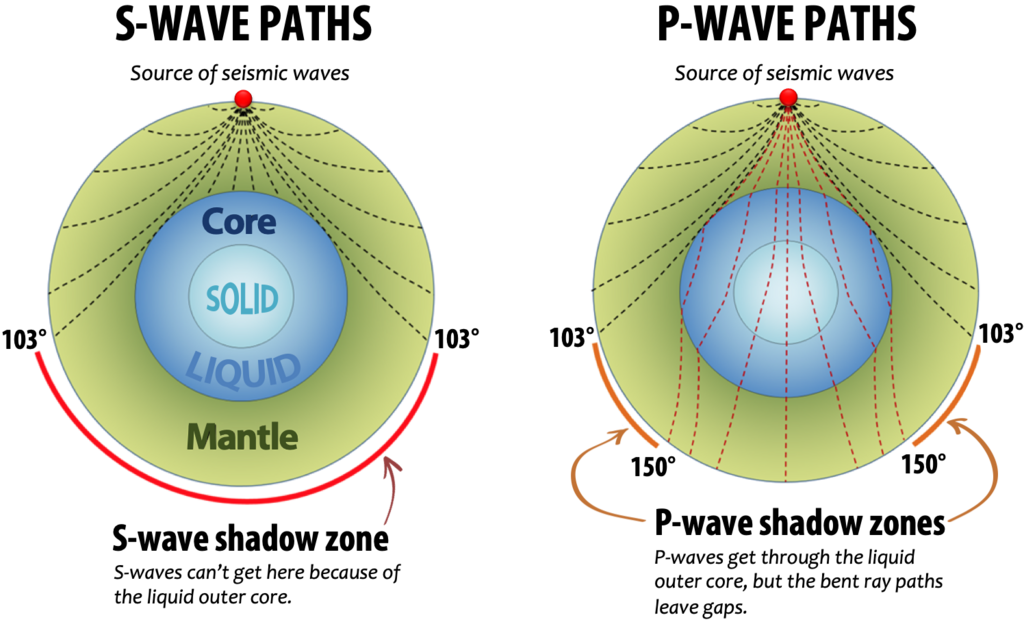
This shearing motion has a critical limitation: S-waves can only travel through solids. Liquids and gases don't have the rigidity to spring back from a shear force, so the wave simply dies out. This single property is how seismologists discovered that the Earth's outer core is liquid.
When P- and S-waves travel deep into the Earth, their paths are bent by changes in material density. S-waves are stopped entirely by the liquid outer core, creating a large "shadow zone" on the opposite side of the planet where they cannot be detected. P-waves are refracted, or bent, as they pass through the core, creating smaller shadow zones of their own.
The Destructive Surface Waves
When body waves reach the surface, some of their energy is converted into surface waves. These waves travel more slowly than body waves, but they are almost entirely responsible for the damage and destruction we associate with earthquakes. Their amplitude, or the amount the ground moves, can be much larger than that of body waves.
The two main types of surface waves are Love waves and Rayleigh waves.
-
Love waves move the ground from side-to-side in a horizontal motion. This shearing is particularly damaging to the foundations of buildings.
-
Rayleigh waves create a rolling motion, similar to waves on the surface of the ocean. As the wave passes, the ground moves both up and down and side to side in an elliptical path. This rolling can feel unsettling and causes immense structural stress.
| Wave Type | Motion | Travels Through | Relative Speed |
|---|---|---|---|
| P-wave | Compression and expansion (Push-pull) | Solid, liquid, gas | Fastest |
| S-wave | Shearing (Side-to-side or up-and-down) | Solid only | Slower than P |
| Love Wave | Horizontal shearing | Surface only | Slower than S |
| Rayleigh Wave | Rolling (Elliptical) | Surface only | Slowest |
Because these four wave types all travel at different speeds, they arrive at a seismograph station at different times. The P-wave arrives first, followed by the S-wave, and finally the slower Love and Rayleigh waves, which often have the largest recorded amplitudes.
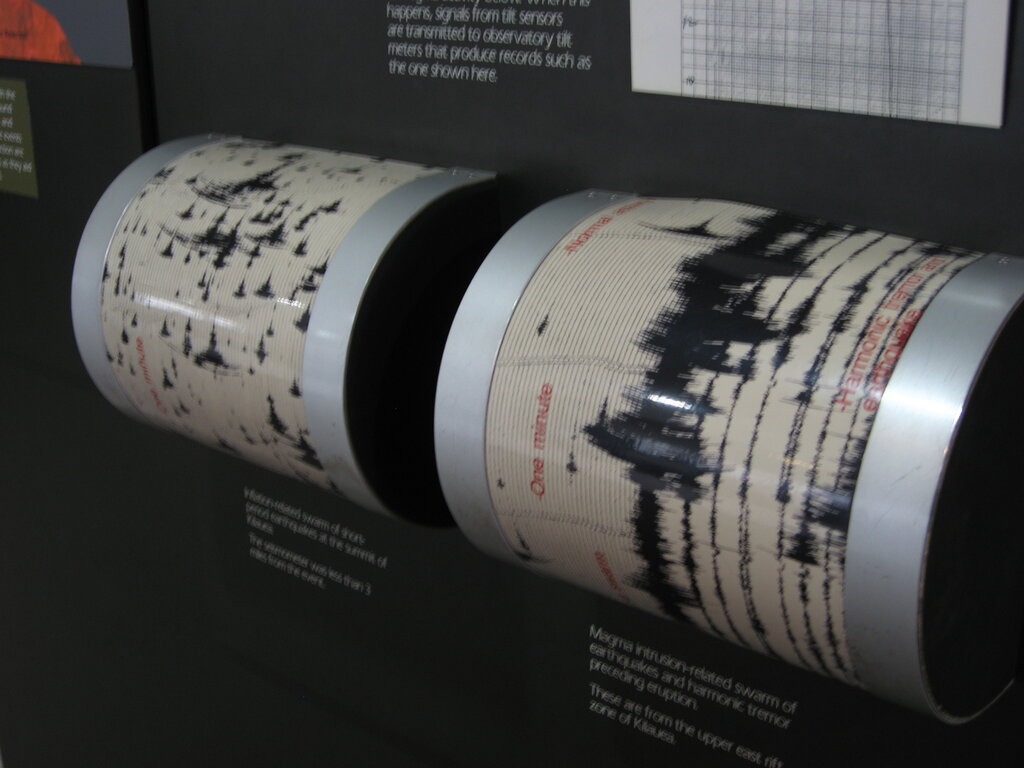
Understanding the behavior of these different waves is fundamental to seismology. By analyzing their arrival times and characteristics, scientists can locate an earthquake's epicenter and learn about the materials the waves traveled through on their journey through the Earth.
Which type of seismic wave is primarily responsible for causing the most damage to building foundations due to its side-to-side horizontal motion?
The fact that S-waves cannot travel through the Earth's outer core is the primary evidence that it is __________.