Earthquake Catastrophe Unveiled
Understanding Earthquakes
The Shaking Earth
An earthquake is a sudden, rapid shaking of the ground. It happens when massive blocks of rock deep within the Earth slip past one another. This movement releases a huge amount of energy, which travels outward in all directions.
Think of it like snapping your fingers. You press your thumb and finger together, building up pressure. When they finally slip, they release energy as a sharp 'snap' sound. Earthquakes work in a similar way, but with giant slabs of rock.
A Cracked Shell
To understand why the Earth shakes, we need to look at its structure. Our planet isn't one solid ball; it's made of distinct layers, almost like a giant peach.
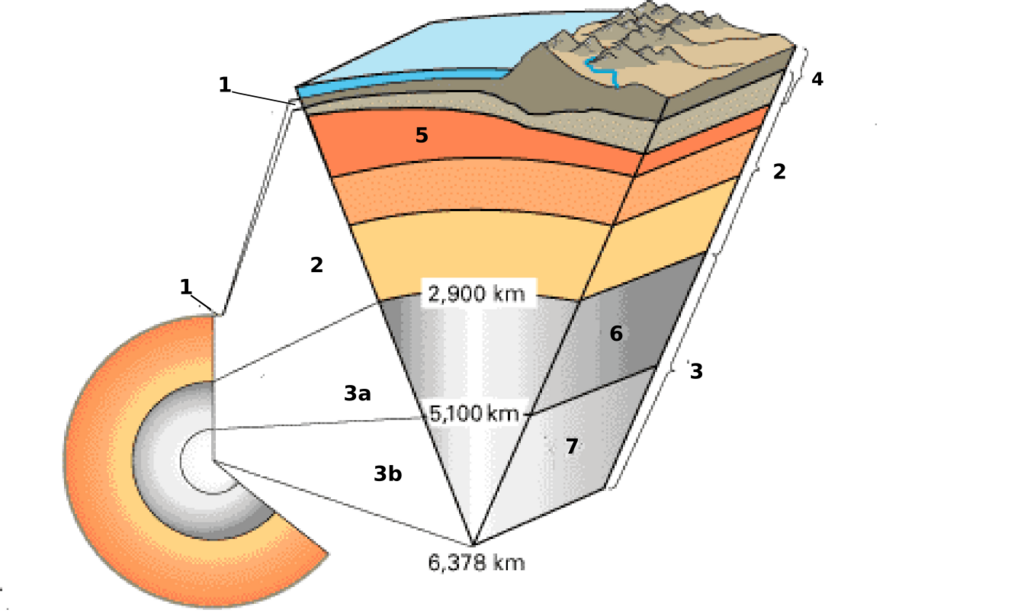
The thin outer layer is called the crust. It's the ground beneath our feet and the ocean floors. Below that is the mantle, a very thick layer of hot, dense rock that flows slowly like thick honey. At the center is the core, made of super-hot iron and nickel.
The crust isn't a single, unbroken shell. It's cracked into many large pieces called tectonic plates. These plates fit together like a puzzle and float on the softer, flowing rock of the mantle below. Because the mantle is constantly moving, it carries the tectonic plates along with it, causing them to drift across the planet's surface about as fast as your fingernails grow.
Most earthquakes happen at the edges of these plates, called plate boundaries. As the plates scrape, collide, or pull apart from each other, their rough edges get stuck. The rest of the plate keeps moving, so stress builds up along the edge. When the stress becomes too much for the rocks to handle, they break and snap into a new position. This sudden release of stored energy creates seismic waves, causing the ground to shake.
Fault
noun
A fracture or zone of fractures between two blocks of rock. Faults allow the blocks to move relative to each other, which can cause earthquakes.
Ripples of Energy
The energy released during an earthquake travels in the form of vibrations called seismic waves. These waves spread out from the earthquake's starting point, known as the focus. The point on the Earth's surface directly above the focus is called the epicenter.
There are two main categories of seismic waves. Body waves travel through the Earth’s interior, while surface waves travel only along the surface of the planet, like ripples on water. It's the surface waves that cause the most shaking and damage.
Body waves can be broken down further into two types: P-waves and S-waves.
| Wave Type | Full Name | Motion | Speed |
|---|---|---|---|
| P-wave | Primary Wave | Compresses and expands the ground (push-pull) | Fastest |
| S-wave | Secondary Wave | Shakes the ground up and down or side-to-side | Slower than P-waves |
P-waves are the first to arrive at a location because they travel the fastest. They can move through both solid rock and liquid layers of the Earth. S-waves are slower and arrive next. They can only move through solid rock, not through any liquid parts of the Earth. The study of these waves is what helps scientists learn about the structure of the Earth's interior.
What are the large, cracked pieces of the Earth's thin outer layer called?
Most earthquakes occur when stress builds up at the edges of tectonic plates. What are these edges called?
By understanding the structure of our planet and the constant motion of its tectonic plates, we can begin to see why the ground beneath us is not as still as it seems.