Dynamics of Waves in Stretched Springs
Wave Speed Dynamics
The Medium's Message
The speed of a wave depends entirely on the medium it travels through. You could shake the end of a spring frantically or gently; the pulses you create will travel at the same speed. That speed is dictated by a constant tug-of-war between two of the medium's properties: its elasticity and its inertia.
Elasticity is the property that causes the medium to return to its original shape. It acts as a restoring force, pulling displaced segments back to equilibrium. The stronger this force, the faster each segment snaps back, and the quicker the wave propagates. On the other hand, inertia is the resistance to changes in motion. The more massive the medium, the more it resists being accelerated, which slows the wave down.
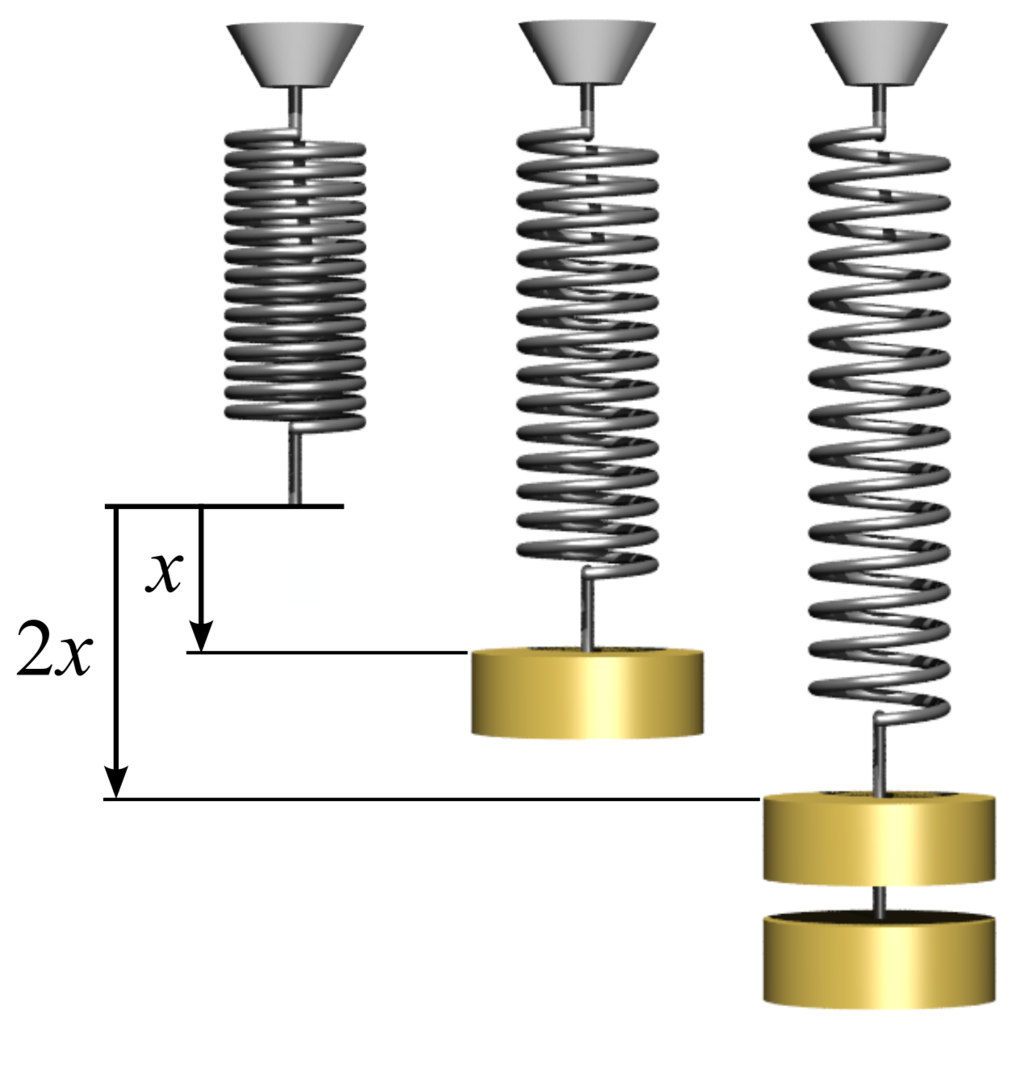
Tension and Restoring Force
For a wave on a string or a spring, the elastic property is provided by tension (). Imagine a taut guitar string. When you pluck it, a small segment of the string is displaced. The high tension in the string immediately pulls that segment back towards the centre line. This quick snap-back forces the next segment to move, and so on, propagating the wave.
A greater tension means a greater restoring force. This force causes any displaced part of the spring to accelerate back to its equilibrium position more quickly. A faster acceleration for each segment results in a faster propagation speed for the entire wave. So, increasing the tension in a spring or string directly increases the speed of waves travelling along it.
Mass and Inertia
The inertial property of the medium is described by its linear mass density, often represented by the Greek letter (mu). This isn't just about the total mass of the spring, but how that mass is distributed along its length. A thick, heavy rope has a high linear mass density, while a thin fishing line has a low one.
More mass per unit of length means more inertia. When a wave pulse arrives at a segment of a heavy rope, it has to move a lot of mass. This requires more time and effort, slowing down the transfer of energy to the next segment. Therefore, a higher linear mass density results in a slower wave speed.
Linear Mass Density
noun
The measure of mass per unit of length of a one-dimensional object, like a string or spring.
The Wave Speed Formula
Combining these two factors, tension and linear mass density, gives us the equation for the speed of a wave on a string. The derivation of this formula involves analysing the forces on an infinitesimally small segment of the string as a wave passes. The vertical component of the tension provides the centripetal force needed to make the segment oscillate, and from this, we can relate the forces to the wave's velocity.
This equation confirms our intuitions. Wave speed is directly proportional to the square root of the tension . If you quadruple the tension, the speed doubles. Conversely, speed is inversely proportional to the square root of the linear mass density . If you switch to a string that's four times as dense, the wave speed is halved.
Let's apply this. A 2-meter long steel spring has a mass of 0.8 kg and is stretched with a tension of 50 Newtons. What is the speed of a wave pulse sent along it?
First, we calculate the linear mass density:
Now, we plug this into the wave speed formula:
The pulse will travel along the spring at about 11.2 meters per second.
This relationship underscores a critical point: wave speed is an intrinsic property of the medium. The person or device creating the wave can change its frequency, wavelength, and amplitude, but not its speed. The speed is set by the physical characteristics of the string itself.
Time to check your understanding of what determines how fast a wave travels.
What two properties of a medium primarily determine the speed of a wave travelling through it?
If you increase the tension in a guitar string, how does this affect the speed of a wave travelling along it?
The physics of tension and mass density govern wave propagation not just in springs, but in everything from musical instruments to seismic waves travelling through the Earth.