Dynamics of the French Revolution
Institutional Collapse
A Kingdom in Crisis
By the late 1780s, the French monarchy was on the verge of bankruptcy. Decades of costly wars, including support for the American Revolution, combined with an inequitable tax system, had drained the treasury. The First and Second Estates, the clergy and nobility, were largely exempt from taxes, placing the entire financial burden on the Third Estate, which included everyone from peasants to merchants.
King Louis XVI knew something had to change. His finance minister, Charles Alexandre de Calonne, proposed a radical solution: a universal land tax that would apply to all three estates, no exceptions. To bypass the inevitable resistance, the king summoned an in 1787. This was a hand-picked council of elites, primarily from the nobility and high clergy, who the king hoped would endorse his reforms and give them an air of legitimacy.
The plan backfired. The Notables refused to approve the new tax, arguing that such a fundamental change required the consent of the nation itself. This pushed the kingdom from a fiscal crisis into a constitutional one. The monarchy’s absolute power was being openly questioned by the very elites it was designed to serve.
The Courts Push Back
With the Assembly of Notables dissolved, the king turned to the traditional courts, the parlements, to register his tax edicts into law. These were not legislative bodies like modern parliaments, but high courts of justice whose members were primarily aristocrats. The Parlement of Paris, the most powerful of these courts, declared that only the Estates-General could sanction new taxes.
This created a deadlock. The king insisted on his authority as an absolute monarch, while the parlements positioned themselves as defenders of the kingdom's traditional laws against royal overreach. For months, the two sides were locked in a power struggle. The king exiled magistrates, and the parlements refused to back down, fueling public unrest and political debate across France. The system was paralyzed.
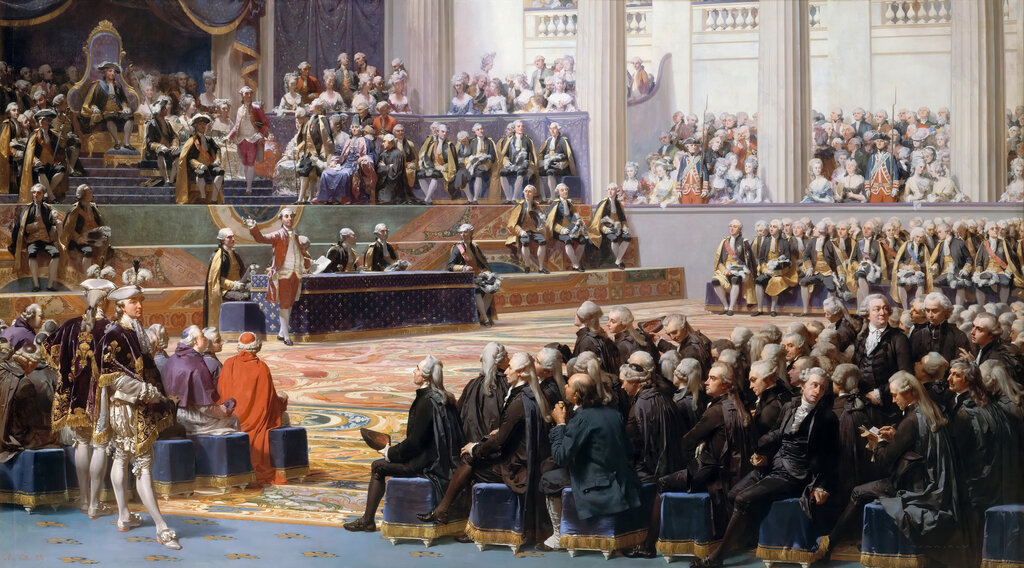
Forced into a corner, Louis XVI finally relented. In 1788, he agreed to convene the Estates-General. He hoped this body, with its rigid structure of voting by estate rather than by head, would approve his reforms. The decision was a monumental concession, signaling that the monarch could no longer rule by decree alone. The stage was set for a dramatic confrontation.
A New Kind of Power
The Estates-General met at Versailles in May 1789, but it immediately stalled over procedure. The Third Estate, representing over 95% of the population, was given as many delegates as the other two estates combined. However, the traditional voting method was by order, meaning each estate got one vote. This allowed the clergy and nobility to consistently outvote the Third Estate, 2-1.
The delegates of the Third Estate refused to accept this. They demanded that all delegates meet as a single body and vote by head, giving each representative an individual vote. After weeks of stalemate, they took a revolutionary step. On June 17, 1789, they declared themselves the National Assembly, an assembly not of the estates, but of the people. They asserted that they alone had the right to represent the nation.
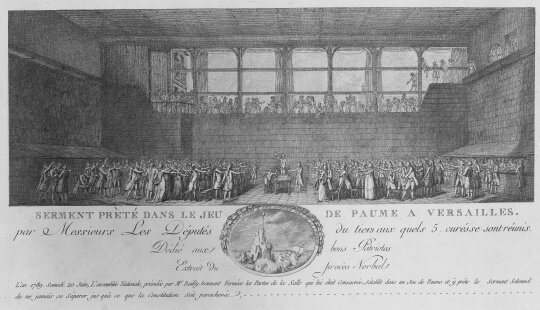
Three days later, the members of the new National Assembly arrived at their meeting hall to find it locked and guarded by soldiers. Fearing a royal plot to dissolve them, they moved to a nearby indoor tennis court. There, they took the famous , swearing not to disband until they had written a new constitution for France. This was a direct challenge to the king's authority.
On June 17, with talks over procedure stalled, the Third Estate met alone and formally adopted the title of National Assembly; three days later, they met in a nearby indoor tennis court and took the so-called Tennis Court Oath (serment du jeu de paume), vowing not to disperse until constitutional reform had been achieved.
The king's inability to manage the fiscal crisis had revealed the deep structural flaws of the absolute monarchy. The traditional institutions had either failed or been turned against him. The transformation of the Estates-General into the National Assembly wasn't just a political maneuver; it was the collapse of one system and the birth of another. The 's institutional framework had shattered.
What was the primary cause of the French monarchy's financial crisis in the late 1780s?
Why did King Louis XVI convene the Assembly of Notables in 1787?
The events of 1787-1789 demonstrated that the old ways of governing were no longer viable. What began as a debate over taxes had become a fundamental struggle over who held power in France.