Dynamics of the Coriolis Effect
Rotating Reference Frames
Motion is Relative
In physics, how we describe motion depends entirely on our point of view, or our frame of reference. An inertial frame is one that's not accelerating. Think of a spaceship coasting through empty space. Inside, Newton's laws work perfectly as you remember them. An object at rest stays at rest, and an object in motion stays in motion with the same speed and in the same direction unless acted upon by a force.
But what if your frame is accelerating? These are called non-inertial frames. A classic example is a rotating frame, like standing on a spinning carousel or, more importantly, on the surface of the Earth. In these frames, Newton's laws seem to break down. Objects appear to accelerate without any obvious force acting on them. To make the math work out, we introduce fictitious forces, which are not real forces but rather apparent effects of the frame's acceleration.
Fictitious forces are mathematical corrections that allow us to apply Newton's second law in a non-inertial frame of reference.
Setting the Scene: Two Frames
Let's imagine two coordinate systems with a common origin. The first, which we'll call , is stationary or inertial. It has basis vectors . The second, , is rotating with a constant angular velocity relative to . Its basis vectors are .
From the perspective of the stationary frame , the basis vectors of the rotating frame are changing direction over time. The rate of change of any rotating basis vector is given by its cross product with the angular velocity vector. For example, for the vector:
The same relationship holds for and . This is the foundation for understanding how measurements of motion differ between the two frames.
The Operator Equation
Now, consider a general vector . We can express it in the rotating frame as . To find its time derivative as observed in the stationary frame , we must use the , because both the components () and the basis vectors () can change with time.
The derivative in the stationary frame has two parts: the rate of change of the vector's components as measured in the rotating frame, , plus the change due to the rotation of the basis vectors themselves. After some algebra, this simplifies to a powerful relationship known as the time derivative operator equation.
This equation is a general tool. It lets us relate the rate of change of any vector as seen from a stationary frame to how it's seen from a rotating one.
Deriving Apparent Forces
Let's apply this operator to the position vector of an object. The time derivative of position is velocity, so . Using our new tool:
This makes sense: the velocity in the stationary frame is the velocity measured in the rotating frame plus the tangential velocity from the rotation itself.
Now for the interesting part: acceleration. We apply the operator again, this time to the velocity vector .
Expanding this expression and using the product rule within the first term gives us several terms. After simplifying, we get the relationship between the accelerations in the two frames:
According to Newton's second law, the true force is . An observer in the rotating frame measures an apparent acceleration . They would calculate an apparent force .
By rearranging the equation, we can see what forces the rotating observer must 'invent' to make sense of the motion they see:
The Coriolis force is what makes hurricanes spin and deflects long-range projectiles. The centrifugal force is the outward push you feel on a merry-go-round. Neither is a real force in the inertial sense. They are consequences of being in an accelerating frame of reference, mathematically necessary to make Newton's laws hold true from a rotating perspective.
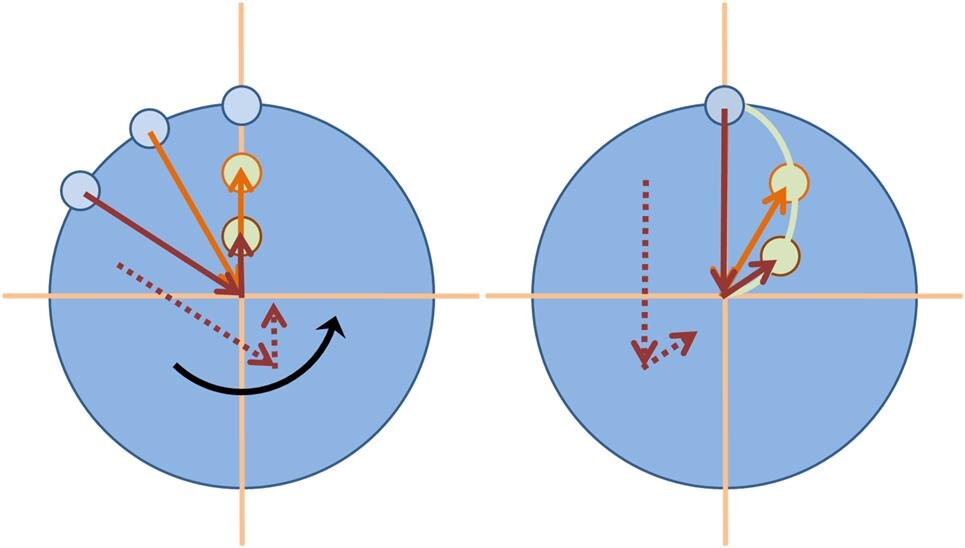
This mathematical journey shows that fictitious forces aren't arbitrary inventions. They are the direct, predictable result of transforming the laws of motion from an inertial frame into a rotating one.
What is the defining characteristic of an inertial frame of reference?
An observer is in a rotating frame of reference (S'). To make Newton's second law work for their observations, they calculate an apparent force, . How does this relate to the true force, ?