Dynamics of Spatial Orientation
3D Rotation Foundations
Orientation in 3D Space
In mechanics, describing an object's location is straightforward. We track its center of mass with a position vector. But for a rigid body, like a satellite or a spinning top, position is only half the story. We also need to know its orientation: which way is it facing? Orientation describes how every point in the body is arranged around its center of mass. While a position vector tells us where an object is, a rotation matrix tells us how it's oriented.
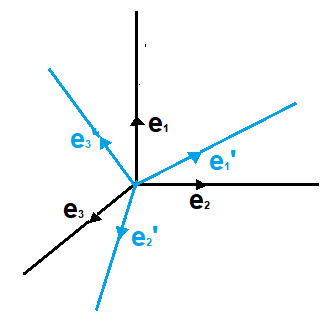
A rotation matrix is a linear algebraic tool that formally describes this orientation. It acts as a set of instructions for rotating a coordinate system from a standard reference orientation to the body's current orientation. To do this correctly, the transformation must preserve the object's physical properties. A rotation can't stretch, shrink, or warp the object. This means all distances between points on the body and all angles must remain unchanged.
The Rules of Rotation
The constraint that rotations must preserve lengths and angles leads to a powerful mathematical property: orthogonality. A matrix is orthogonal if its transpose is also its inverse. This single property ensures that the transformation is a rigid rotation, a reflection, or a combination of both.
For pure rotations in 3D space, we use a specific set of matrices that form a group called the , or . These are 3x3 orthogonal matrices with one extra condition: their determinant must be exactly +1. This constraint cleverly excludes reflections, which would flip the coordinate system (like looking in a mirror) and aren't considered true physical rotations of a rigid body.
The elements of these matrices have a clear geometric meaning. They are known as Direction Cosine Matrices because each element represents the cosine of the angle between an axis of the new (body) coordinate frame and an axis of the original (space) frame. For instance, the element is the cosine of the angle between the new x-axis and the old y-axis.
Changing Your Point of View
A key use for rotation matrices is to perform a change of basis. Imagine a vector pointing to a spot on the surface of our satellite. An observer on the ground (the 'space' frame) and an astronaut bolted to the satellite (the 'body' frame) would describe that vector using different components. The vector itself is a physical reality, but its coordinates depend on your perspective.
The rotation matrix is the bridge between these two descriptions. It transforms the vector's coordinates from the body frame to the space frame. This is fundamental in rigid body dynamics, allowing us to calculate things like velocity and acceleration in a convenient frame (like the body frame, where the geometry is fixed) and then transform them back to a global frame to see the overall motion.
This concept becomes critical when dealing with material properties. Some materials are isotropic, meaning their properties (like thermal conductivity or stiffness) are the same in every direction. Think of a uniform block of steel. Others are , where properties depend on orientation. Wood is a classic example: it's much stronger along the grain than across it. The inertia tensor, which describes how an object's mass is distributed and how it resists rotation, is often anisotropic. A rotation matrix allows us to correctly express the inertia tensor in any coordinate system, which is essential for predicting how an object will spin.
Understanding rotation matrices as operators that describe orientation and facilitate changes of basis is the first step in mastering rigid body dynamics. They provide a robust framework for handling the complexities of motion in three dimensions.
What is the primary function of a rotation matrix when describing a rigid body?
A matrix that represents a pure physical rotation must be orthogonal. What additional property is required for it to belong to the Special Orthogonal Group, ?