Dynamics of Planetary Rotation
Axial Tilt Dynamics
The Tilted Traveler
Earth doesn't spin straight up and down as it orbits the Sun. Instead, its axis of rotation is tilted at an angle of roughly 23.5 degrees. This tilt, known as the , is measured relative to a line perpendicular to its orbital path.
Imagine Earth is a spinning top gliding across a vast, flat tabletop. That tabletop represents the —the flat plane containing Earth's orbit around the Sun. Our planet isn't spinning perfectly upright on this plane; it's permanently tilted.
Crucially, this tilt doesn't change direction as Earth journeys around the Sun. The North Pole consistently points toward Polaris, the North Star, no matter where Earth is in its orbit. This phenomenon is called axial parallelism. Think of it like carrying a tilted umbrella around a fountain; you keep the umbrella handle pointed at the same distant tree the entire time.
This steady tilt has a huge impact on how sunlight hits our planet. The line that divides the sunlit side of Earth from the dark side is called the circle of illumination . Because of the tilt, this circle doesn't always cut neatly through the North and South Poles.
Solstices and Equinoxes
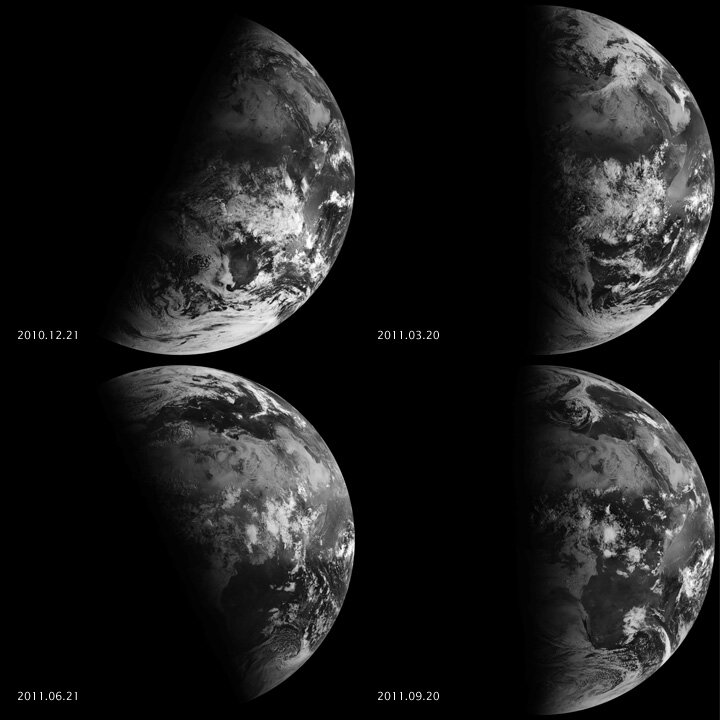
The geometry of Earth's tilt creates four key moments in our yearly orbit: two solstices and two equinoxes.
A solstice occurs when one of the Earth's poles has its maximum tilt toward the Sun. During the June solstice, the Northern Hemisphere is tilted most directly towards the Sun. Sunlight hits the Tropic of Cancer (23.5°N latitude) at a direct 90-degree angle, resulting in the longest day of the year for the Northern Hemisphere.
Six months later, during the December solstice, the situation is reversed. The Southern Hemisphere is tilted towards the Sun, which shines directly on the Tropic of Capricorn (23.5°S latitude). This marks the shortest day in the north and the longest day in the south.
Solstices represent the extremes of solar energy exposure for each hemisphere.
An equinox happens when Earth's tilt is neither toward nor away from the Sun, but perfectly sideways to it. At these two points in the orbit, the circle of illumination passes directly through both the North and South Poles.
During the March (vernal) and September (autumnal) equinoxes, the Sun shines directly on the equator. As a result, day and night are of roughly equal length all over the world. These events mark the astronomical beginning of spring and autumn.
What is the approximate angle of Earth's axial tilt, also known as the angle of obliquity?
The phenomenon where Earth's axis maintains the same alignment, with the North Pole pointing towards Polaris throughout its orbit, is called: