Dynamics of Earth's Solar Orbit
Orbital Equilibrium Mechanics
A Continuous Fall
An orbit isn't about floating peacefully in space. It's a high-stakes balancing act, a state of continuous falling where you always miss the ground. Earth is constantly falling toward the Sun, but it's also moving sideways so fast that it perpetually misses. This sideways motion is called tangential velocity.
Imagine standing on a very tall mountain and throwing a baseball. It travels forward for a bit, but gravity pulls it down, and it eventually hits the ground. Now, imagine throwing it much faster. It travels farther before it lands. If you could throw it at an incredible speed, the Earth's surface would curve away beneath the ball at the exact same rate that gravity pulls it down. The ball would never land. It would be in orbit.
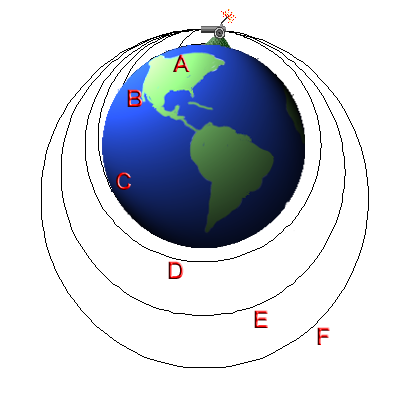
This sideways speed is a result of inertia, the tendency of an object to keep moving in a straight line at a constant speed. Without the Sun's gravity, Earth would shoot off into space in a straight line. Gravity is the tether that prevents this escape, constantly redirecting Earth's straight-line path into a curved, elliptical orbit.
The Centripetal Force
The force that pulls an object toward the center of its circular path is called centripetal force. For Earth, the Sun's gravity provides this force. It's not a separate force but rather the specific job that gravity is doing in this context. This inward pull is always perpendicular to the direction of Earth's motion.
Gravity provides the centripetal force needed to keep Earth in orbit, preventing it from flying off into space due to its inertia.
The strength of this gravitational pull is described by Newton's Law of Universal Gravitation, which states that the force is proportional to the product of the two masses (Sun and Earth) and inversely proportional to the square of the distance between them. This means the farther away the Earth is, the weaker the Sun's pull.
Achieving Equilibrium
A stable orbit is achieved when the gravitational force is just right to continuously bend the planet's path into an ellipse. If Earth’s tangential velocity were to suddenly increase, its inertia would start to overpower the Sun's gravity, and it would move into a larger, more distant orbit. If its velocity decreased, gravity would win, and Earth would spiral closer to the Sun.
This delicate balance is what defines orbital equilibrium. The centripetal force required to keep Earth in its orbit at its current velocity is perfectly supplied by the Sun's gravitational pull. We can express this balance mathematically:
By simplifying this equation, we can solve for the orbital velocity () needed for a stable circular orbit at a given distance ():
This equilibrium is dynamic. As Earth moves along its elliptical path, its distance from the Sun changes. At (its closest point), gravity is stronger, and Earth's orbital speed is at its maximum. At (its farthest point), gravity is weaker, and its speed is at its minimum. This constant adjustment keeps the orbit stable over billions of years.
Let's check your understanding of these orbital dynamics.
What is the term for the sideways motion that keeps a planet in orbit, preventing it from falling directly into the star it orbits?
According to Newton's Law of Universal Gravitation, if the distance between two objects doubles, the gravitational force between them becomes...
The intricate dance between gravity and inertia governs the motions of everything from moons to entire galaxies, all held in a state of perpetual, balanced falling.