Dynamics of Earths Rotation
Angular Momentum Origins
From Cloud to Sphere
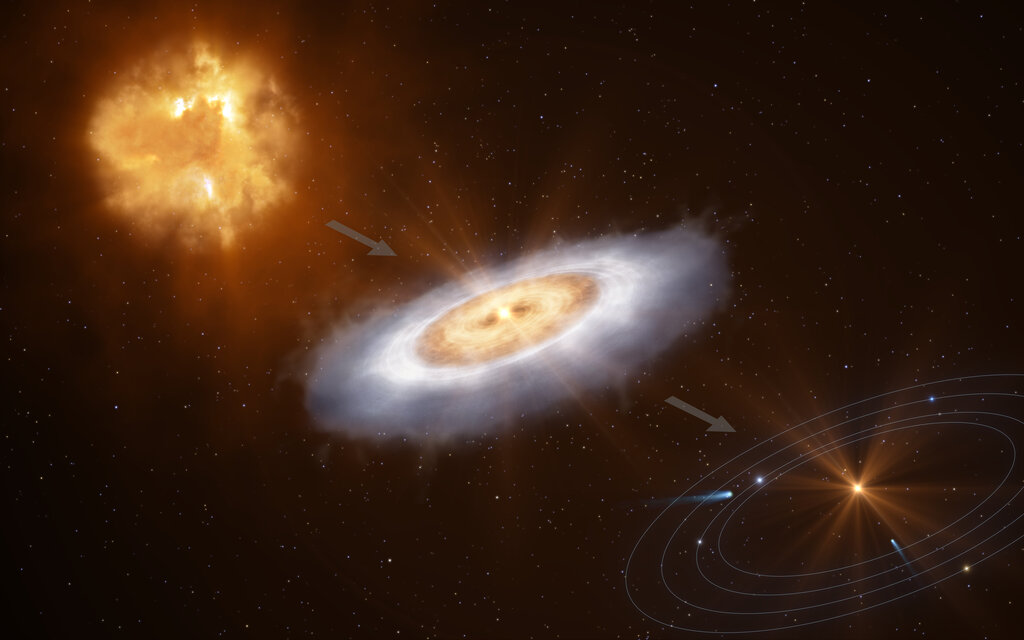
The story of Earth's spin begins long before Earth itself existed. It starts with a vast, slowly churning cloud of gas and dust. Within this protoplanetary disk that surrounded our young sun, particles moved in countless random directions. But as gravity began to pull this material together, a subtle but crucial thing happened: all those random motions started to average out into a slight, net rotation.
As the cloud collapsed under its own gravity, it converted gravitational potential energy into heat and kinetic energy. This collapse had a dramatic effect on its rotation. Think of an ice skater pulling her arms in to spin faster. By drawing mass closer to the center of rotation, the cloud had to spin more rapidly to conserve its angular momentum. What started as a lazy, barely perceptible drift became a powerful, defining spin as the proto-Earth took shape.
The Physics of Rotation
This spinning motion is quantified by a vector called angular momentum. It's not just about how fast something is spinning, but also how its mass is distributed and the axis around which it rotates. The relationship is captured in a fundamental equation.
The moment of inertia is the rotational equivalent of mass. It measures an object's resistance to being spun up or slowed down. For a simple point mass, it's easy to calculate, but for a complex body like a planet, it depends entirely on how mass is arranged. A planet with a dense iron core and a lighter crust has a different moment of inertia than a planet with uniform density, even if their total mass is the same. During Earth's formation, heavier elements like iron and nickel sank to the center, creating a dense core. This act of differentiation lowered Earth's overall moment of inertia, causing its rotational speed to increase further to keep angular momentum constant.
Spinning in a Void
Once established, Earth's angular momentum had no reason to disappear. In the near-vacuum of space, there are no significant external forces, or torques, to slow it down. This is the essence of the law of conservation of angular momentum: in an isolated system, the total angular momentum remains constant.
The law of conservation of angular momentum says that angular momentum will stay constant as a system changes its configuration.
This principle not only keeps Earth spinning on its axis but also governs its orbit around the Sun. While the system isn't perfectly isolated—Earth experiences tiny from the Moon and Sun—these torques are incredibly weak. They do have a cumulative effect, very slowly decreasing Earth's rotational speed and lengthening our day, but this process unfolds over geological timescales. For all practical purposes, the spin you feel as day turns to night is the same momentum imparted to our planet billions of years ago.
Let's check your understanding of how Earth got its spin.
What was the initial state of the material that eventually formed the Earth and other planets?
The text uses the analogy of an ice skater pulling her arms in to explain why the proto-Earth spun faster as it collapsed. What fundamental principle does this illustrate?
The initial rotation of that ancient gas cloud, magnified by gravitational collapse, set our planet in motion—a motion that persists to this day.