Dynamics of Earths Rotation
Angular Momentum Origins
From Cloud to Disc
Everything that would become our solar system, including the Earth, started as a vast, slowly swirling cloud of gas and dust. This was the solar nebula. Under the relentless pull of its own gravity, this enormous cloud began to collapse inward. As the material contracted, it didn't just fall straight to the center. Instead, a fundamental principle of physics took over: the conservation of angular momentum.
Think of an ice skater spinning. When she pulls her arms in, her spin speeds up dramatically. The solar nebula did the same thing. As gravity pulled its material closer to the center, its rate of rotation increased, just like the skater.
This accelerated spinning had a profound effect on the cloud's shape. It prevented everything from simply crashing into the center. Instead, the cloud flattened out into a spinning platter of material known as a , with a dense, hot protostar forming at its core. This disk was the birthplace of the planets.
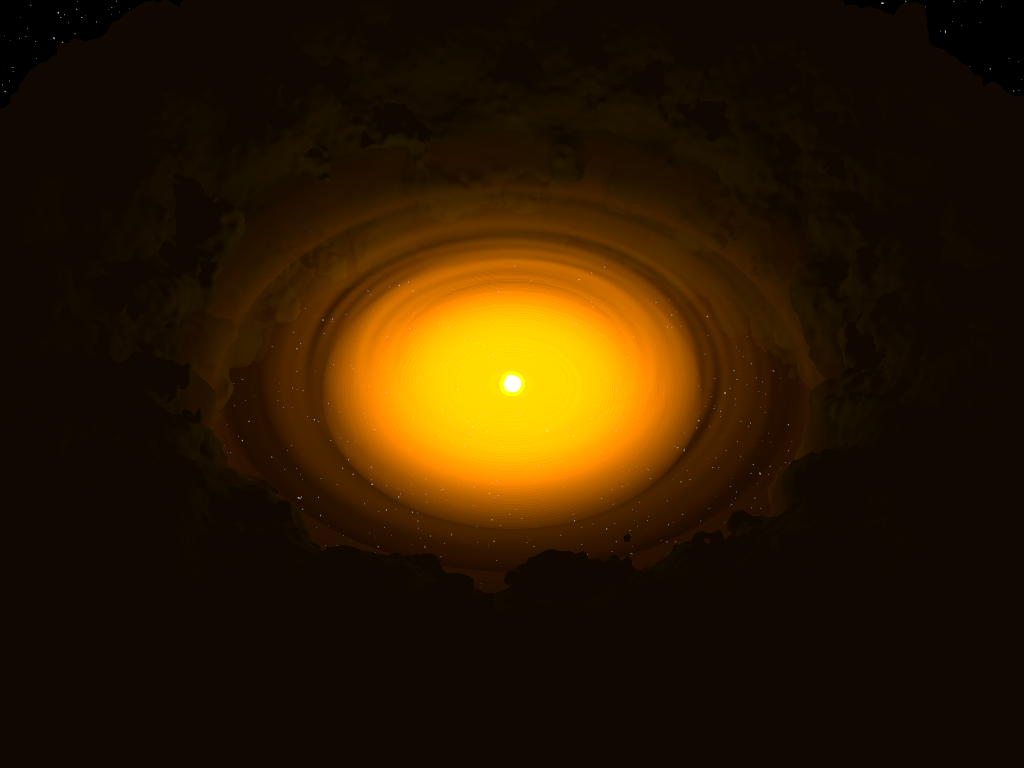
The Birth of Spin
Within this spinning disk, the process of planet formation began. Tiny dust grains started sticking together through electrostatic forces, much like dust bunnies forming under a bed. Over millions of years, these small clumps grew larger through a process called , gathering more and more material through gravitational attraction. They formed planetesimals, the building blocks of planets.
Crucially, every particle, clump, and planetesimal in the disk was already orbiting the central protostar. They all carried a piece of the disk's original angular momentum. As these pieces merged to form the proto-Earth, their individual angular momenta combined. The result was a large, spherical body that was not only orbiting the sun but also spinning on its own axis. Earth's rotation is the inherited spin from the countless smaller bodies that came together to create it.
The law of conservation of angular momentum states that if no external torque acts on an object, its angular momentum () will not change. If the moment of inertia () decreases (like the skater pulling in her arms), the angular velocity () must increase to keep constant.
Locked in Motion
Once formed, the Earth kept spinning because there was nothing in the vacuum of space to stop it. This is a direct consequence of Newton's first law of motion applied to rotation. An object in motion stays in motion, and a spinning object stays spinning, unless acted upon by an external twisting force, or torque.
The initial spin of the Earth has not been perfectly constant over its 4.5-billion-year history. The gravitational pull of the Moon, for example, creates that cause friction, ever so slightly slowing Earth's rotation and causing the Moon to gradually drift farther away. A day on the early Earth was likely much shorter, perhaps only a few hours long.
Despite these slow changes, the fundamental reason Earth spins today is the same reason it spun at its creation: the conservation of angular momentum, a cosmic inheritance from a collapsing cloud of stardust.
Ready to check your understanding?
What was the vast, slowly swirling cloud of gas and dust that eventually formed our solar system called?
Which fundamental principle of physics caused the collapsing solar nebula to flatten into a spinning disk shape?
The spinning of our planet is a beautiful and direct result of the physical laws that govern the universe, from the grand scale of a nebula to the focused grace of an ice skater.