Dynamics of Earths Rotation
Solar Nebula Dynamics
From Cloud to Disc
About 4.6 billion years ago, our solar system was just a vast, cold, and slow-drifting cloud of gas and dust. This enormous structure, known as the , contained all the raw materials for the Sun, the planets, and everything else in between. Over millions of years, a disturbance, perhaps a nearby supernova, sent a shockwave through the cloud, causing it to begin collapsing under its own gravity.
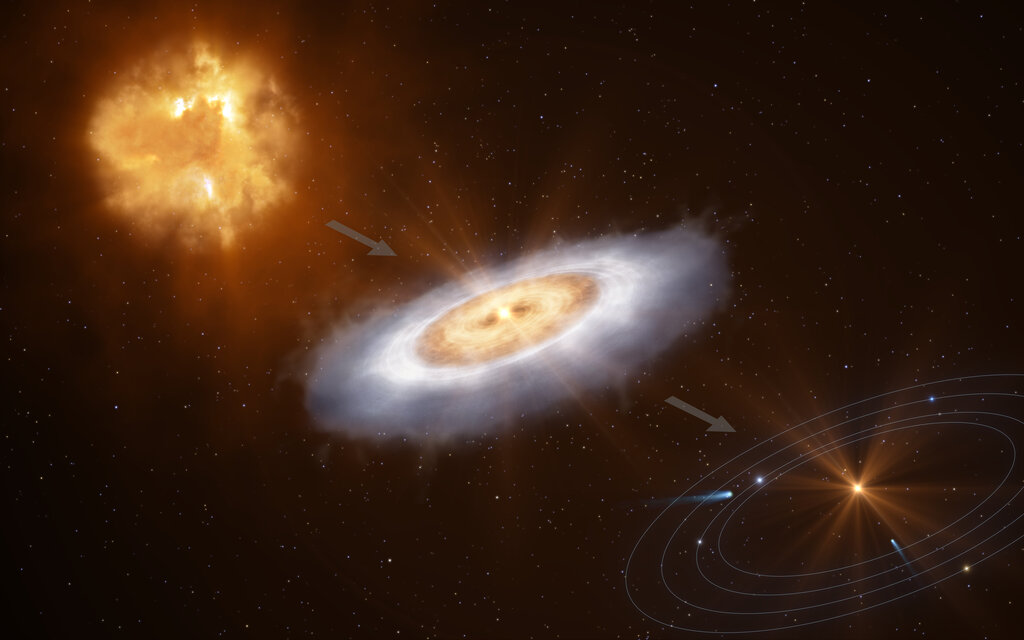
As the nebula contracted, a fundamental principle of physics took over: the conservation of angular momentum. Imagine an ice skater spinning with her arms outstretched. When she pulls her arms in, her spin speeds up dramatically. The same thing happened to the solar nebula. The cloud had some slight, random rotation to begin with. As gravity pulled the material inward, shrinking its radius, the rotation rate had to increase to conserve momentum. This rapid spinning flattened the collapsing cloud into a pancake-like structure called a protoplanetary disc, with a dense, hot protostar forming at its center.
Like a figure skater pulling in her arms to spin more rapidly, the collapsing proto-Solar System with its averaged out particle momentum began to spin faster and faster.
Building a Planet
Within this swirling disc, the stage was set for planet formation. The 2% of heavier elements started to clump together through a process called . Tiny dust grains stuck to each other, first through electrostatic forces, like dust bunnies under a bed. As these clumps grew larger, their own gravity became strong enough to attract more material. These planetesimals, or infant planets, continued to collide and merge, sweeping up material in their orbital paths.
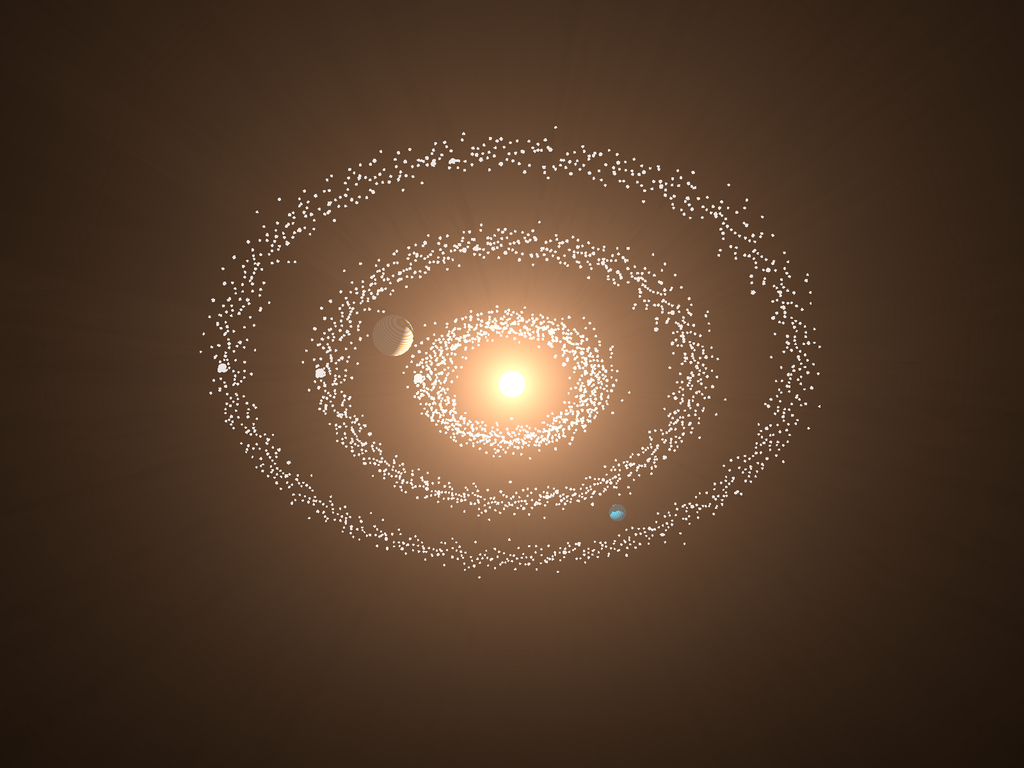
The protoplanet that would become Earth grew through countless collisions. While impacts came from all directions, they weren't perfectly symmetrical. The entire disc was rotating in one direction, and this imparted a net spin to the forming Earth. Each collision added not just mass, but also angular momentum. The result was a young Earth spinning on its axis, a direct inheritance from the motion of the parent nebula.
Energy in Motion
The collapse of the solar nebula was a massive energy conversion event. As gas and dust fell towards the center, their gravitational potential energy was converted into other forms. Much of it turned into heat, which is why the center of the disc became hot enough to ignite nuclear fusion and form the Sun. The rest was converted into kinetic energy, the energy of motion. This included the orbital motion of the planets and their rotational (or spin) motion.
The principle of conservation of angular momentum can be expressed mathematically. Angular momentum () is the product of an object's moment of inertia () and its angular velocity ().
For the collapsing nebula, the total angular momentum had to stay constant. As gravity pulled the material closer together, the moment of inertia decreased. To keep the equation balanced, the angular velocity had to increase. This is the mathematical reason the disc spun faster as it shrank, and why the objects forming within it, like Earth, were born spinning.
Time for a quick check on these cosmic concepts.
What was the initial state of our solar system approximately 4.6 billion years ago?
As the solar nebula collapsed, its rotation speed increased. This is a direct consequence of which physical principle?
So, Earth's daily rotation isn't an accident. It's a direct consequence of the physical laws that governed the birth of our entire solar system, a leftover spin from a giant, ancient cloud of stardust.