Dynamics of Earths Rotation
Rotational Inertia and Days
The Two Kinds of Day
When we think of a day, we usually mean the 24 hours it takes for the Sun to return to the same position in the sky. This is called a solar day. But it's not the full story of Earth's rotation.
Our planet is doing two things at once: spinning on its axis and orbiting the Sun. Because we're constantly moving along our orbital path, the Earth has to rotate a little extra each day—about one degree more—for the Sun to appear in the same spot. A true 360-degree rotation, measured against distant stars, is actually shorter. This is called a sidereal day, and it lasts about 23 hours and 56 minutes.
So, why does the Earth keep spinning at such a steady rate? The answer lies in a fundamental principle of physics: conservation of angular momentums. Think of an ice skater pulling her arms in to spin faster. The Earth behaves similarly. Its total spin, or angular momentum, remains constant unless an external force acts on it. This momentum, established when the solar system formed billions of years ago, is what keeps our planet rotating day after day.
Earth's Rotational Speed
The Earth's spin isn't just about time; it's also about speed. Because the Earth is a sphere, the speed of rotation is fastest at the equator and zero at the poles. We can calculate this equatorial speed using the planet's circumference and its rotational period.
The circumference of the Earth at the equator is approximately 40,075 kilometers. To get the speed, we divide this distance by the time it takes for one full rotation, which is the sidereal day.
Despite this incredible speed, we don't feel it because everything around us—the atmosphere, the oceans, the ground—is moving along with us.
A Not-So-Constant Clock
Although the conservation of angular momentum keeps the Earth spinning steadily, the length of a day isn't perfectly constant. It fluctuates by milliseconds due to several factors.
The gravitational pull of the Moon and Sun creates tidal bulges on Earth. The friction from these tides acts like a brake, gradually slowing our planet's rotation over geological time. This means days are slowly getting longer.
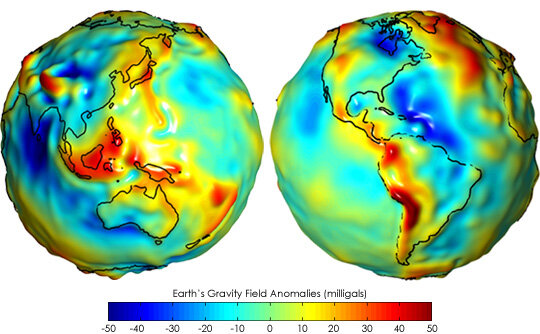
Additionally, the distribution of mass within and on the planet can cause short-term changes. Just as an ice skater changes speed by moving her arms, events like earthquakes, melting ice sheets, or motions in the planet's liquid outer core can shift mass around. This alters the Earth's moment of inertia and, to conserve angular momentum, its rotational speed adjusts slightly. This interaction between the liquid core and the solid layer above is known as core-mantle couplings.
These fluctuations are tiny, but they are crucial for technologies that require precise timekeeping, like GPS. To account for this, scientists occasionally add a "leap second" to our official time, keeping our clocks in sync with the Earth's ever-so-slightly wobbly rotation.
What is the primary difference between a solar day and a sidereal day?
The principle of conservation of angular momentum is what keeps the Earth spinning.
Understanding Earth's rotation is key to grasping how we measure time and navigate our place in the cosmos.